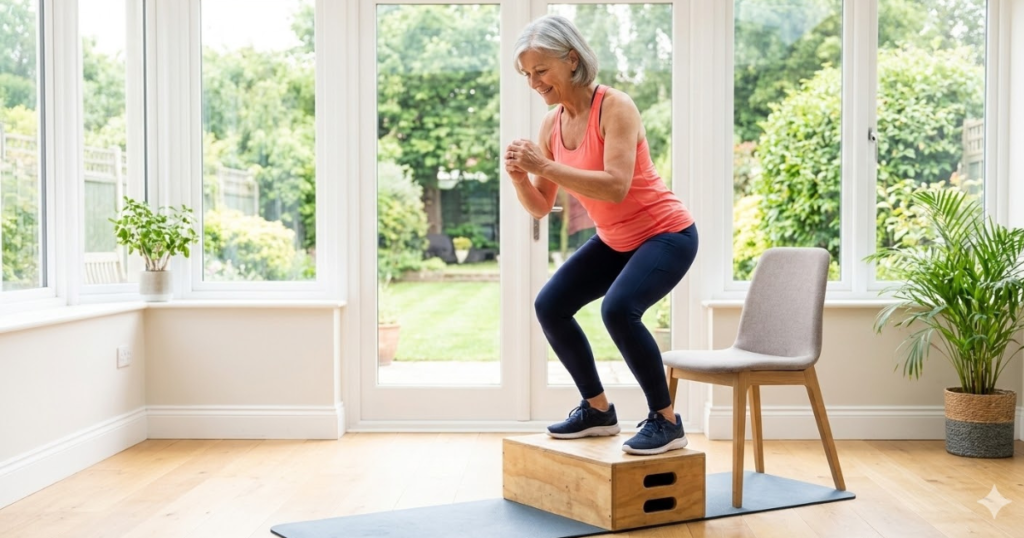
Unlocking Glute Power: The Controlled Step Down for Safer Hips.
For decades, we’ve been handed a simple rule book for staying strong as we age. If you want strong legs, a healthy body, and independence, you must squat. Squats are hailed as the “king of exercises.” While that might ring true for young, resilient bodies, there’s a crucial reality that rarely makes it to the center of the conversation.
As the years pass, forcing our bodies to squat can feel like fitting a square peg into a round hole.
I’ve had the immense privilege of connecting with a growing community of adults over 50 who are choosing to stay strong, active, and independent together. Seeing people from all over joining this movement is beautiful. But when the conversation turns to leg strength, many share stories of frustration. They’ve tried squatting. They know the importance of strong legs. Yet, they still struggle with persistent back pain, knee strain, poor posture, and unsteady walking.
It leads to an uncomfortable question: if squats are so great, why are so many people over 50 still struggling despite doing them?
The answer is surprising to many aging bodies. Squats often don’t train what matters most for our long-term stability and pain-free movement anymore: our glutes. Today, I want to challenge that common belief. You do not need to force your body to squat to build strong hips and a stable lower body. In fact, there are two smarter, safer exercises that may serve you better, changing how your body feels, moves, and ages.
Let’s step away from forcing a “king” exercise onto every body and instead focus on what your body actually needs to stay vibrant and independent.
The Squat King’s Fallen Crown: Why the CDC and Joint Health Suggest a Smarter Path
The statistics surrounding aging and mobility are sobering, yet they hold the key to understanding why our fitness routines need a shift. According to the CDC, more than one in four adults over 65 falls each year. This is not a distant concern; it is a current risk that impacts independence. Problems with balance, hip strength, and lower body control are among the biggest culprits behind these life-altering events.
Furthermore, studies published in the Journal of Geriatric Physical Therapy show a strong association between weak hip and glute muscles and poor balance, slower walking speeds, and a significantly higher fall risk. The evidence points directly to the hip engines—the glutes—not necessarily the muscles prioritized by heavy squats.
So why do so many seniors who attempt to squat still face these issues?
It often comes down to “gluteal amnesia.” Years of sitting—at desks, in cars, watching TV—can cause the brain to literally forget how to fully activate your glute muscles. When your brain can’t “turn on” your main engine, your body will compensate. Other muscles start doing work they weren’t designed for. Your lower back is strained, trying to provide stability that the hips should. Your knees endure excessive stress with every step. Your posture slowly collapses forward.
The common belief is that doing squats is the best way to fix this “amnesia.” But squats are complex, compound movements. While they can recruit glutes, they also heavily engage the quads (front of the thighs), hamstrings (back of the thighs), and lower back. For people over 50, especially those with knee or spinal sensitivity, squats often end up working everything except the glutes, creating pain that discourages progress.
The shocking part? Research using EMG muscle testing shows that some simpler, more targeted exercises can activate the glutes just as much, or even more, than squats—all with far less stress on your sensitive joints. Our focus today is different. We are targeting the glutes directly and intentionally, rebuilding strength where it matters most, with better control and significantly reduced injury risk.
Understanding Your Hip Engines: The Three-Muscle Key to Balance and Spinal Support
Let’s take a closer look at the muscles we are truly focusing on today: your glutes. Your “glutes” are not just one single muscle; they are made up of three major muscles working together as the main engine of your lower body:
- Gluteus Maximus: The largest and most powerful muscle in your body. This is your primary engine for hip extension (pushing the hip forward).
- Gluteus Medius: A smaller but critical muscle on the side of your hip.
- Gluteus Minimus: Also located on the side of the hip, working in tandem with the medius.
Why are these smaller muscles so important? The gluteus medius and minimus are your dynamic stabilizers. They are what keep you balanced and stable when you walk or simply stand on one leg—which, let’s remember, is what you do every single time you take a step.
When all three of these muscles are strong and properly activated, they do so much more than make you look powerful. They protect your back by taking the strain off the spine. They stabilize your hips, preventing that wobble that leads to unsteady walking. They keep you strong, upright, and confident when you walk, climb stairs, or get up from a chair.
But when they are weak or inactive, which is exceptionally common as we age, the rest of your body has to pick up the slack. That’s where the trouble of posture collapse and pain really begins.
Mastering the Smarter Path: The Modified Step Down for Ultimate Control
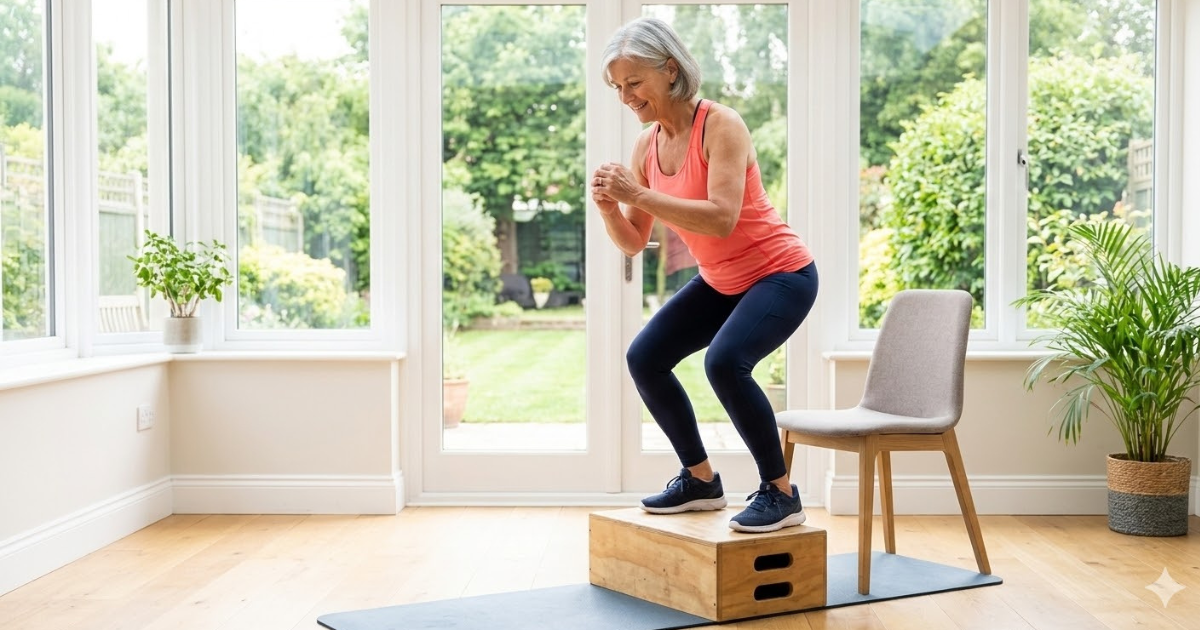
If we are moving past squats, what takes their place? We need exercises that are low-impact but offer a high reward for glute development. The first essential exercise is the Modified Step Down.
Don’t let the simple name fool you. While it may look basic, when performed with intention and proper technique, it is one of the most powerful moves to reactivate and rebuild your glutes—specifically the mighty gluteus maximus. What makes it so effective compared to a squat is its unique angle. Unlike squats, which work the muscle primarily when it’s short, this movement isolates the glutes at their lengthened position, which is where most adults over 50 are naturally weakest. It teaches control from the bottom of your range of motion up.
How to Perform the Modified Step Down:
- Find your Step: Stand on a sturdy step, a low box, or a stable household platform that is around knee height.
- Let it Hover: Allow one foot to hover off the edge of the step.
- Hinge, Don’t Bend: Focus on hinging your hips back like you are trying to sit your butt onto a chair far behind you—not just bending your knee. Keep your torso supported.
- The Light Tap: Slowly lower your hovering foot down until the heel lightly taps the floor. Do not put weight on that foot.
- Press and Rise: Pause at the bottom for a moment, then press powerfully through the heel of your standing leg to return smoothly to the starting position.
- Slow and Controlled: The entire movement should be slow, controlled, and intentional—not rushed.
Pro Tips for Better Results:
- Knee Alignment is Key: Keep your standing knee in line with your foot. Do not let it cave in or shoot forward excessively.
- Use Balance Support: If you are new to this or feel unsteady, use a wall, a sturdy chair, or even counter space for balance support until you feel stable. Safety first!
- Need a Challenge? When you are ready for more, hold a dumbbell in the hand opposite of your working leg. This adds a subtle rotational challenge, forcing your glute medius to work even harder for stability.
Why the Modified Step Down Beats Squats for 50+ Adults:
- Drastically less pressure on delicate knees and the spine.
- More intentional glute engagement, particularly the gluteus maximus, at its weakest length.
- It is incredibly easy to modify the height or use support, making it accessible from day one.
- It trains not just strength, but critical control and balance, directly impacting your ability to walk with confidence and prevent falls.
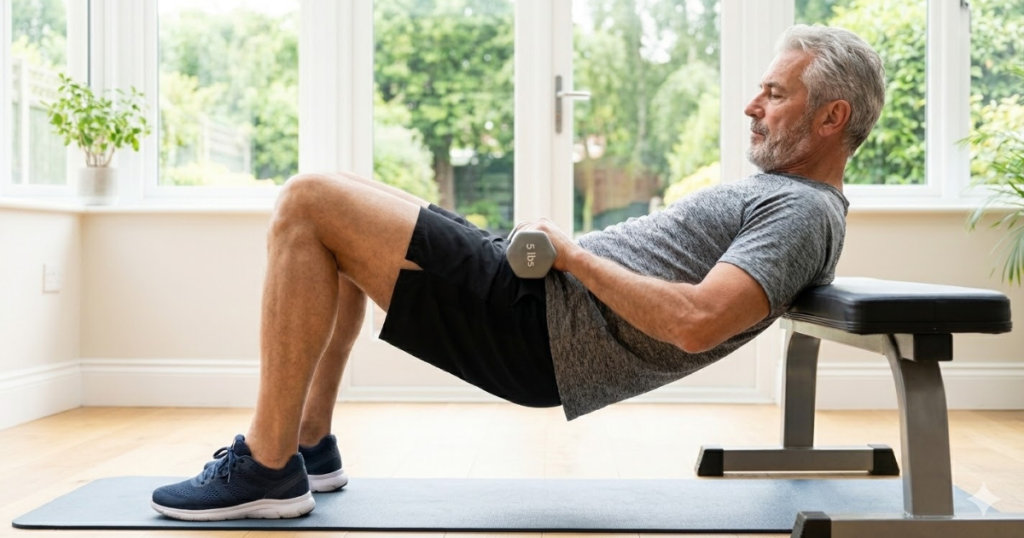
Firing Up the Engine: Direct Glute Isolation with the Hip Thrust.
Firing Up Your Peak Power: The Hip Thrust and the Magic of the “Scoop Motion”
While the step down builds control and strength at the lengthened range, we also need an exercise that builds power where your glutes are strongest and fully contracted (the top). That exercise is the Hip Thrust, performed with a special technique I call the Scoop Motion.
Think of this dynamic duo (Modified Step Down and Hip Thrust) like training both ends of a powerful rubber band. The step down stretches and strengthens it, while the hip thrust ensures it can snap back with force and control. It’s the combination that truly locks in strength.
How to Perform the Hip Thrust:
- Get Supported: Sit on the floor with your upper back resting against a sturdy bench, a couch, or a stable chair.
- Foot Placement: Bend your knees and place your feet flat on the floor, about hip-width apart.
- Check your Shins: Your shins should be vertical when you reach the top of the movement.
- Hands or Weights: Rest your hands lightly on your hips for feedback or, if you want a challenge, hold a light dumbbell across your lap.
- Drive and Squeeze: Drive through your heels to lift your hips toward the ceiling. Squeeze your glutes tightly at the very top.
The “Scoop Motion”: The Magic that Protects Your Back and Fires Up Your Glutes:
Here is the key that separates a hip thrust from a simple glute bridge and makes it safer and more effective for over 50s. Instead of arching your lower back to get your hips higher (which disengages the glutes and strains the spine), tuck your chin slightly toward your chest and keep your ribs down. As you rise, “scoop” your pelvis under, as if you are zipping up a tight jacket from the very bottom. This ensures your glutes, not your spine, are doing the work.
Common Mistakes to Avoid:
- Bench too low makes the movement wobbly and disengages the core.
- Feet too close or too far causes the quads or hamstrings to take over.
- Hyperextending the back reduces glute activation and significantly increases the risk of lower back injury.
Why the Hip Thrust Beats Squats for 50+ Adults:
- Direct and complete glute isolation, providing a stimulus that is hard to replicate.
- The spine stays supported against the bench, reducing compression and strain.
- It is a low-impact move with exceptionally high rewards for pelvic health and lower body stability. When done correctly, this move helps you feel your glutes light up in a way that most squats simply cannot replicate, even with heavy weight.
Building a Sustainable Habit: Frequency and Progression After 50
Now that you’ve learned the two exercises that outrank squats for glute health, let’s talk practical application. When it comes to exercise, especially after 50, consistency always beats intensity.
The goal is steady, manageable progress. Leading physical therapists recommend the following for building a strong longevity habit:
- Frequency: Do each of these two exercises two to three times per week.
- Structure: Start with three sets of 8 to 12 slow, controlled repetitions per exercise.
- Form First: Prioritize perfect form above everything else. Do not worry about how heavy you lift; focus on how the movement feels. If you can only do 6 reps with great form, start there.
- Progressive, Manageable Stress: If you are sore, that is a sign of new stimulation—not damage. However, avoid pushing to the point of pain or such severe fatigue that it disrupts your next scheduled session. Listen to your body and avoid exhaustion that leads to criticism of your progress.
Remember the leading quote from expert coaches: Stimulate, don’t annihilate. Progress is a steady staircase, not an arduous mountain climb. Your glutes will grow stronger week by week with patience and consistency.
Fueling Your Glute Engines: Nutrition to Fight Sarcopenia and Support Recovery
No matter how masterful your workout routine is, your glutes cannot grow without the right fuel. This becomes critical after age 50, when we naturally tend to lose muscle faster—a process known as sarcopenia. Nutrition is not about dieting; it’s about nourishing your body to stay strong and active for life.
To slow sarcopenia down and support glute development, your body needs protein, the essential building block of muscle. Many older adults consume less protein than they actually need to maintain their muscle mass. A general guideline is to aim for 1.0 to 1.2 grams of protein per kilogram of body weight daily (for a 150lb/68kg person, that’s about 68-82g of protein).
Excellent sources of protein include:
- Eggs
- Greek yogurt
- Tofu
- Cottage cheese
- Lean meats like chicken or turkey breast
- Fatty fish like salmon or sardines (which also provide anti-inflammatory Omega-3s)
Fueling your workouts also requires balanced energy from healthy carbs. Carbs are not the enemy; whole grains, sweet potatoes, and legumes provide the glucose your brain and muscles need to power through those deliberate movements and support recovery.
Hydration is equally critical, as water supports digestion, efficient circulation, and joint health.
A critical note: if you have health conditions like diabetes, kidney disease, or gout, always consult a registered dietitian or your doctor to personalize your nutrition plan.
The 24/7 Strategy: Daily Habits to Keep Your Glutes “Awake” Between Workouts
Even the best 20-minute targeted workout cannot compete with what you do for the remaining 23 hours and 40 minutes of your day. The exercises we shared are a powerful stimulus, but your daily habits are what reinforce that progress.
As we discussed, sitting is the root cause of “gluteal inhibition” (when glutes “forget” to turn on). That is why movement integrated throughout the day is non-negotiable for vibrant mobility. Try these simple habits:
- Stand and Stretch: Set a timer on your watch or phone. Stand up and stretch for just 60 seconds every 45 to 60 minutes.
- Post-Meal Walk: Take a short, 10 to 15-minute walk after meals. It aids digestion and reactivates your metabolism and glutes.
- Choose the Stairs: Opt for stairs over the elevator whenever possible. Climbing stairs is a natural, dynamic glute exercise.
- Intentional Getting Up/Down: When you get out of your car, out of a low chair, or off the couch, focus on pressing through your heels and pushing your hips forward—this turns getting up into a targeted movement.
These small, habitual actions reactivate your glutes and reinforce the strength you build in your dedicated workouts. It keeps your body engaged and strong between sessions, ensuring “gluteal amnesia” never returns.
A Community Commitment: Consistency, Connection, and Safe Progression
Moving into your senior years does not mean settling for decline. It means making smarter, safer, and more intentional choices. You don’t need to force heavy squats or keep up with 25-year-olds at the gym. What you need is something much more powerful: consistency, connection, and care for your unique body.
These two exercises, the Modified Step Down for control and the Hip Thrust (with Scoop Motion) for contracted strength, target exactly what most adults over 50 need. They deliver stronger glutes, better posture, improved dynamic balance, and significantly less strain on your sensitive back and knees.
It is beautiful to see this community of adults over 50 choosing independence and vitality together. You might have ignored your glutes for years without knowing it, letting other muscles pay the price in pain. That ends today.
Start small. Two or three times a week. Listen to your body and prioritize perfect form. Stay curious about how your body moves and how it feels to finally re-engage your primary engine. Over time, you will feel your body move with more strength, confidence, and ease than you thought possible. The movement toward longevity and strength begins with unlocking the power that was already there. Let’s do it together.