What if I told you that one of the most universally trusted exercises for staying strong after 50 might actually be doing the exact opposite of what you intend?
For decades, the fitness industry has echoed a singular mantra: if you want strong legs, you have to do squats. Doctors mention it during annual physicals, personal trainers recommend it as a foundational movement, health magazines repeat it endlessly, and most of us simply accept it as common sense. But what if that conventional advice—the very routine meant to keep you strong, active, and independent—is quietly putting your knees at severe risk?
Living near Elk Grove, California, I spend many of my mornings walking the beautiful local park trails. Over the years, I’ve spoken with countless vibrant, active individuals in their 60s and 70s who suddenly had to stop doing what they love. They didn’t stop because they were lazy or lacked motivation; they stopped because their knees simply gave out. They thought they were doing the right thing by pushing through the pain of their daily squats, not realizing their bodies were asking for a completely different kind of support.
The Hidden Danger of Deep Squats for Aging Joints
According to extensive research cited by Harvard Medical School, nearly one in two adults over the age of 55 show signs of knee degeneration or chronic knee pain. While squats are an incredible exercise for general strength, biomechanical studies have revealed a startling truth: deep squatting can place up to five to seven times your body weight in compressive force directly through the knee joint.
Think about the math for a moment. If you weigh 180 pounds, your knees could be absorbing anywhere from 900 to over 1,200 pounds of pressure every single time you lower yourself into a deep squat.
This does not automatically mean squats are inherently “bad.” For younger joints, or for individuals with perfect mobility, flawless form, and zero cartilage issues, they remain a highly effective tool. But here is the reality that standard fitness advice often overlooks: your body at 55, 60, or 75 is fundamentally different from the body you had at 30.
As we age, several physiological shifts occur:
- Cartilage Thins Out: The natural cushioning in your joints naturally diminishes over time.
- Lubrication Decreases: Synovial fluid, which helps joints glide smoothly, is produced less efficiently.
- Reaction Times Slow Down: The nervous system takes fractions of a second longer to correct imbalances.
- Stabilizer Muscles Weaken: The tiny, crucial muscles around the hips, knees, and ankles quietly lose their tone if not specifically targeted.
When your knees start to ache during a squat, or you feel a slight wobble on your way up, it is easy to blame yourself. You might think, “Maybe I’m just getting old,” or “Maybe I need to push through the pain and get stronger.” But the problem isn’t your effort. The problem is relying on one-size-fits-all exercise advice for a body that requires specialized, mindful care.
The Real Threat to Your Independence
After crossing the half-century mark, the biggest threats to your physical independence are not a lack of muscular bulk or the inability to lift heavy weights. The true adversaries are a loss of balance, a loss of movement control, and ultimately, a loss of confidence in your own body’s capabilities.
Studies published in the Journal of Orthopaedic & Sports Physical Therapy and The Lancet Public Health have highlighted a crucial paradigm shift: falls and mobility loss in older adults are driven far more by poor balance, diminished movement control, and weakness in stabilizing muscles than by a simple lack of sheer strength.
When we rely solely on safe, predictable routines like walking on flat surfaces, we do wonders for our cardiovascular health. However, flat-surface walking is entirely predictable. It does not challenge your balance, it does not strengthen the deep lateral stabilizers around your hips, and it does not train your nervous system to react to the unexpected—like stepping off a misjudged curb or catching yourself if you slip.
The goal of exercising after 50 is not to prove how much weight you can move. The goal is to stay independent, remain confident, and continue doing the things you love without the looming fear of pain or a catastrophic fall.
3 Smarter Exercises to Protect Your Knees and Build Real-Life Strength
The solution to aging joints isn’t to stop moving, nor is it to push harder through pain. The solution is to train smarter. Here are three highly effective, joint-friendly exercises that are superior to traditional squats for building real-world stability and confidence.
1. Step-Downs with Eccentric Control (The Art of Slowing Down)
Going up a flight of stairs requires strength, but going down requires something much more complex: eccentric control. If you have ever felt your knees wobble while descending stairs or felt a jarring impact stepping off a curb, you have experienced a lack of eccentric strength.
Eccentric contraction occurs when your muscles—specifically the quadriceps on the front of your thighs—have to lengthen while simultaneously holding tension. It acts as your body’s braking system. Traditional exercises like the leg press build the strength to push, but they completely ignore the ability to resist, slow down, and stabilize.
A 2021 study published in the Journal of Geriatric Physical Therapy found that older adults who practiced controlled step-down exercises improved their joint stability by an astounding 47% and reduced their fear of falling by over 35% in just eight weeks. Furthermore, eccentric training protects cartilage by drastically reducing the shock-absorption load on the knee.
How to Perform It:
- Find a low, sturdy step (about 4 to 6 inches high). The bottom stair in your home works perfectly.
- Stand with both feet on the step. Place a chair or rest your hand on a railing nearby for support.
- Slowly lower one foot down toward the floor. The key is to control the descent—do not just let gravity drop your foot.
- Once your heel lightly taps the floor, press through the foot that is still on the step to return to the starting position.
- Frequency: Repeat for 10 to 12 slow, mindful repetitions per leg. Aim for two to three sets a day. The focus is on a smooth, quiet movement, not speed.
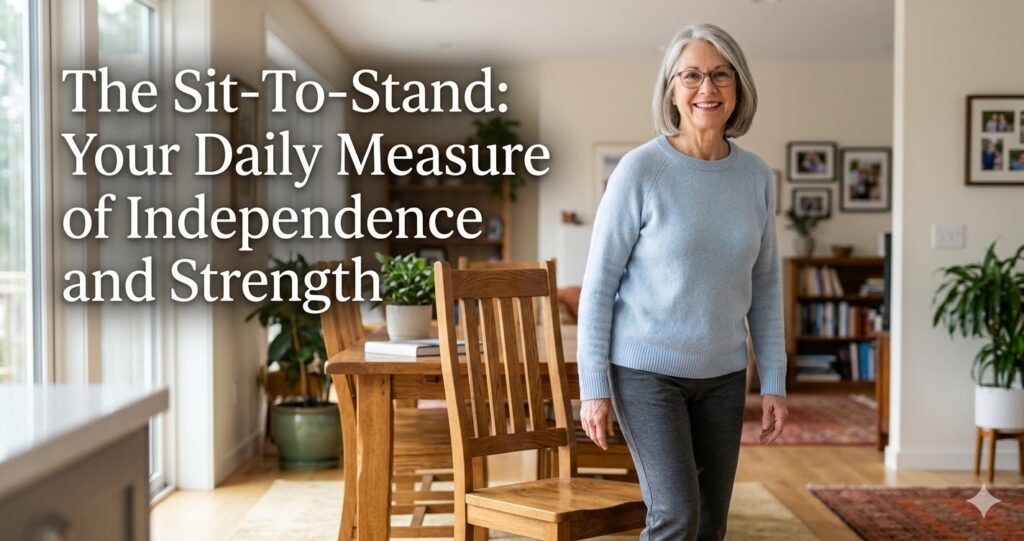
2. The Sit-to-Stand (Mastering Everyday Autonomy)
Getting out of a chair might just seem like a mundane daily task, but in the realm of senior health, it is the ultimate test of independence. Most people take this movement for granted until the day they hesitate, their knees ache, and they have to awkwardly rock back and forth to gain momentum.
The sit-to-stand movement perfectly mirrors the biomechanics of daily life. It engages the quadriceps, the glutes, the hamstrings, and the deep core stabilizers that maintain your posture. Unlike gym routines that isolate muscles on restrictive machines, the sit-to-stand forces all these systems to coordinate and work together.
A landmark long-term study published in the Journal of Aging and Physical Activity (2018) revealed that the sit-to-stand test is one of the most accurate predictors of fall risk and loss of autonomy in adults over 60. Participants who practiced this exact movement daily showed a 30% to 40% improvement in functional leg strength and daily confidence after just six weeks.
How to Perform It:
- Choose a sturdy, firm chair (avoid deep, squishy couches for this exercise). Sit near the front edge with your feet flat on the floor, shoulder-width apart.
- Engage your abdominal muscles and lean slightly forward from your hips, keeping your spine straight.
- Press firmly through your heels and rise slowly to a full standing position.
- Pause briefly at the top to establish your balance.
- Slowly, with complete control, lower yourself back down into the chair. Do not just “flop” down.
- Frequency: Start with 8 to 10 repetitions. Build up to two or three sets a day. If it feels too easy, try crossing your arms over your chest so you cannot use your hands for momentum.
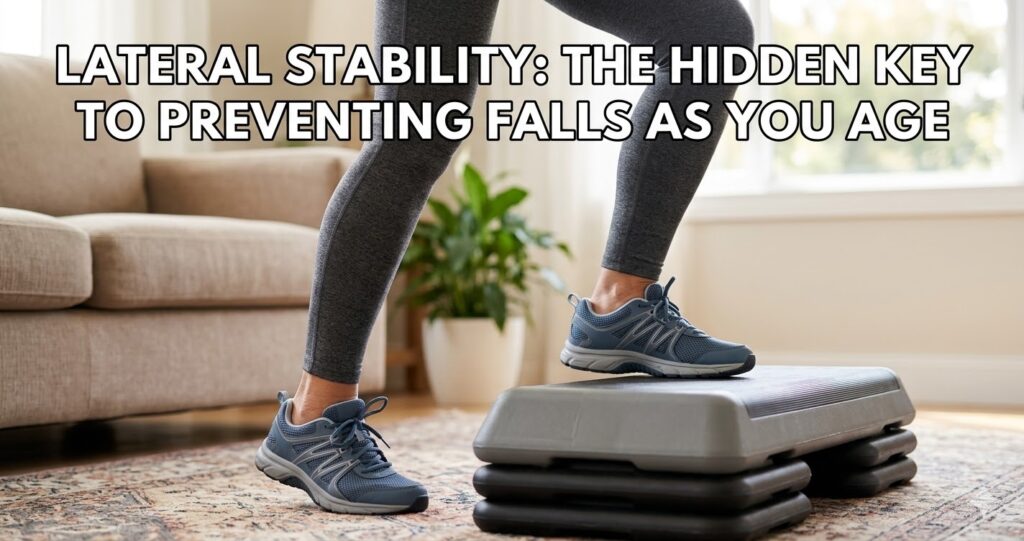
3. Lateral Step-Ups (Building Strength from the Side)
Most of our conscious movement is linear—walking forward, reaching forward, climbing straight up. Because of this, we rarely question why we should train sideways. However, real-life falls rarely happen when walking in a perfectly straight line. They happen when you pivot to grab a ringing phone, sidestep a pet, or slightly lose your footing on uneven terrain.
In these critical, split-second moments, the muscles that save you are not your large forward-moving muscles. They are your lateral stabilizers. The unsung hero of this system is the gluteus medius, a small muscle located on the upper outside edge of your hip. It acts as the steering wheel for your pelvis and the primary shock absorber for your knees.
When this muscle is ignored and weakens, your body compensates dangerously. Your knees twist inward, your ankles wobble, and your hips over-rotate. A 2022 report from the Harvard Health Letter identified weak lateral hip muscles as a massive, hidden predictor of fall risk during turns and side-steps. Training the gluteus medius through lateral step-ups has been shown to improve balance response times by 28% and reduce stair-climbing knee pain by 36%.
How to Perform It:
- Use the same low, sturdy 4-to-6-inch step. Stand sideways with your right foot resting near the edge of the step.
- Step up sideways, pressing your weight entirely through the heel of your right foot.
- Bring your left foot up to meet the right foot on the step. Pause at the top to ensure you have total balance.
- Step down slowly in reverse order, controlling the descent laterally.
- Frequency: Perform 10 to 12 controlled repetitions, then switch sides. Aim for two to three sets daily. Keep your chest lifted and your eyes looking straight ahead, rather than down at your feet.
Moving Forward: Precision Over Punishment
Let’s take a collective breath. You have just learned three foundational movements that the majority of aging adults completely overlook. These exercises might not be flashy, and they certainly don’t look like traditional, sweat-drenched gym workouts. But make no mistake: these calculated movements build something infinitely more valuable than sheer muscle mass. They rebuild your trust in your own body.
We have spent decades trying to move more; now it is time to focus on moving smarter. Every controlled step-down trains your knees to absorb life’s impacts gently. Every sit-to-stand fortifies the muscles that grant you your daily dignity. Every lateral step-up sharpens your reflexive stability in a world where movement is unpredictable.
Aging does not mean an automatic forfeiture of strength, and it certainly does not mean you have to surrender your confidence. Your strength is merely waiting to be invited back into your life through the right avenues. Take one small step today—not toward perfection, but toward presence. Listen to your body, train with patience instead of pressure, and trust that even 10 to 15 focused minutes a day can yield a strength that feels remarkably like freedom.
Disclaimer: The information provided in this article is for educational purposes only and does not substitute for professional medical advice. If you have existing health conditions, chronic joint pain, or recent surgeries, please consult with your physician or a licensed physical therapist before beginning any new exercise regimen. Prioritizing safety is not fear; it is wisdom.
I would love to hear from you. If any part of today’s message resonated with you, please leave a comment below! Share your first name, your age, or where you are reading from. Your personal journey might be the exact spark of encouragement someone else needs to start theirs today.