SeniorJourneyBlog.com · April 2026 · 10 min read · By the SeniorJourney Editorial Team
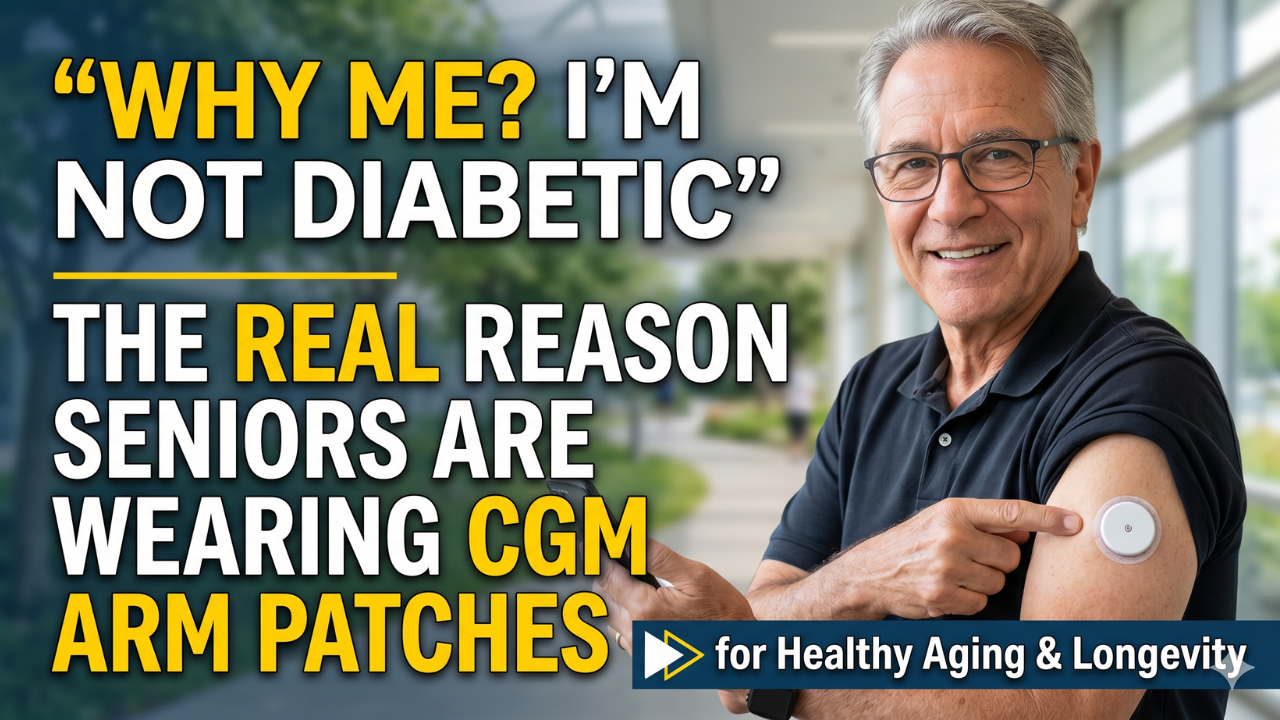
If you’ve spotted a small round patch on an older adult’s upper arm at the grocery store or the gym — and wondered if they were diabetic — you’re not alone. And chances are, they’re not. What they are is something increasingly common among health-conscious adults over 60: informed.
Continuous Glucose Monitors (CGMs) have quietly moved out of the diabetes clinic and into the daily lives of millions of older Americans who want a clearer, more honest picture of their metabolic health. This guide will walk you through exactly what these devices are, why non-diabetic seniors are embracing them, what the science says, and — most importantly — what you can do with this information starting today.

What is a CGM — and how does it work?
A Continuous Glucose Monitor is a small, coin-sized wearable sensor that adheres to the skin — most often the back of the upper arm. A hair-thin filament, painlessly inserted just beneath the surface, measures glucose concentration in the interstitial fluid (the fluid between cells) every one to five minutes.
That data is transmitted wirelessly to a companion smartphone app, producing a continuous, real-time graph of your blood sugar levels throughout the entire day — including while you sleep.
No needles. No finger pricks. No waiting for a lab result.
CGMs were originally developed for people managing Type 1 diabetes, who need minute-by-minute glucose feedback to calibrate insulin doses. But the technology has advanced rapidly, and its potential applications have expanded just as fast. In 2024, the U.S. Food and Drug Administration (FDA) cleared the first over-the-counter CGM specifically designed for non-diabetic adults — a watershed moment in consumer health technology.
Key devices currently available (2025–2026)
- Dexcom Stelo — FDA-cleared OTC, designed for non-diabetic use, 15-day wear
- Abbott Lingo — OTC available, consumer-focused app with lifestyle coaching
- Abbott FreeStyle Libre 2/3 — Prescription in most states, widely used by clinicians
Why would a healthy senior need one?
This is the question every doctor hears when a patient shows interest. And it’s a fair one. The short answer: because your annual blood test only shows you a snapshot — and a lot happens between snapshots.
The limits of standard blood sugar testing
Most adults receive two glucose-related values at their annual physical: a fasting glucose reading and, every few years, an A1C (a measure of average blood sugar over the past 90 days). Both are useful. Neither tells you what your blood sugar is doing right now, after a specific meal, during a stressful afternoon, or at 3 AM.
A CGM fills in every gap between those snapshots — giving you and your doctor a continuous, unfiltered record of your metabolic reality.
Aging changes how your body handles glucose
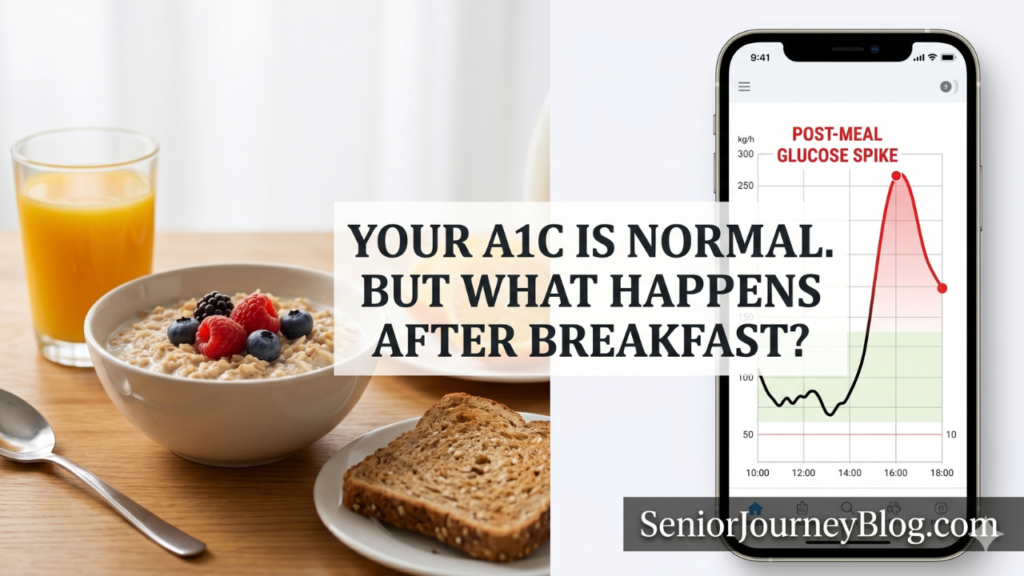
Here’s something that doesn’t always make it into the doctor’s office conversation: insulin sensitivity — the body’s ability to efficiently move glucose from the blood into cells — naturally declines with age. This means that even adults with perfectly normal A1C values may be experiencing significant post-meal blood sugar spikes that neither they nor their physicians are aware of.
Research published in Diabetes Care and Nature Metabolism has consistently shown that post-meal glucose excursions (sharp rises and falls after eating) are among the strongest metabolic predictors of cardiovascular risk, cognitive decline, and all-cause mortality — independent of fasting glucose or A1C levels.
96M+
Americans with prediabetes (CDC, 2024)
80%
don’t know they have it
1 in 3
adults over 65 are prediabetic
The brain-glucose connection
One of the most compelling reasons older adults are turning to CGMs is the emerging science linking blood sugar instability to brain health. A growing body of peer-reviewed literature — including large longitudinal studies — has found that chronic glucose dysregulation is associated with accelerated cognitive aging, reduced memory consolidation, and elevated risk of dementia.
Some researchers have informally described Alzheimer’s disease as involving impaired cerebral glucose metabolism, occasionally referencing it in the literature as “Type 3 diabetes” — though this framing remains actively debated. What is not debated is that the brain is an extraordinarily glucose-dependent organ, and that protecting glucose stability appears to be one of the more actionable strategies for long-term cognitive health.
The landmark PREDICT study — a collaboration between King’s College London and Harvard — found that even among healthy adults eating identical meals, post-meal blood sugar responses varied dramatically by individual. This means that population-level dietary advice may not reflect what your body actually does.
What seniors are actually discovering
The gap between what we believe to be healthy and what a CGM reveals can be genuinely surprising. Here are patterns consistently reported by older adults using CGMs for the first time:
- Fruit smoothies and juices spike blood sugar significantly higher than whole fruit — even when the ingredients are identical — because blending destroys the fiber matrix that slows absorption.
- Instant and rolled oatmeal, widely promoted as heart-healthy, causes sharp glucose rises in many older adults. Steel-cut oats produce a markedly flatter response.
- A 10–15 minute walk after meals reduces post-meal glucose spikes by 20–30% in most users — a finding supported across multiple randomized controlled trials.
- Overnight glucose dips or spikes between 2 and 4 AM are frequently correlated with poor sleep quality and early-morning fatigue.
- Stress and sleep deprivation measurably raise the following morning’s fasting glucose — a physiological chain reaction invisible without continuous monitoring.
- White rice, white bread, and pasta produce dramatically higher glucose responses than their fiber-rich equivalents in most users over 60.
Your action plan: how to get started with a CGM
If you’re curious about trying a CGM, here is a practical, step-by-step path forward.
1. Talk to your doctor first
Before purchasing any CGM, have a conversation with your primary care physician or endocrinologist. Share your interest and ask them to contextualize your current A1C and fasting glucose. Bring any CGM data you collect to future appointments — many physicians now welcome this information. If you take blood thinners or have a bleeding disorder, confirm that sensor application is appropriate for you.
2. Choose the right device for your situation
For non-diabetic adults, over-the-counter options like the Dexcom Stelo or Abbott Lingo are designed specifically for you — their apps use lifestyle-focused benchmarks rather than clinical diabetes thresholds. If your doctor wants to be more involved in interpreting results, they may prescribe the Abbott FreeStyle Libre 3, which integrates with clinical monitoring platforms. Each sensor lasts 10–15 days.
3. Apply the sensor and calibrate your expectations
Application takes under 60 seconds using the included auto-inserter. Most users describe the sensation as a light snap — comparable to a rubber band flick. The sensor is fully waterproof. Plan to wear it for at least one full week before drawing conclusions — you need enough data across a variety of meals, activities, and sleep patterns to identify meaningful patterns rather than single-meal anomalies.
4. Keep a simple food and activity log
The CGM data becomes far more useful when paired with context. Use the notes function in your CGM app — or a simple paper journal — to log what you ate, when you exercised, your stress level, and your sleep quality. After two weeks, patterns become strikingly clear: which meals spike you, which activities buffer glucose, and how your sleep affects the next morning’s baseline.
5. Make one change at a time — then measure
The most common mistake first-time CGM users make is changing everything at once and losing the ability to determine what worked. Instead, make a single dietary or lifestyle adjustment — swapping instant oats for steel-cut, adding a post-dinner walk, reducing portion size of one food — and observe the glucose response for three to five days. This turns the CGM into a genuine personal experiment, not just a monitoring device.
6. Share your findings with a registered dietitian
Many registered dietitians now specialize in CGM-guided nutrition counseling. Bringing your two-week data report to a session allows for highly personalized dietary guidance — not generic food pyramids, but a nutrition plan calibrated to your specific metabolic fingerprint. Many insurance plans cover RD visits; check your Medicare Advantage benefits if applicable.

What does the medical community say?
The consensus is still forming — and that’s worth acknowledging honestly.
Major diabetes organizations, including the American Diabetes Association, have not yet issued formal guidelines recommending CGMs for metabolically healthy adults. This is largely because large-scale randomized controlled trials on CGM use in non-diabetic populations are still underway.
However, a meaningful and growing segment of physicians — particularly in endocrinology, preventive cardiology, and longevity medicine — are actively encouraging patients to use CGMs, especially those with prediabetes, a family history of Type 2 diabetes, unexplained fatigue, cardiovascular disease, or difficulty managing weight.
The most responsible medical perspective: CGM data is most valuable when shared with and interpreted alongside a physician or dietitian. Data without context can generate unnecessary anxiety. Data with context can change lives.
Understanding your numbers: what to look for
For non-diabetic adults, these are the general reference ranges used by most OTC CGM platforms:
- Fasting glucose (upon waking): 70–99 mg/dL is considered normal. 100–125 mg/dL indicates prediabetes range.
- Post-meal peak (1–2 hours after eating): Ideally below 140 mg/dL. Sustained readings above 140 mg/dL after most meals are worth discussing with your doctor.
- Time in Range (TIR): Most longevity-focused practitioners aim for 90%+ of readings between 70–140 mg/dL throughout the day.
- Glucose variability: Frequent, large swings — even if most readings are “normal” — are increasingly recognized as an independent risk factor.
A note on accuracy
CGMs measure interstitial fluid glucose, not blood glucose directly. There is typically a 5–15 minute lag between the two, and readings can vary slightly from fingerstick tests. OTC CGMs are designed for trend monitoring and pattern recognition — not for clinical diagnosis. Always confirm any concerning readings with a traditional blood glucose meter or lab test.
Closing thoughts
The question “why would I wear one if I’m not diabetic?” has a simple answer: because your body is doing things you can’t see — and some of those things matter enormously for how you age, how you think, and how you feel every single day.
Wearing a CGM isn’t about fear. It’s about curiosity. It’s about giving yourself the same quality of metabolic data that elite athletes and longevity researchers have been using for years — now made available to anyone who wants it.
You’ve spent decades taking care of others. This might be one of the most concrete, actionable things you can do to take care of yourself.
Want to see CGMs explained visually — with real data examples and practical meal comparisons? We’ve put together a video walkthrough on the SeoulcastUSA YouTube channel that covers exactly how to read your first two weeks of CGM data and what changes actually move the needle.Watch on SeoulcastUSA YouTube
Frequently Asked Questions
Is it safe to use a CGM if I don’t have diabetes?
Yes. Over-the-counter CGMs cleared by the FDA — such as the Dexcom Stelo and Abbott Lingo — are specifically designed and approved for use by non-diabetic adults. They are passive monitoring devices only: they collect and display data but do not deliver medication or alter body chemistry in any way. As with any health data, the value depends on how thoughtfully you act on what you learn. Discussing your results with your physician is always recommended.
Do I need a prescription to get a CGM?
Not necessarily. As of 2024–2025, the Dexcom Stelo and Abbott Lingo are available over the counter at major U.S. pharmacies and online without a prescription. Other CGMs, such as the Abbott FreeStyle Libre 3, may still require a prescription depending on the state and the intended use. If your physician wants to be involved in reviewing your data, they may choose to write a prescription so the data integrates with clinical platforms.
Will Medicare or my insurance cover a CGM if I’m not diabetic?
Standard Medicare (Parts A and B) and most private insurance plans do not currently cover CGMs for non-diabetic adults. However, if you have a formal prediabetes or diabetes diagnosis, coverage may apply — check with your insurer directly. Health Savings Accounts (HSA) and Flexible Spending Accounts (FSA) can typically be used to purchase OTC CGMs. Out-of-pocket costs for OTC sensors generally range from $89 to $149 for a two-pack (approximately one month of monitoring).
What blood sugar levels should I aim for as a non-diabetic senior?
Most OTC CGM platforms for non-diabetic adults use these general benchmarks: fasting glucose of 70–99 mg/dL upon waking; post-meal readings ideally staying below 140 mg/dL one to two hours after eating; and 90% or more of all daily readings within the 70–140 mg/dL range. If you consistently see post-meal spikes above 140 mg/dL or fasting readings above 100 mg/dL, bring your CGM data to your physician for a more thorough evaluation.
Does applying the CGM patch hurt?
The overwhelming majority of users — including older adults with sensitive skin — describe the application as a brief, mild snap, similar to a rubber band flick. The auto-inserter mechanism makes the process nearly instantaneous. Once in place, most users report they quickly forget the sensor is there. The patch is waterproof and can be worn through showering, swimming, and exercise. Each sensor lasts 10–15 days before needing replacement.