Japan’s health transformation through Taiso
I’ll never forget my first trip to Tokyo a few years ago. Jet-lagged and awake before dawn, I wandered into a neighborhood park around 6:30 a.m. expecting solitude. Instead, I found dozens of people—grandparents, parents, even children—standing in neat rows. Suddenly, music began playing from a loudspeaker, and with synchronized precision, the entire group began a gentle, rhythmic exercise routine. It was mesmerizing, joyful, and deeply communal. Later, I learned I had witnessed Radio Taiso, a cornerstone of Japanese culture and a powerful contributor to their world-leading longevity.
Staying active as we age is the central mission here at SeniorJourneyBlog, but we often fall into the trap of thinking “exercise” means strenuous hour-long sessions at the gym. The astonishing truth I discovered in Japan is that a remarkably simple 3-minute exercise routine can yield life-changing results. In fact, this practice is credited with helping turn Japan from one of the shortest-lived populations into the longest-living people on Earth. If you are looking for a sustainable, joyful way to boost your vitality, it is time to learn about Radio Taiso.
A Nation United in Movement: The Radio Taiso Phenomenon
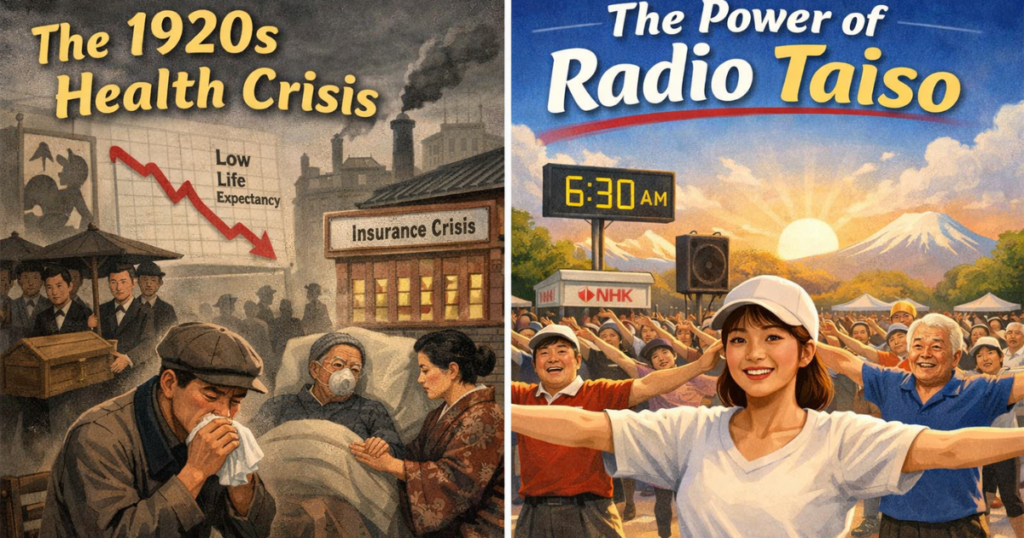
Every morning at exactly 6:30 a.m., something truly remarkable happens across Japan that most of the world remains unaware of. NHK, the national broadcasting organization, transmits the specific Radio Taiso music and instructions nationwide via radio and television.
The scale of participation is staggering. Approximately 27 million Japanese people participate in Radio Taiso regularly. To put that in perspective, that is nearly 20% of Japan’s entire population doing the exact same 3-minute routine simultaneously. It is as if the entire population of Texas committed to the same health routine every single day.
This massive national health movement is particularly prevalent among Japan’s burgeoning senior population. The authors of the best-selling book Ikigai spoke to over 100 of the oldest people in Okinawa, a region famous for having the highest concentration of centenarians in the world. When asked about their daily habits, nearly everyone they interviewed practiced the same simple routine: Radio Taiso. It is undeniably one of the reasons why Japan boasts more centenarians per capita than anywhere else on Earth.
From Crisis to Centenarians: The History of Japan’s Health Revolution
It is easy to assume Japan has always been a beacon of longevity, but that was not the case a century ago. Let us travel back to the 1920s. Japan was facing a severe public health crisis. Life expectancy had stagnated at a shocking 42 years for men and 43 years for women. People were dying young, and insurance companies were struggling to remain viable. The Japanese government recognized that a fundamental shift in national health strategy was necessary.
The solution came from an unexpected source: the Postal Life Insurance Bureau. In 1925, officials traveled to the United States to study the insurance business. There, they discovered that the Metropolitan Life Insurance Company was broadcasting 15-minute exercise routines on the radio to keep their policyholders healthier. The Japanese officials were inspired and thought, “What if we could adapt this for our entire population?”
The Birth and Evolution of “National Health Exercises”
In 1928, to commemorate the coronation of Emperor Hirohito, they launched “national health exercises,” broadcast over the radio to reach millions simultaneously. The philosophy was simple but revolutionary: if everyone performed the same gentle exercises every day, they could improve the collective health of the entire nation.
The government did not view this merely as a fitness program; it became a cornerstone of Japan’s preventative health strategy. They invested heavily in making Radio Taiso accessible, establishing instructor training programs and creating standardized routines. Over the decades, the program evolved. The modern versions we know today, Radio Taiso 1 and 2, were structured in 1951 and 1952.
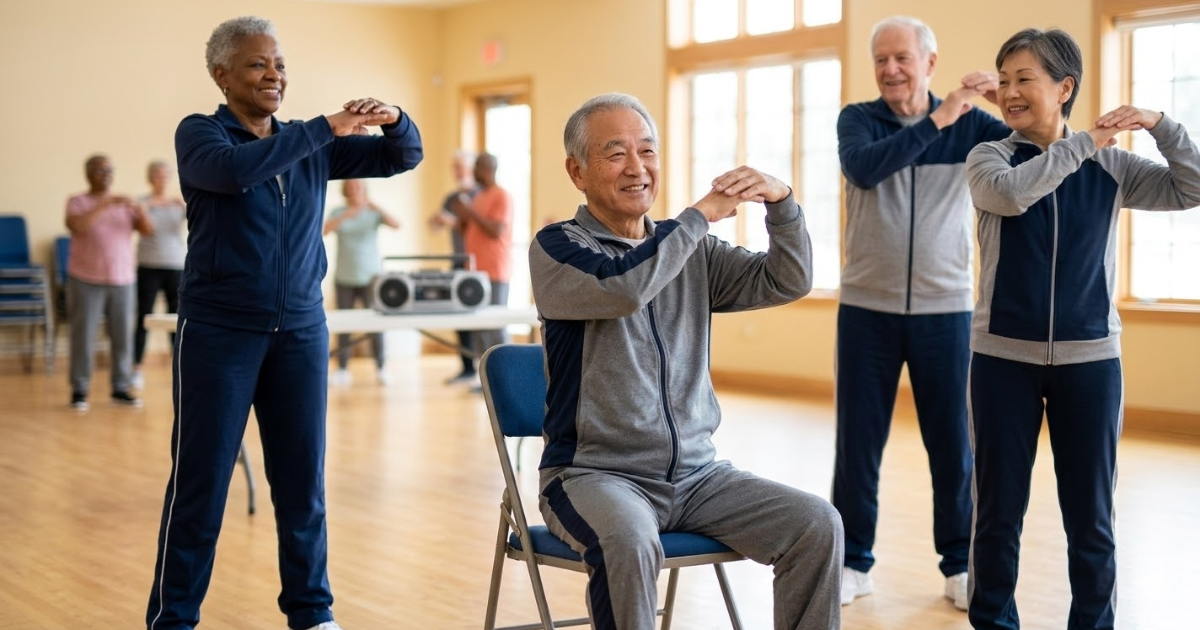
In 1999, demonstrating their continued commitment to inclusivity, the government created a new version called “Exercise for Everyone,” utilizing universal design principles so no one would be left out. This version even includes a chair-based routine, making it perfectly accessible regardless of mobility limitations or joint issues. This nearly century-long investment in simple, accessible movement has been a critical factor in Japan’s transformation into a global leader in longevity.
The Science of the Sequence: Breaking Down the 13 Movements
What makes Radio Taiso truly remarkable is that it is not just a collection of random movements. It is a scientifically designed sequence of 13 specific exercises. This short routine systematically addresses every major movement pattern and joint system your body needs daily.
The routine is masterful in its progression. It targets all planes of movement: forward and back (flexion and extension), side to side (lateral flexion), and rotation. It begins with simple warm-up movements, builds to full-body integration, and concludes with calming breathwork.
Let’s walk through what this comprehensive 13-movement system targets:
Counteracting Stiffness and Countering Modern Posture (Exercises 1-4)
- Exercises 1 through 3: These involve arm stretching, arm and leg coordination, and arm rotation movements. These focus specifically on spinal mobility and shoulder flexibility. These are perfect for counteracting the natural stiffness many seniors experience upon waking.
- Exercise 4: The chest opening movement. This is crucial in our modern world, as it specifically targets forward head posture, something most of us develop from years of desk work, driving, and look at screens.
Spinal Health and Core Stability (Exercises 5-7)
- Exercises 5 and 6: These side-bending and forward-backward bending movements work diligently on core stability while simultaneously enhancing spinal flexibility in multiple directions. Maintaining a healthy spine is vital for virtually all daily activities.
- Exercise 7: The twisting movement. Maintaining spinal rotation is critical for simple, essential tasks that we take for granted until we lose them, such as reaching for a seatbelt, looking over your shoulder while driving, or grabbing something behind you.
Integration, Balance, and Vitality (Exercises 8-13)
- Exercises 8 and 9: These arm stretching and forward bending movements challenge your coordination and balance, which research consistently shows is the single most important factor in preventing falls among older adults.
- Exercise 10: The body circles. This integrates full spinal mobility while simultaneously challenging your coordination and your vestibular (inner ear balance) system.
- Exercise 11: Gentle jumping. This movement is included to help maintain bone density and cardiovascular health without subjecting your joints to high-impact stress.
- Exercise 12: Knee bends with arm lifts. These strengthen your legs and hips, improve circulation throughout the lower body, and open up the chest for better posture and breathing.
- Exercise 13: Deep breaths with a full-body stretch. This final step is vital; it calms your nervous system, improves oxygen flow, loosens any remaining stiff muscles, and helps you stand taller.
In just three minutes, this comprehensive sequence builds strength, improves flexibility, enhances balance, and supports your mental well-being.
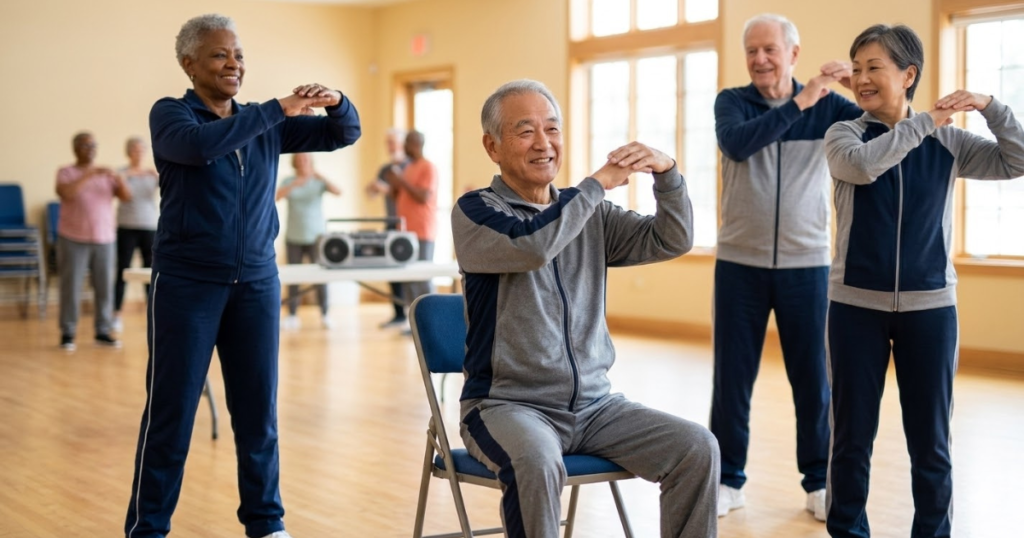
The joyful, accessible practice of radio Taiso.
The Researched Health Benefits: Hard Proof the 3 Minutes Work
You might be skeptical. Can just three minutes truly make a difference? The actual research says an emphatic “yes.”
A illuminating 2024 study followed frail seniors who performed the Radio Taiso routine at home for 12 weeks. The results showed meaningful improvements in the exact areas required to maintain independence and health as we age:
- Significant Agility and Dynamic Balance Improvements: Researchers measured this using a “timed up-and-go” test (getting up from a chair, walking around a cone, and sitting back down). This test is a potent predictor of fall risk and a senior’s ability to live independently.
- Enhanced Aerobic Endurance: Participants showed measurable improvement in a 2-minute step-in-place test. Remember, this benefit came from only 3 to 4 minutes of gentle daily movement.
- Increased Exercise Self-Efficacy: Perhaps most importantly, participants reported higher confidence in their ability to exercise regularly. In the world of wellness, this is “the secret sauce”—it is what keeps people moving long-term.
The Most Shocking Statistic: Adherence
The study also found something truly remarkable that shames most Western fitness programs: 94% of participants stuck with the program for the full 12 weeks. Compare that to typical gym membership usage or complex physical therapy regimens, and you understand why Radio Taiso succeeds where others fail.
Furthermore, participants shared qualitative benefits. One individual noted that the 3-minute routine helped clear her mind and lift her mood, crucially offering these benefits without the mental pressure of planning or executing a long, intimidating workout.
Radio Taiso removes the overwhelming barriers that cause most senior exercise programs to fail: time, complexity, and intimidation.
The Ultimate Checklist for Starting Your Senior Radio Taiso Journey
Are you ready to join millions and unlock the power of these three minutes? Use this checklist to start your own sustainable longevity habit today:
- Consult Your Doctor: While Radio Taiso is gentle, always speak with your healthcare provider before starting any new movement routine, especially if you have pre-existing conditions.
- Find the Routine: You do not need a shortwave radio! The routines are widely available on YouTube. Simply search for “Radio Taiso 1” (the most common version).
- Assess Your Mobility: Watch the video first. If the standing version feels unstable, search for “Chair Radio Taiso.” The benefits are just as potent.
- Lace Up Safely: While the movement is gentle, wear supportive shoes and ensure you are exercising on a non-slip surface.
- Commit to 6:30 (Any) AM: While Japan does it at 6:30 a.m., the “ikigai” value is in consistency, not the exact time. Make it the very first thing you do upon waking to establish the habit.
- Focus on the Breath: Do not hold your breath! Sync your breathing with the rhythm of the music, especially during the final exercise.
- Embrace the Community (Optional): If you can, recruit a friend, spouse, or even neighbors. The communal aspect I saw in Tokyo is a powerful motivator.
🌿 Weekly wellness, health & beauty insights — straight to your inbox
Free subscription · Cancel anytime