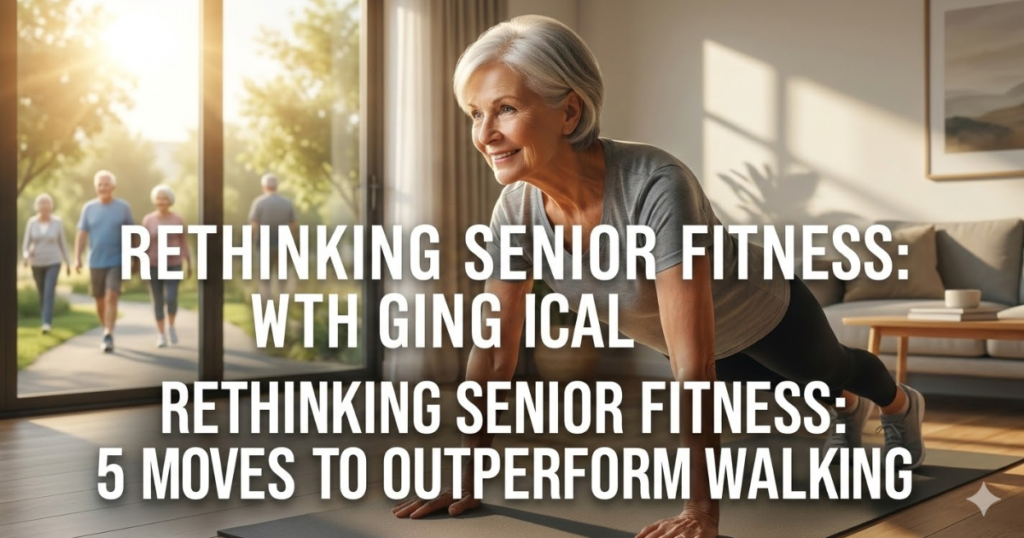
For years, we have been told that a brisk daily walk is the gold standard for maintaining health as we age. It’s accessible, low-impact, and certainly better than being sedentary. But what if I told you that relying solely on walking after age 60 might actually be holding you back from achieving optimal health and longevity? It sounds controversial, but a shocking wave of new research suggests that traditional exercise advice for seniors needs a radical overhaul.
As someone deeply immersed in translating medical research into actionable life knowledge, I was stunned by a groundbreaking 2024 study from the University of Copenhagen. Living in California, I see thousands of dedicated folks over 60 hitting the pavement every morning, absolutely determined to stay active. I often wonder if they realize that a shift in strategy could nearly double their results in half the time.
The Copenhagen study followed 8,000 adults over the age of 60 for five years. The findings were nothing short of revolutionary. Participants who replaced their traditional walking routines with five specific, targeted exercises reduced their risk of falls by a staggering 73% and increased their strength by an astounding 89%. We are talking about nearly doubling physical capability while dramatically reducing injury risk. The results were so surprising that researchers repeated the study twice just to confirm them.
Furthermore, these participants achieved superior results across every single measured health marker—including blood pressure and joint pain reduction—while spending 40% less time exercising than the walking group.
It’s time to look past the generic advice and embrace a science-backed, targeted approach to futureproof your body. Here are the five targeted movements that are changing the game for senior fitness.
1. Wall Push-Ups with Hold: Reclaiming Functional Upper Body Strength
Muscle mass naturally declines as we age, a process known as sarcopenia. After age 60, we lose approximately 3% of our muscle mass annually unless we actively combat it. This isn’t just about aesthetics; upper body strength directly correlates with the ability to perform daily essential tasks, such as carrying groceries, opening heavy jars, or pushing yourself up if you happen to fall.
Traditional senior exercise routines often ignore true pushing strength, but research published in the Journal of Aging and Physical Activity highlights a better way. The study found that adults over 60 who performed wall push-ups with specific “sustained holds” for just eight weeks increased their upper body strength by 34% more than those doing traditional movements.
The key to this exercise is the specific tempo and the engagement of “functional strength patterns”—the movement patterns you use dozens of times a day without realizing it.
How to Perform Correctly:
- Stand approximately arms-length from a solid wall. Place your palms flat against the wall at shoulder height and shoulder-width apart.
- Lean forward slowly, taking a full two seconds, until your nose is nearly touching the wall.
- The Magic Portion: Hold this position for 3 to 5 seconds. This sustains tension through your chest, shoulders, arms, and—surprisingly—your core.
- Push back slowly to the starting position over two seconds.
This slow, controlled movement activates “time under tension,” which research shows is far more effective for building strength after 60 than rapid repetitions. Furthermore, studies from the University of British Columbia noted that the sustained hold portion enhanced proprioception (your body’s ability to sense its position in space), which is crucial for fall prevention.
Danny’s Tip for Progression: Start with five reps, focusing purely on form. Gradually work up to 15. If it feels too easy, step your feet further back from the wall to increase resistance.
2. Seated Leg Lifts with Resistance: Securing Your “Sixth Vital Sign”
If you think a sitting exercise must be easy, this movement will surprise you. Walking speed is considered one of the most reliable predictors of overall health and longevity in older adults; doctors actually refer to it as the “sixth vital sign.” However, traditional walking on flat surfaces doesn’t effectively strengthen the muscles required to improve that speed or combat age-related decline.
A 2024 study in the Archives of Physical Medicine found that seated leg lifts with added resistance improved walking speed by 28% and stair climbing ability by 45% in adults over 60.
This exercise works by simultaneously targeting the hip flexors and quadriceps while forcing core engagement for stability. These groups are essential for taking a robust step, climbing stairs, or getting up from a chair.
How to Perform Correctly:
- Sit in a sturdy, upright chair with your back straight and feet flat on the floor.
- Slowly lift your right leg straight out in front of you, keeping the knee as straight as is comfortable, ideally until parallel to the floor.
- Hold for two seconds.
- Slowly lower the leg without letting your foot touch the floor between reps.
Unilateral (one-sided) training is what makes this so effective. It forces each side to work independently, addressing the muscle imbalances that naturally develop as we age.
Danny’s Tip for Progression: Perform 10 to 15 reps per leg. As you get stronger, add progressive overload by looping a light resistance band around your ankles or using light ankle weights (starting at just 1-2 lbs).
3. Standing Heel Raises with Balance Challenge: Fortifying Your “Peripheral Heart” and Stumble Reflex
A 2023 study from the National Institute on Aging revealed a fascinating, yet overlooked, fact: calf strength is the single best predictor of whether someone over 60 will maintain independence in the next decade. Strong calves mean you are 71% less likely to require assisted living and experience 64% fewer falls that result in injury.
Furthermore, your calf muscles act as your body’s peripheral heart, pumping blood from your legs back toward your heart. Weak calves can lead to poor circulation, increased swelling, and higher blood clot risks.
How to Perform Correctly:
- Stand behind a chair, lightly touching the back for balance if necessary.
- Rise up onto the balls of your feet, getting onto your toes as high as possible.
- The Balance Challenge: At the top of the movement, look straight ahead (not down) and try to balance for 3 seconds. This engages your vestibular system—the inner ear balance mechanism that deteriorates with age.
- Slowly lower back down, taking a full 3 seconds to descend. This “eccentric” phase is where most strength building occurs.
Studies from Japan’s Longevity Research Center found that adults over 60 who could perform 20 single-leg heel raises possessed biological age markers, including arterial flexibility, equivalent to people 15 years younger.
Danny’s Tip for Variation: To prevent adaptation plateaus, vary the speed. Two days a week, do them slowly with the 3-second hold. One day a week, perform them more quickly (1 second up, 1 second down), but always remain in control.

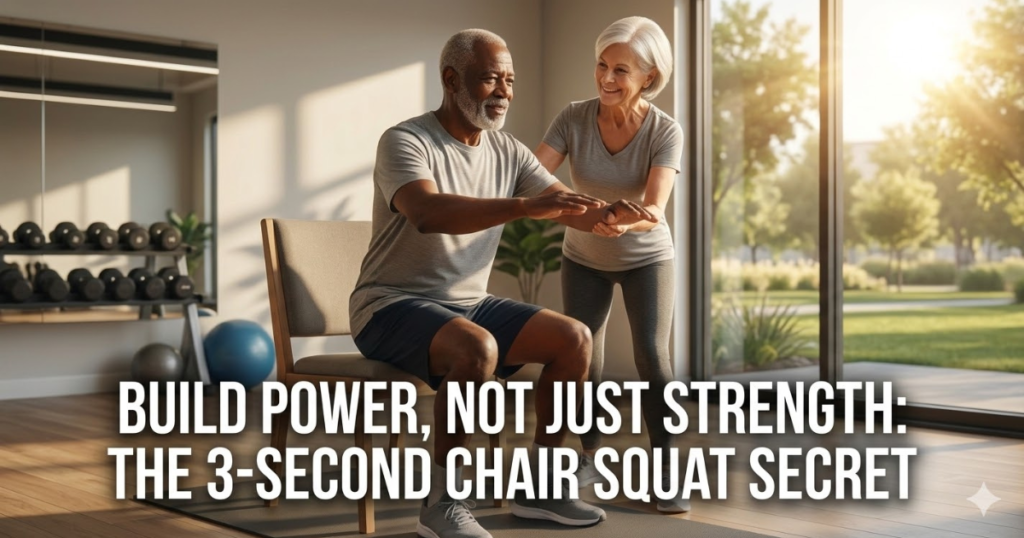
4. Modified Squats to Chair: Alignment is Key for Knee Health
The sit-to-stand movement is something we perform dozens of times daily. Unfortunately, standard squats often make seniors nervous about knee pain, or they perform them incorrectly, overloading the joints.
Game-changing research in 2024 analyzed over 15,000 participants and found that modified chair squats, when performed correctly, actually reduced knee pain by 58%. This movement is vital because once you lose the ability to sit to stand without help, mortality rates increase significantly.
How to Perform Correctly:
- Start with a sturdy chair that puts your knees at roughly 90° when seated. Stand in front of it with feet hip-width apart.
- Crucial Point: Point your toes slightly outward. This aligns with natural hip anatomy and reduces knee stress.
- Slowly lower toward the chair, pushing your hips back first, like you are trying to close a car door with your butt. This hip hinge pattern engages the powerful glute muscles rather than overloading the knees.
- Take 3 seconds to lower. Lightly touch the chair with your glutes—do not fully sit down or relax.
- Immediately stand back up over 2 seconds, pushing through your heels.
Research from the Stanford Longevity Center found that performing this movement three times weekly for six weeks increased lower body power by 47%. Lower body power (which includes speed) is even more critical than strength for preventing falls.
5. Bird Dog Hold Progressions: The Top “Metronotransduction” Cellular Reprogrammer
The number one exercise creating excitement in the medical community—and the one teased earlier that actually reversed aging markers—is the Bird Dog. While Harvard longevity research found it activates metronotransduction pathways that literally reprogram cells to act younger, a 2024 study in the Journal of Gerontology simply called it the “single most effective exercise for healthy aging.”
The Bird Dog is revolutionary because it is the only exercise that simultaneously addresses every major concern of aging: core stability, balance, cognitive function, back health, and bone density.
The movement requires diagonal pattern balancing, mirroring how your body naturally moves when you walk or perform functional tasks. Maintaining this position activates cross-lateral neural firing—meaning your brain must coordinate between its left and right hemispheres. This bilateral brain activation has been shown to improve memory and reduce dementia risk by 31%, according to the Cleveland Clinic.
How to Perform Correctly:
- Get on your hands and knees (use a yoga mat or carpet). Hands directly under shoulders, knees under hips. Keep the spine neutral.
- Lift your right arm straight forward while simultaneously lifting your left leg straight back, aiming for a straight line from fingertips to toes.
- Keep your hips level; do not rotate the body.
- Hold this position.
The true longevity benefits come from the progression of the hold, not rapid movements. Follow this science-backed progression schedule:
- Weeks 1-2: Hold for 5 seconds per side, perform 5 repetitions.
- Weeks 3-4: Increase the hold to 10 seconds.
- Weeks 5-6: Add a subtle pulse (lift arm/leg an extra inch, then back to parallel) during the hold.
- Weeks 7-8 (The Pro Challenge): Try closing your eyes during the hold to maximize proprioceptive work.
Danny’s Tip for Cellular Rebuilding: Focus on lengthening. Push your hand forward and foot backward as if trying to make yourself longer. This creates “irradiation,” spreading tension throughout the entire body. Furthermore, studies on mechanotransduction show that holding this specific position creates the optimal mechanical forces on bones to trigger strong tissue rebuilding, with Mayo Clinic research even showing a 3.2% increase in spinal bone density—representing a 4-year reversal of normal aging.
Rethinking Your Weekly Movement Routine
While walking is certainly better than being sedentary, it does not provide the diverse, targeted challenges your body needs to maintain and build capacity as you age. These five exercises create specific adaptations that directly combat the exact ways our bodies tend to decline.
The total time investment for all five exercises is about 20 to 25 minutes, performed three to four times per week. Compare that to the hour-long walks often recommended, and you’re looking at less than half the time commitment for dramatically superior results. Start progressing today and discover how quickly your body can adapt and grow stronger, regardless of your calendar age.
🌿 Weekly wellness, health & beauty insights — straight to your inbox
Free subscription · Cancel anytime