Watching my 82-year-old neighbor here in Elk Grove, California, practically glide up his steep driveway every morning completely shifted my perspective on aging. For the longest time, I assumed that maintaining that level of vitality required lucky genetics or grueling, hours-long sessions at a local health club. But when I finally asked him about his routine, he just laughed. He doesn’t own a single dumbbell or a gym membership. Instead, he relies on a remarkably simple, consistent routine that takes less than 10 minutes a day.
If you have ever wondered how some seniors seem to stay active, energetic, and fiercely independent well into their 70s, 80s, and even 90s while others struggle with basic mobility, you are about to discover their shared secret. When longevity researchers and physical therapists study older adults who remain highly active, they notice a distinct pattern. These individuals aren’t doing complicated workout routines; they are doing a few simple, highly targeted exercises consistently.
Today, we are diving deep into the three foundational exercises that active seniors swear by. These movements work in perfect harmony: one builds functional strength, one improves critical balance, and one increases vital flexibility. Together, they address the three most important physical domains you need to preserve your independence. No special equipment, no gym fees, and no heavy lifting required.
The Science of Aging and Muscle Maintenance
Before we get to the movements, it is crucial to understand why these specific exercises are so effective. As we age, our bodies naturally undergo a process called sarcopenia, which is the progressive loss of skeletal muscle mass and strength. According to clinical studies, after the age of 30, you begin to lose as much as 3% to 5% of your muscle mass per decade, and this rate accelerates after age 60.
However, muscle loss is not an inevitable life sentence. The human body is incredibly adaptive. By applying light, consistent resistance and challenging your proprioception (your body’s ability to sense its position in space), you can halt and even reverse functional decline. The three exercises detailed below are designed to combat the exact physical vulnerabilities that lead to mobility loss and falls.
Exercise 1: The Sit-to-Stand (Functional Leg Strength)
If there is a holy grail of senior fitness, this is it. The sit-to-stand is the absolute foundation of staying active, and it is the number one exercise that physical therapists prioritize for older adults.
Why It Is the Foundation of Independence
Think about your daily life. Every single day, you need to stand up from dining chairs, get out of bed, rise from the toilet, and get out of the car. This specific biomechanical movement is absolutely essential for independent living. When you can no longer perform this action easily, your entire world shrinks, and you become reliant on others for basic needs.
This exercise is a complete lower-body workout disguised as a simple daily movement. It directly strengthens your quadriceps (front of the thighs), glutes (buttocks), hamstrings (back of the thighs), and your core stabilizers.
How to Perform the Perfect Sit-to-Stand
Form is everything when it comes to maximizing the benefits of this exercise while protecting your joints.
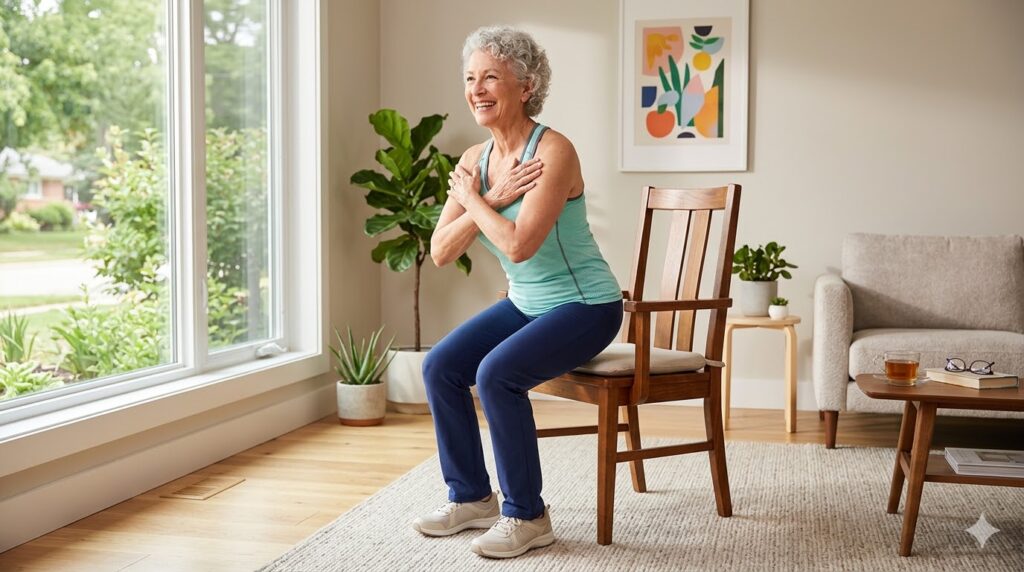
- The Setup: Find a sturdy, armless chair. Place it against a wall so it cannot slide backward. Sit on the front half of the seat with your feet flat on the floor, about shoulder-width apart.
- Arm Placement: Cross your arms over your chest or hold them straight out in front of you. The goal is to avoid using your hands or momentum to push off your thighs or the armrests.
- The Ascent: Lean forward slightly from the hips, keeping your back straight. Push firmly through your heels and engage your leg muscles to stand up.
- The Completion: Stand all the way up until you are fully upright with your hips extended.
- The Descent: Slowly and deliberately lower yourself back down into the chair with total control. Do not simply drop or fall back into the seat. The downward phase (eccentric motion) is where you build exceptional muscle control.
Actionable Goal: Start with 8 to 10 repetitions. As you build strength over a few weeks, gradually work your way up to 15 or 20 reps. Move slowly; feeling your muscles engage is the key to success.
Case Study: Regaining Mobility
Take the case of Robert, a 74-year-old retired teacher who found himself increasingly relying on his wife to pull him up from his favorite armchair. After integrating just three sets of 10 sit-to-stands into his morning routine, within six weeks, he had completely regained his ability to stand unaided. More importantly, he noted a significant decrease in knee pain because his strengthened quadriceps were finally supporting his joints properly.
Exercise 2: The Single-Leg Balance (Fall Prevention)
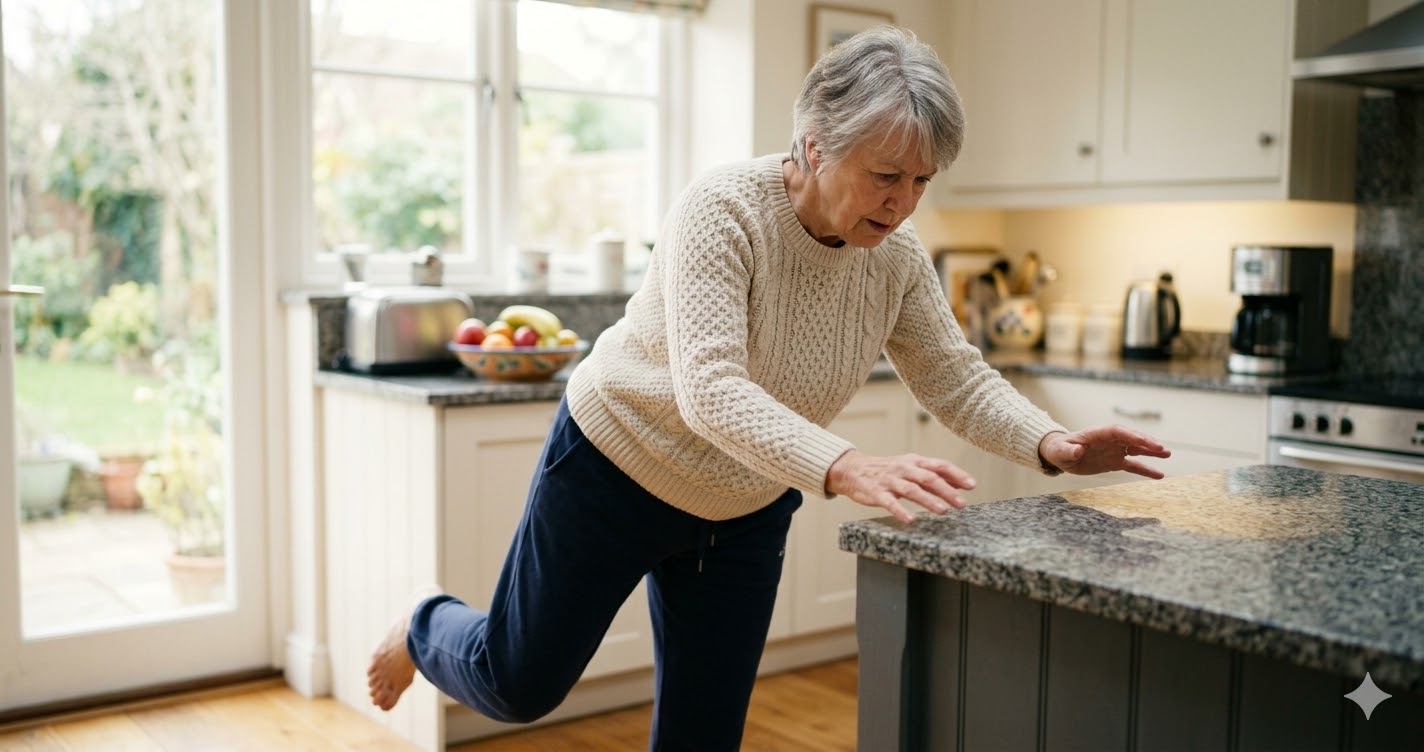
Now that we have addressed strength, we must talk about stability. The single-leg balance is what keeps active seniors confident on their feet, and it is arguably the most crucial exercise for preventing life-altering falls.
The Crucial Role of Proprioception
Balance naturally declines with age if it is not actively trained. The inner ear, vision, and sensory nerves all play a part, but the muscular aspect—proprioception—is something you can rapidly improve at any age.
When you stand on one leg, you force the small stabilizer muscles in your ankles, knees, and hips to work overtime. These are the exact automatic-response muscles that engage when you step on an uneven sidewalk, misjudge a curb, or trip over a rug. Training these muscles ensures they are awake, alert, and ready to catch you before you fall.
Step-by-Step Guide to Mastering Your Balance
Safety is paramount here. Never practice balance exercises in the middle of a room without a support structure nearby.
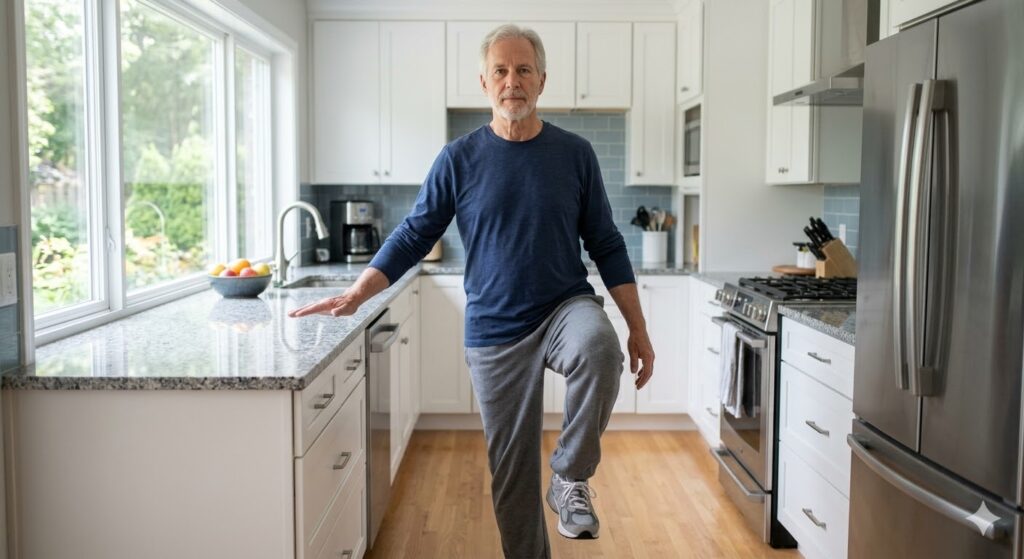
- The Setup: Stand next to a kitchen counter, a heavy dining table, or the back of a sturdy sofa. Stand tall with excellent, upright posture.
- The Lift: Lift one foot just a few inches off the ground. You do not need to hike your knee up high; simply hovering your foot is perfect.
- The Stance: Balance on your standing leg, ensuring that your standing knee is slightly bent, not completely locked out. A soft knee absorbs shock and forces the muscles to do the work rather than resting on the joint.
- The Hold: Aim to hold this position for 20 to 30 seconds.
- The Support: Initially, keep your fingertips lightly resting on the counter. As you improve, challenge yourself by lifting your fingers to hover just an inch above the counter, ready to grab it if you sway.
Expert Tip: Advanced seniors often practice this while brushing their teeth—two minutes of built-in balance practice every single day! Once you master the standard hold, you can try closing your eyes for a few seconds, which dramatically increases the difficulty by removing visual stabilization cues.
Exercise 3: The Standing Hamstring Stretch (Mobility & Flexibility)
Strength and balance are vital, but without flexibility, your movement becomes rigid and restricted. The third pillar of the active senior’s routine is the simple standing hamstring stretch, a movement essential for preventing stiffness and maintaining a youthful range of motion.
Overcoming Stiffness and Lower Back Pain
The hamstrings are the large muscles running down the back of your thighs. Because we spend so much of our modern lives sitting, these muscles tend to shorten and tighten over the decades.
Why does this matter? Tight hamstrings pull downward on your pelvis, tilting it out of its natural alignment. This pelvic tilt forces your lower spine to overcompensate, which is one of the leading hidden causes of chronic lower back pain in older adults. Furthermore, tight muscles affect your natural gait (how you walk), making your strides shorter and more shuffle-like, which ironically increases your risk of tripping.
The Right Way to Stretch Without Bouncing
Stretching should feel like a gentle release, never a sharp, tearing pain.
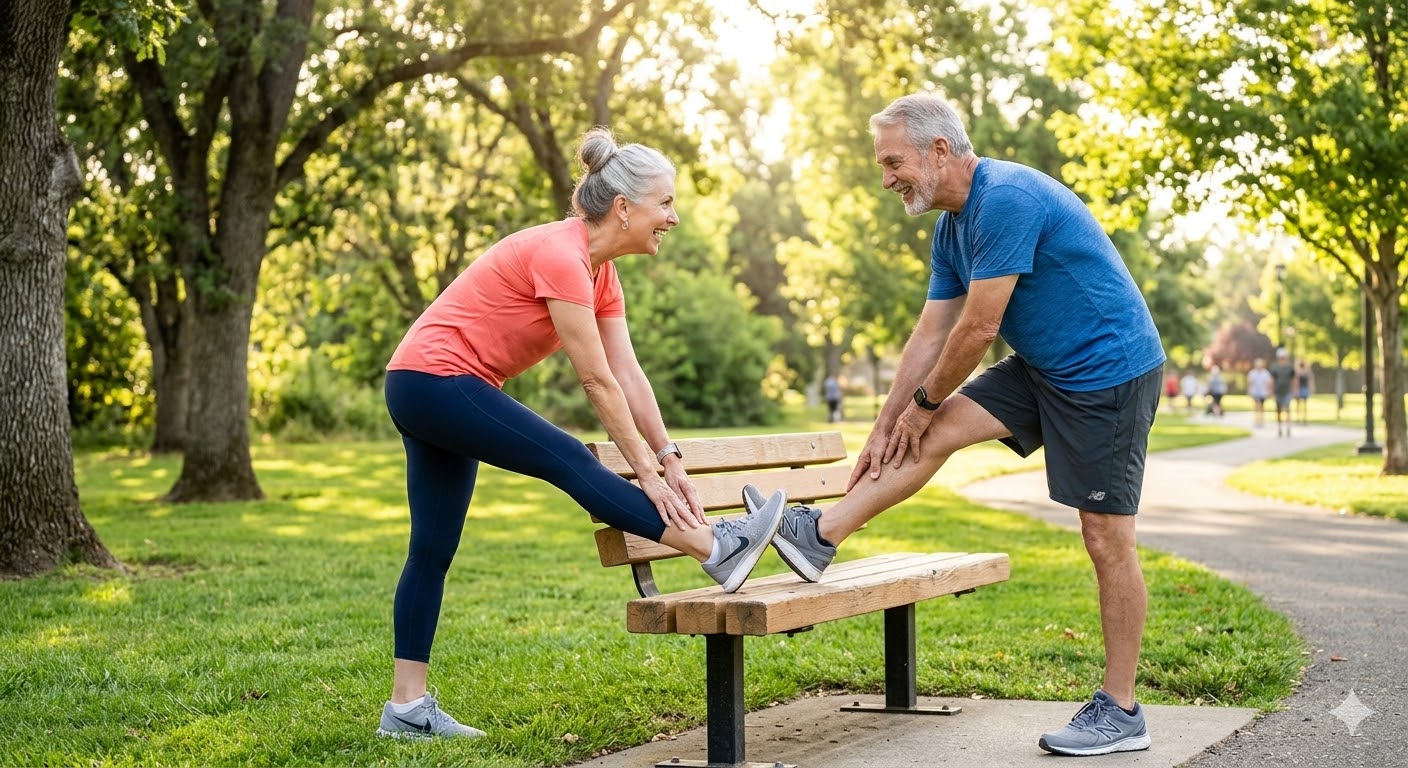
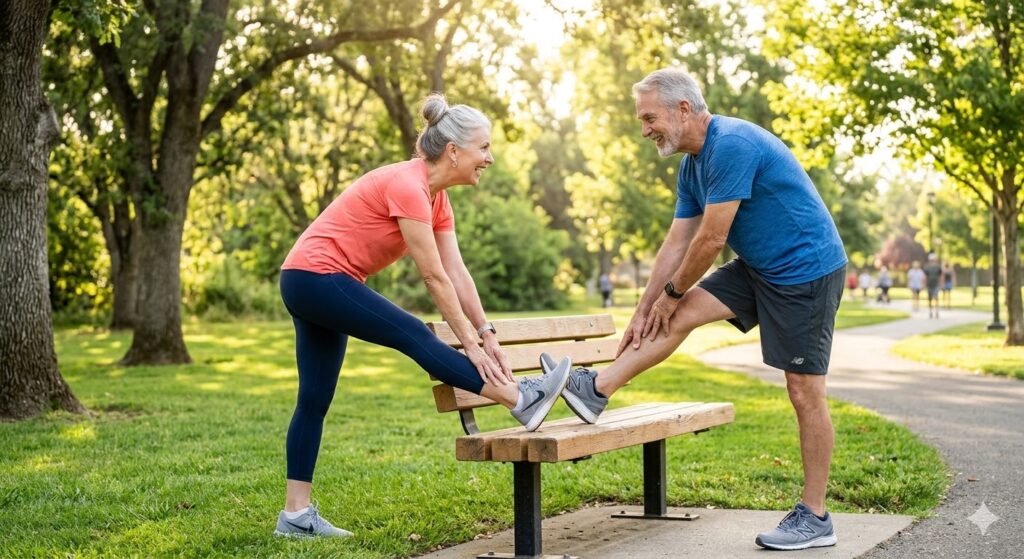
- The Setup: Stand facing a low step, a sturdy wooden box, or the bottom step of your staircase.
- The Placement: Place one heel firmly on the step. Keep that leg straight, with your toes pointing upward toward the ceiling. Keep your other foot flat on the ground, supporting your weight.
- The Hinge: This is the most important part: keeping your back completely straight, gently lean forward from your hips. Do not round your shoulders or your spine. Imagine bringing your belly button toward your thigh.
- The Stretch: As soon as you feel a gentle, dull pull along the back of your raised leg, stop.
- The Hold: Hold this steady position for 20 to 30 seconds. Breathe deeply and normally. Never bounce. Bouncing triggers a defensive reflex in the muscle that actually makes it contract tighter.
- The Switch: Slowly step down and repeat with the other leg. Aim for two to three stretches per leg.
When you maintain flexible hamstrings, you can bend over to tie your shoes with ease, walk with a long, confident stride, and significantly reduce your chances of straining a muscle during daily activities.
Building Your 10-Minute Daily Routine
Knowing these exercises is only half the battle; consistency is where the magic happens. Active seniors treat this routine exactly like brushing their teeth or taking their morning vitamins—it is simply a non-negotiable part of their day.
Here is a simple, actionable checklist to integrate these movements into your life seamlessly:
The Morning Activation Checklist
- 7:00 AM (In the Kitchen): While waiting for the coffee to brew or the kettle to boil, stand at the kitchen counter and perform your Single-Leg Balances. 30 seconds per leg, twice. (Total time: 2 minutes)
- 7:30 AM (In the Living Room): Before sitting down to watch the morning news or read the paper, stand in front of your chair and complete 10 to 15 slow Sit-to-Stands. (Total time: 2 minutes)
- 8:00 AM (Near the Stairs): On your way to get dressed, use the bottom step of the staircase to perform your Standing Hamstring Stretches. 30 seconds per leg, twice. (Total time: 2 minutes)
Total time invested? Roughly 6 minutes. The return on investment? Years of preserved independence and mobility.
Crucial Safety Tips for Senior Exercise
While these exercises are incredibly safe and designed for all ages, it is always important to approach physical activity with respect for your body’s current limitations.
- Environmental Safety: Never perform balance or strength exercises on slippery surfaces like polished hardwood in just your socks. Wear athletic shoes with good traction, or perform them barefoot on a non-slip yoga mat.
- Listen to the Pain: There is a distinct difference between the mild, dull burn of muscle fatigue and sharp, acute pain in a joint. Muscle fatigue is good; it means you are building strength. Sharp pain in the knees, hips, or lower back is a warning sign. If you feel sharp pain, stop immediately. It is always better to do fewer repetitions safely than to push through bad pain and risk an injury.
- Medical Clearance: If you have underlying health conditions such as advanced heart disease, severe osteoporosis, or severe arthritis, or if you have recently had joint replacement surgery, you must consult your primary care physician or a physical therapist before beginning any new routine.
- Start Slow: If you are starting from zero after a long period of inactivity, leave your ego at the door. Do just five sit-to-stands instead of ten. Hold the balance for 10 seconds instead of 30. Your strength will increase faster than you think, provided you remain consistent and avoid injury.
Conclusion: Your Next Step Toward Independence
The grand secret that active seniors know is ultimately very simple: staying vibrant is not about pushing yourself to exhaustion or joining an intimidating fitness boot camp. It is about doing the right targeted movements with unrelenting consistency.
These three simple exercises—the sit-to-stand for functional power, the single-leg balance for unshakeable stability, and the hamstring stretch for fluid mobility—can literally mean the difference between struggling with daily chores and moving through your golden years with grace, ease, and confidence.
Don’t wait for a Monday or a new month to begin. Right after you finish reading this post, find a sturdy chair, stand near a counter, and try these three movements. Notice how your body feels. Commit to just 10 minutes a day, and within a few short weeks, you will be amazed at the renewed strength and vitality you possess.
Are you ready to give this 10-minute routine a try today? Let us know in the comments which exercise you found the most challenging!
🌿 Weekly wellness, health & beauty insights — straight to your inbox
Free subscription · Cancel anytime