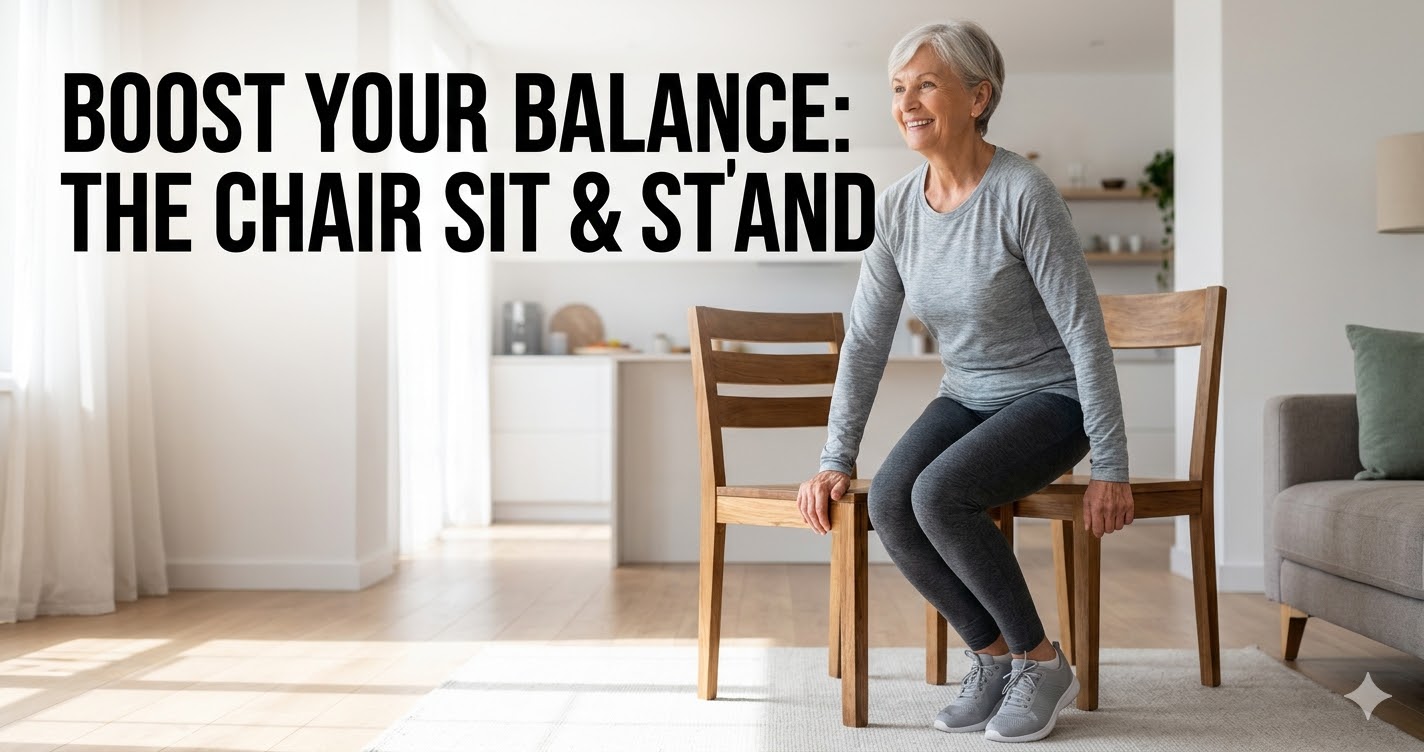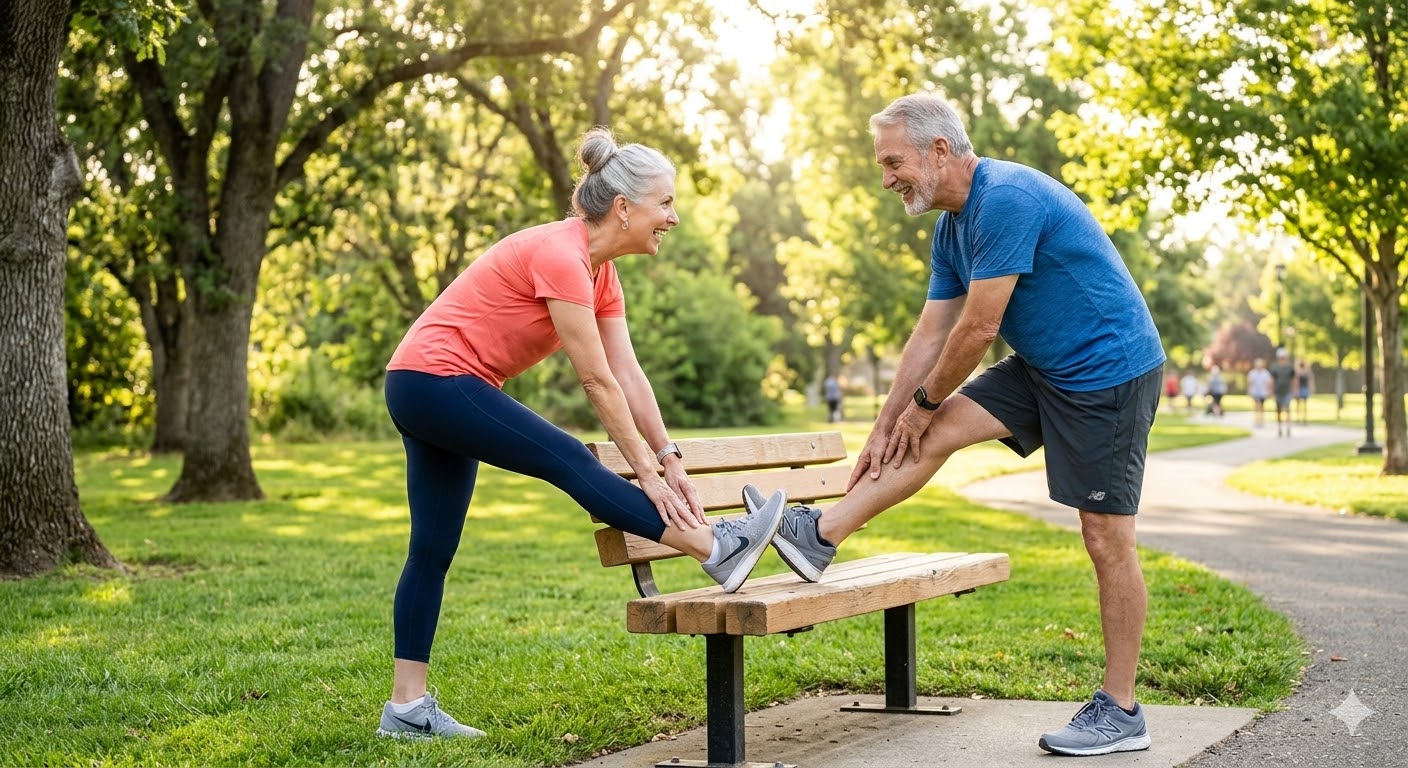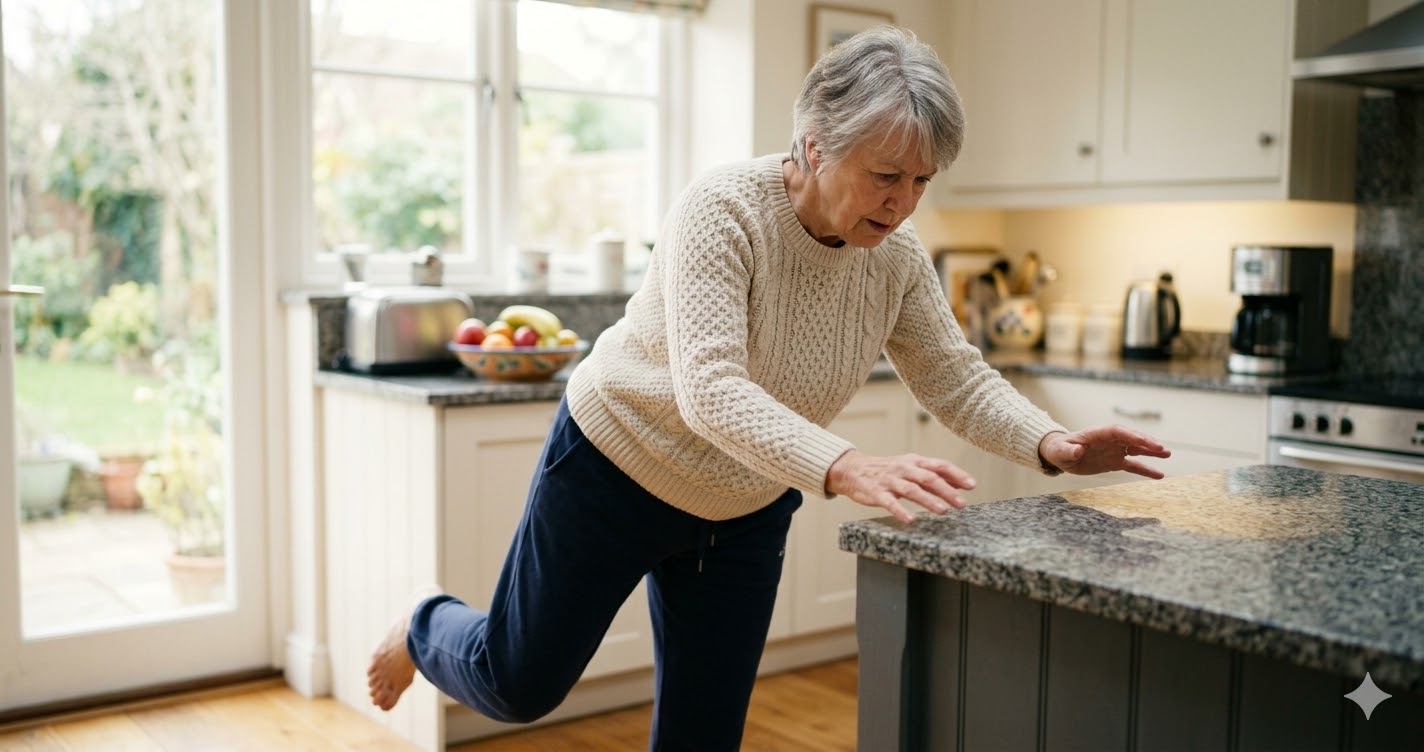
As we age, maintaining an active, vibrant lifestyle is about more than just filling our days with hobbies; it’s about preserving our independence, mobility, and confidence. For many older adults, the thought of losing that independence due to a sudden fall is a looming and very real concern. Living in California, I’ve seen countless active seniors who once loved hiking our local trails or walking along the coastline suddenly become hesitant, trading their confident, energetic strides for a cautious, fearful shuffle. It is a frustrating transition to witness, but it absolutely does not have to be a permanent one.
Having spent nearly three decades deeply involved in fitness and rehabilitation, I have poured over hundreds of clinical articles, research papers, and case studies focused entirely on balance, fall prevention, and improving walking mechanics in older populations. Today, I want to share a groundbreaking truth with you—one that challenges conventional wisdom and can completely transform the way you or your loved ones move through the world. The secret to preventing falls is not what you might expect, but it is incredibly effective.
The Hidden Truth About Senior Falls and Muscle Weakness
When an older person begins to stumble or lose their balance, the immediate assumption from both medical professionals and family members is often that they have simply grown physically weak. The standard prescription usually involves a battery of lower-body strength exercises. However, focusing solely on muscular strength misses the root of the problem entirely.
Why Squats and Ankle Raises Aren’t Enough
For years, exercises like squats, leg presses, and ankle raises have been the go-to recommendations for seniors struggling with mobility. These exercises have been tested over and over again in clinical settings, and the results are consistently surprising: while they certainly build muscle mass and improve general fitness, they do not significantly reduce the rate of falls, nor do they vastly improve walking mechanics in seniors who are already struggling.
Strength is important for overall health, but walking is not merely a test of strength. It is a highly complex neurological symphony of weight distribution, spatial awareness, and dynamic equilibrium. If your brain is not properly communicating with your body about where your center of gravity is, having stronger quadriceps will not stop you from tipping over.
The Fear of Falling: Understanding the Shuffling Cycle
To truly understand why balance deteriorates, we have to look at how older adults move when they feel insecure. When an older person is having difficulty walking, pay close attention to their feet. They are rarely actually “walking” in the traditional sense; instead, they are shuffling.
This shuffling happens because there is a distinct lack of weight shifting. When we walk normally, we naturally shift our entire body weight onto one leg for a fraction of a second while the other leg swings forward. It requires a moment of controlled, single-leg balance. However, seniors with balance issues are terrified to lift their legs. They subconsciously believe that if they break contact with the ground, even for a millisecond, they will fall. This profound fear leads to a rigid, wide-stanced shuffle that ironically makes them more prone to tripping over uneven surfaces.
The Science of Balance: Why Weight Shifting Matters
If weakness isn’t the core issue, what is? The answer lies in the neurological process of weight shifting. Balance is not a static state; it is a dynamic process of continuous adjustment. When you lose the ability to confidently shift your weight from one side of your body to the other, your brain essentially forgets how to stabilize you in motion.
Reprogramming the Brain for Stability
The good news is that the human brain possesses remarkable neuroplasticity—the ability to rewire and reorganize itself—well into our senior years. The way people get better at balancing is not by building bigger muscles, but by reprogramming their brains. We have to relearn the fundamental ability to stand on one leg. It is a process of trial and error, of gently pushing the nervous system to adapt to instability until that instability feels normal again.
What works is introducing a specific, controlled balance challenge. By forcing the brain to repeatedly navigate the sensation of weight shifting in a safe environment, we can rebuild the neural pathways responsible for upright stability.
The Ultimate Balance Solution: Single-Leg Standing
After 29 years of professional observation and research, I can confidently tell you that there is one single activity that can help people improve their balance more than anything else: single-leg standing. It sounds incredibly simple, almost too simple to be the ultimate cure for such a complex problem. Yet, its effectiveness lies in its direct targeting of the exact mechanical and neurological deficit that causes the shuffling gait.
Step-by-Step Guide to the Perfect Single-Leg Stand
To reap the benefits of this exercise, it must be done correctly and, most importantly, safely. Here are the precise directions to follow, whether you are trying this yourself or guiding a senior client or family member:
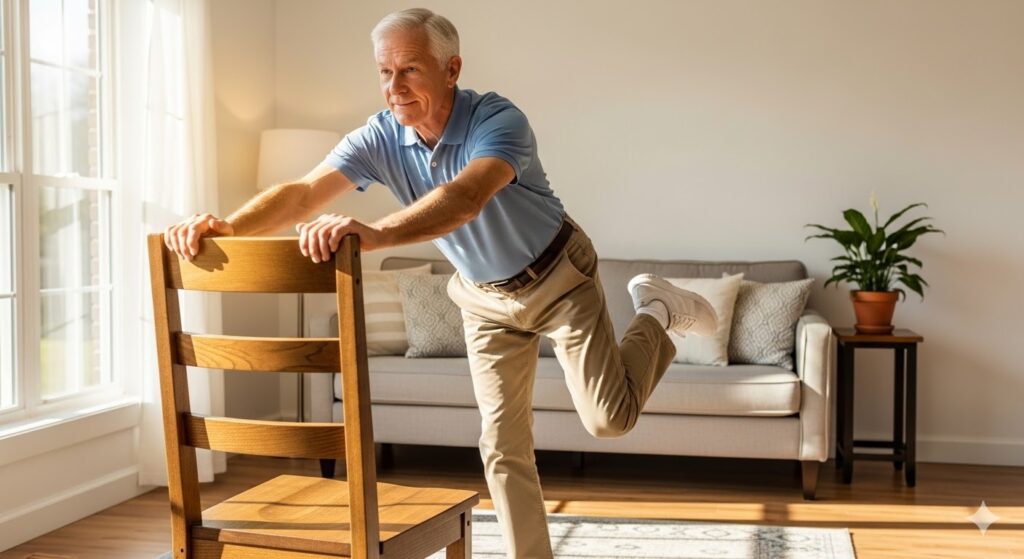
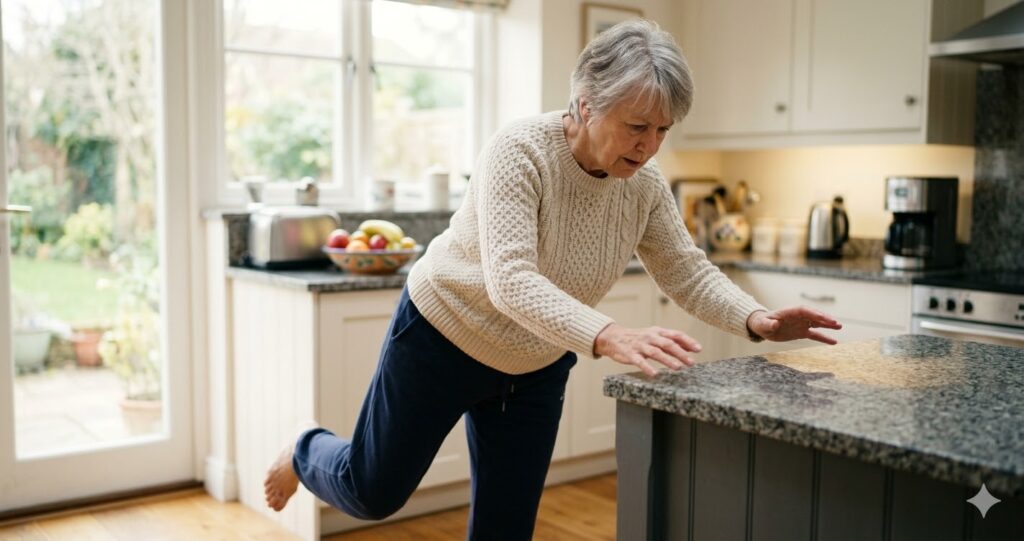
- Find a Secure Anchor Point: Have the person stand directly in front of a solid, immovable object. This could be a heavy bathroom sink, a commercial piece of gym equipment, a heavy dining table, or the sturdy back of a heavy chair. It absolutely must be something that will not tip over if they suddenly lose their balance and need to grab it forcefully to steady themselves.
- The Crucial Weight Shift: Tell the person to focus on one leg. Before lifting the other foot, they must physically shift their entire body weight directly over the leg they are planning to stand on. This deliberate shift is the most critical part of the entire movement, as it is the exact mechanism they are failing to execute when they shuffle.
- Lift and Hover: Once the weight is fully shifted, instruct them to slowly lift the non-weight-bearing leg just an inch or two off the ground.
- The “Let Go” Challenge: Here is where the real work begins. While hovering the foot, they should try to let go of their anchor point. They can hover their hands just millimeters above the sink or chair so they are ready to grab it instantly, but they must break physical contact to truly challenge the brain.
Overcoming the Initial Hurdles and Frustrations
It is vital to set realistic expectations. The first few times someone who is actively struggling with their balance attempts this, they are going to fail. They might only last a fraction of a second before they panic and grab right onto the object near them. This is completely normal. They are reacting to a deeply ingrained fear of falling.
As a coach, caregiver, or even as the individual practicing, you have to encourage persistent repetition. Have them do this two or three times on one leg, then switch to the other leg to prevent muscular fatigue and give the nervous system a brief reset.
In order for someone who is severely struggling to see tangible improvement, they may literally have to do this hundreds and hundreds of times. It is a journey of trial and error. Sometimes it takes an immense amount of practice, patience, and gentle encouragement. But it can make a profound difference, and it absolutely can be done.
Real-Life Impact: Case Studies in Balance Recovery
To illustrate just how powerful this simple intervention can be, let’s look at how single-leg standing has practically transformed lives in real-world scenarios.
Case Study 1: Regaining Independence After a Scare
Consider the case of a 74-year-old woman who had experienced a minor slip in her kitchen. She didn’t break any bones, but the psychological impact was devastating. Within weeks, she stopped going to the grocery store and confined herself to her home, adopting a severe, shuffling walk. Traditional physical therapy focused on resistance bands did little to restore her confidence.
When she transitioned to a dedicated single-leg standing protocol, the first week was fraught with frustration. She couldn’t let go of her kitchen counter for more than a second. However, by practicing for just five minutes every morning and evening, her brain began to adapt. By week four, she was holding a steady stance for 10 seconds per leg. By week eight, the shuffling was gone entirely. She had retrained her brain to trust her body’s ability to shift weight, completely restoring her independent, active lifestyle.
Case Study 2: Overcoming the Fear of Walking Outdoors
Another common scenario involves seniors who are fine indoors but terrified of uneven outdoor terrain. A 78-year-old gentleman who loved gardening found himself unable to navigate his own backyard. The slightly uneven grass made him feel like he was constantly on a boat.
By practicing single-leg stands—eventually progressing to doing them while standing on a slightly soft surface like a folded yoga mat indoors—he conditioned his ankles and his neurological feedback loop to handle micro-adjustments. The act of weight shifting became automatic again. Within three months, he was back to tending his garden without a walker or a cane, proving that the brain’s ability to relearn balance has no strict age limit.

A Comprehensive Checklist for Daily Balance Practice
If you want to implement this life-changing routine, consistency is your best friend. Here is a daily checklist to ensure you are practicing safely and effectively:
- Environment Check: Are you standing near a heavy, completely unmovable object (like a granite counter or heavy sink)?
- Footwear Check: Are you wearing supportive, flat-soled shoes, or are you barefoot? (Avoid thick, squishy running shoes as they dampen sensory feedback from the floor).
- Posture Check: Are you standing tall with your chest up and looking straight ahead, rather than staring down at your feet?
- The Shift: Did you consciously shift 100% of your body weight over the standing leg before lifting the other foot?
- The Hover: Are your hands hovering just an inch above your support surface, ready to grab but not resting on it?
- Time Tracking: Are you aiming for small, incremental improvements rather than perfection on day one?
The Ultimate Goal: The 20-Second Benchmark
How do you know when you have successfully “reprogrammed” your balance? In the world of rehabilitation, we have a specific benchmark. The ultimate goal for this activity is to have an individual stand on one leg for a full 20 seconds without holding on to anything, and without their standing foot violently wobbling or hopping.
Once someone can confidently hit that 20-second mark on both the left and the right leg, their risk of a debilitating fall drops dramatically. They have regained the neurological control necessary for safe, fluid walking. Once that milestone is achieved, I highly encourage them to keep doing this exercise daily as a maintenance routine—perhaps while brushing their teeth or waiting for morning coffee to brew.
Conclusion: Taking Control of Your Mobility
Aging gracefully and actively isn’t about avoiding all risks by sitting still; it’s about equipping your body and your brain with the tools to navigate the world confidently. Weakness is not your enemy, and a shuffling gait is not an inevitable life sentence. The loss of the ability to shift weight is the true culprit behind senior falls.
By embracing the challenge of single-leg standing, you are doing more than just an exercise. You are engaging in a profound dialogue with your nervous system, demanding that it remember how to keep you upright, moving, and free. It takes patience, it takes hundreds of tiny failures, and it takes dedication. But this one, brilliantly simple activity can help people improve their balance more than anything else that anyone can do. Start today, hold on tight to that counter, shift your weight, and take the first step toward reclaiming your active life.
🌿 Weekly wellness, health & beauty insights — straight to your inbox
Free subscription · Cancel anytime