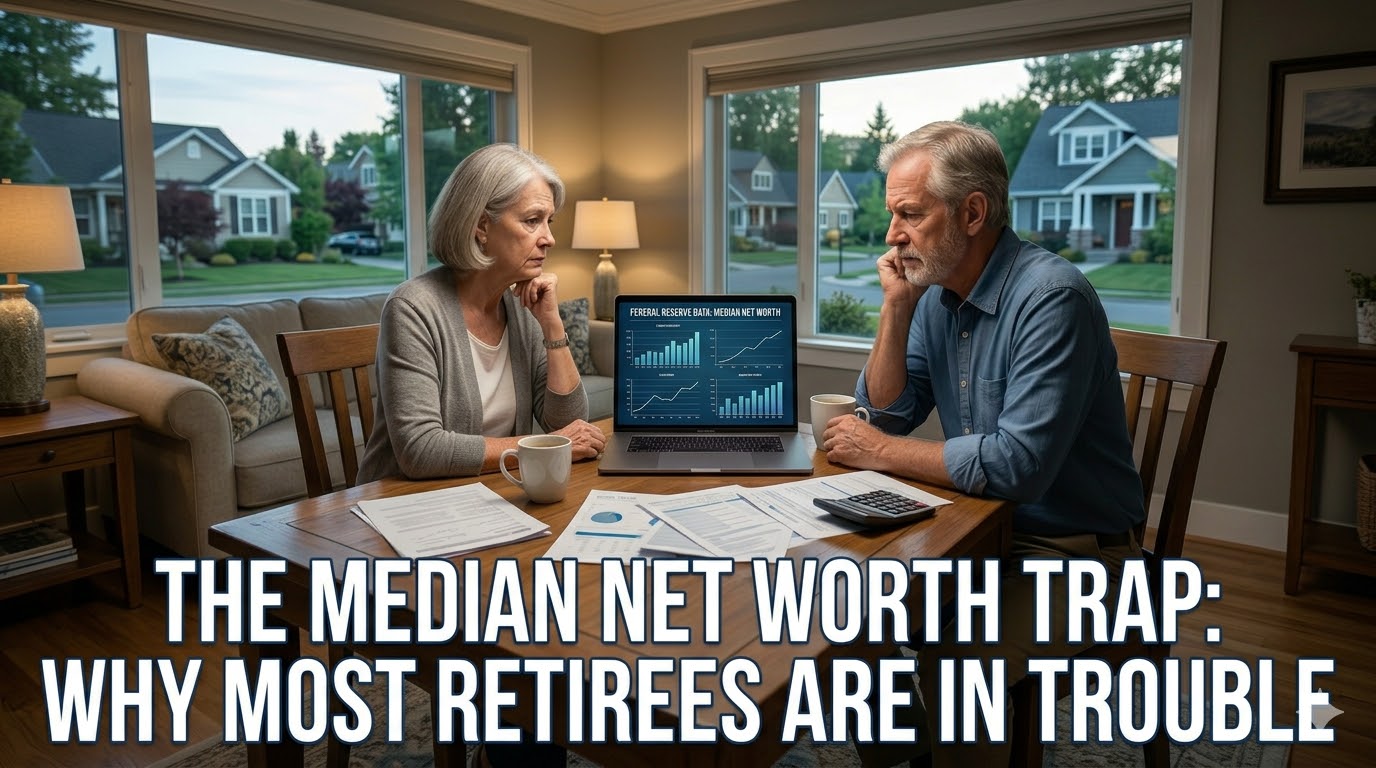
There are over 60 million retirees in the United States right now, and about 70 million Gen Xers are going to start joining their ranks very soon. If you’re one of them, or even close, you’ve probably felt that nagging worry: Do I really have enough?
The unfortunate truth is that many retirees in the United States are facing a big problem—a financial trap that many don’t see coming until it’s too late. It’s a crisis built on assumptions, and it can derail an otherwise active and vibrant retirement lifestyle. I want to share with you exactly what this issue is, backed by the latest data, and, more importantly, what we can all do to protect ourselves and ensure our golden years are truly golden.
It’s easy to feel confident when looking at high-level numbers, but when we dig deeper, the reality is far more challenging. Let’s look at the data together and chart a course toward a secure, active future.
The Net Worth Narrative: A Hidden Trap in Plain Sight
We need to start off with some concrete data. If you’ve read any financial reports, you might have seen a generally positive picture. But let’s look at the Survey of Consumer Finance data put out by the Federal Reserve, which is the most recent data. You can see for 55 to 64-year-olds (pre-retirement or just entering), the median net worth is about $365,000. For 65 to 74-year-olds, that number rises to about $410,000.
Now, a $400,000 net worth—that sounds pretty good, right? A comfortable cushion for an active life?
But here is the single most important detail: that is net worth. For most of us, this number is a combination of all our savings accounts, retirement accounts, and, crucially, the home equity in our house.
And the home equity is going to represent about half of that $410,000 figure.
This is the classic good news, bad news scenario. The good news is you have $400,000; the bad news is that $200,000 of it is completely illiquid. That $200,000 in your home equity is just numbers on a piece of paper. You cannot use it to pay for groceries, a flight to visit your grandkids, or that gym membership that keeps you active.
So let’s call your real liquid assets—the money you can actually spend—just $200,000. This is the median net worth trap. Half of your fortune is locked up, and, as the data shows, it’s remarkably difficult to unlock.
The Challenges of Unlocking Your Home Equity
If $200,000 is the problem, then unlocking your home equity is the solution. Right? We have equity, but how likely is it that we’re going to move to use it?
Let’s look at another data point from Vanguard. This report shows the percent of people that actually choose to move every year, broken down by age. You can see when we’re young, we move fairly frequently. 20- to 29-year-olds—over a fourth of them move each and every year. But you can see that number goes down by age. By the time we hit the 70-to-79-year-old range, it drops to a little less than 6%. (It does pop up a bit at 80, but I suspect most of that increase is for people that need assistance with daily living).
So, while we have equity in our homes, we are not statistically likely to move to access it. Only about 1 in 5 (20%) of retirees move interstate, away from their current high-cost-of-living area.
The dilemma is simple but powerful: in order to unlock that equity, we have to do one of a couple things. One is we have to downsize. That’s one option. Another is we have to move—we have to move from a high-cost location to a low-cost location.
But as the Vanguard data shows, very few of us are going to move outside of our state. The challenge is, how do we actually unlock this equity to power an active lifestyle? The answer, for most of us, is not as simple as selling the house and moving.
Your Comprehensive Roadmap Forward: Four Powerful Strategies
So what do we do? The median net worth is trapped; our liquid assets are not enough, but Social Security isn’t enough to fill the gap alone.
I’m going to share with you four powerful things we do, and I’ll include a checklist you can immediately implement.
1. Actively Confront Your True Housing Costs
Do you keep your large home? If you don’t sell your house and half of your net worth is locked up in it, you have limited liquid assets. I want to share this article by Go Banking Rates: Boomers are facing a new retirement problem and here is how to deal with it. Number one is housing costs. A lot of people of all ages are seeing drastic increases in mortgage payment because of an increase in property tax and the cost of insurance.
First, your children and grandchildren come visit, they don’t care how big your house is. They’ll still come to visit. They might stay at a hotel, but they spend the day with you. Second, the article goes on to say a larger house isn’t just more expensive to buy, it’s also much more expensive to maintain. You cannot have an active lifestyle if you’re stuck doing yard work or repairs.
Checklist:
- Audit Your Expenses: Sit down and look at all of your housing-related costs from the last 12 months. This includes property taxes, insurance, home maintenance (repairs, landscapers), and utilities.
- Create an “Inflation Budget”: Use software designed to help you make a robust comprehensive decision, like Bolden (formerly New Retirement). I like Bolden because it’s powerful, easy to use, and it’s affordable. This kind of software will help you build an “inflation budget” that accounts for rising taxes and costs.
2. Strategic Relocation and Tax Considerations
Things to consider when looking for a new home or possibly a new state to move is the state’s tax laws because each state varies when it comes to taxes, not just for your house, but for the retiree themselves. Is your Social Security going to be taxed? Does the state have capital gains tax rate if you sell stocks that have appreciated?
Also, does your state have personal state income tax? Is there property tax relief for retirees or disabled veterans?
Some states are much more tax-friendly to retirees. For example, Florida, Nevada, and Wyoming are often make the list for being tax-friendly in retirement. A good advisor or CPA can assist with these decisions.
3. Actively Vote and Advocate for Social Security
Regardless of your political affiliation, vote. It is important that we get Social Security figured out and that we save it. Social Security is a stronger safety net than many of us think.
An op-ed by Andrew Biggs, a former senior official at the Social Security Administration, argues you don’t need to be a millionaire to retire. An average couple retiring in 2022 received total annual benefits of nearly $46,000. Biggs points out that a typical couple can expect to make more than twice the elderly poverty threshold before they touch a penny of their own savings.
So, while hardly extravagant, Social Security is an enormously important safety net for 65 million people in the United States. That’s a huge population, and we vote.
4. Implement a Personal Saving Strategy: The 50/30/20 Rule
You do what you can. You do what you can. You save as much as you can. If you’ve been having trouble saving in the past, let’s look at the rule of 50/30/20.
- Necessities: Keep your necessary spendings—things like rent or mortgage, fuel for your car, food from the grocery store—try to keep your necessities to 50% of your after-tax take-home pay before savings.
- Wants: Things like taking a nice vacation, going out to eat, things that show up at the cardboard box at your front door—try to keep your wants under 30%.
- Saving: If you can do that—50% necessities, 30% wants—that leaves 20% to save. It doesn’t take long saving 20% a year to make a difference.
💡 Frequently Asked Questions (FAQ)
Q1: Why is my net worth not a good indicator of my retirement preparedness?
A1: Net worth often includes your primary home, which is your largest illiquid asset. While it represents wealth, you cannot use it for daily expenses. You must focus on your liquid assets—like savings and retirement accounts—and guaranteed income like Social Security.
Q2: Should I work with a financial advisor, or can I use software?
A2: Both can be valuable. Honestmath.com is great for a high-level view (like a quick check), but I recommend using robust software designed for comprehensive decisions, like Bolden. A qualified financial advisor or CPA is especially helpful for complex decisions, such as analyzing the tax implications of relocating to a different state.
Q3: What if I can’t save 20% of my income?
A3: The 50/30/20 rule is a target. If you can’t save 20% right now, save 5% or 10%. The key is to implement some regular saving structure. Every bit counts, and focusing on reducing wants (the 30% bucket) can free up cash to build your liquid retirement assets over time.
🌿 Weekly wellness, health & beauty insights — straight to your inbox
Free subscription · Cancel anytime