As I sit here reviewing my latest portfolio statement, it hit me how much emphasis we place on saving for retirement, yet how little we discuss the optimal way to spend that savings once we arrive. I recently dove deep into a concept that sounds too good to be true—a strategy used by the ultra-wealthy that frankly surprises me isn’t talked about more in senior financial circles.
Let’s talk about the “borrow until you die” strategy that the IRS doesn’t exactly advertise. While it might sound extreme, it is definitely a strategy you should know about. It’s one of the easiest ways to replicate how billionaires maintain their lifestyle while remaining super tax-efficient. Surprisingly, at our levels, most of us could theoretically do this and pay very little tax. But simple isn’t always safe. The strategy is simple, but it is not without its risks.
Let me explain the strategy first, how it bypasses traditional capital gains, and then I’m going to share with you what the fatal risk is—and what is often a much better alternative for everyday seniors.

Decoding the ‘Borrow Until You Die’ Strategy (The Billionaire Playbook)
Think about the founders of major tech or retail companies that have done exceptionally well. Essentially, they bought their original stock for close to nothing, and it is now worth tens of millions, hundreds of millions, or even billions of dollars. They have immense wealth, but it is locked in ‘paper gains’—real estate, stocks, and business equity.
If they were to sell those stocks to pay for their lifestyle, they would have to pay long-term capital gains tax on the entire difference between what they paid (almost zero) and what they sold it for. In high-tax states like California (where I often saw this played out with tech executives), this can be a massive tax bill.
So, what do they do instead of selling? They get an arrangement with a bank and essentially say, “I want to borrow money, and I am going to pledge my stock as collateral.”
The bank sets up what is often called a Securities-Based Line of Credit (SBLOC). This gives the billionaire a massive pool of cash—maybe borrowing whatever it is, a million dollars a year, for their lifestyle—while their original stock remains untouched, continuing to appreciate, untouched by capital gains tax. Furthermore, in some circumstances, the interest they pay on that borrowing from the bank is a tax-deductible expense (against their limited ordinary income).
Important Note: I am not an accountant or a financial advisor. If you are interested in doing this, you should absolutely speak to a qualified professional regarding your specific situation and current IRS rules.
The Secret Weapon: The Step-Up in Basis Loophole
Now, the obvious question arises: What happens when they die? This is where the strategy becomes potent and tax-efficient on an intergenerational level.
When a person passes away, under current tax law, most assets receive what is called a “step-up in basis.”
Imagine a portfolio of stocks you purchased for $200,000 many years ago. It has increased significantly and is now worth $1 million. If you sold it during your lifetime, you would owe capital gains on that $800,000 profit. However, if you hold it until death, the IRS resets the “cost basis”—the hypothetical price the new owners paid—to the fair market value on the date of your death.
For your heirs, it is as if they paid that $1 million. The previous $800,000 in embedded capital gains simply disappears. They can sell the entire position immediately and owe zero capital gains tax. They then have the cash to easily pay off the loan you took out during your lifetime.
Where This Rule applies (And where it Doesn’t)
This step-up in basis rule is incredibly valuable, but it does not apply everywhere. This is a crucial distinction for seniors doing financial planning:
- Applies To: Most of us will get a step-up in basis on all of the money held in our taxable accounts (regular brokerage accounts or individual stock holdings).
- Does NOT Apply To: Your IRA or your 401(k). Money in these accounts is treated as Income in Respect of a Decedent (IRD). When your heirs inherit these accounts, they will be forced to take distributions and pay ordinary income tax on every dollar they withdraw, just like you would have. The embedded gains remain taxable.
The Fatal Flaw: Why Everyday Seniors Shouldn’t Try to Be Billionaires
This strategy seems like a godsend—perpetual wealth, minimal taxes, and a simplified inheritance. So why don’t you hear financial planners (including me) recommend this strategy often on SeniorJourneyBlog? Why do so many seniors avoid it if it’s so great?
The reasons are simple: Debt equals risk.
While some financial gurus, like Dave Ramsey, are okay with minimal debt (like a primary home mortgage paid off as quickly as possible), debt always introduces complexity and risk into a retirement plan. When you are in the distribution phase of your life, complexity is often your enemy.
The Problem with High Borrowing Costs and Market Volatility
For average seniors (those without a $100 million portfolio), the mechanics of a Securities-Based Line of Credit are very different from a billionaire’s customized SBLOC:
- Borrowing Costs: The interest rates standard seniors pay will likely be much higher than those offered to the ultra-wealthy. Those costs erode the tax benefit.
- The Collateral Trap (The Margin Call): What happens if the stock market goes down significantly? Your bank is holding that stock as collateral. If the value of your portfolio drops below a certain threshold (e.g., 50% or 60% of the loan value), the bank will issue a margin call.
During a margin call, the bank may say, “We don’t have enough collateral now. What used to be worth $1 million is now only worth $700,000 because the market corrected. We are going to require that you put more cash in immediately to back the loan, or we will sell your stock right now to get our money back.”
Suddenly, your strategy backfires. The bank sells your stock at the absolute bottom of a market downturn to repay the debt, forcing you to realize a massive capital gain (on which you will owe tax) and decimating your remaining portfolio precisely when it should be set up to rebound. Things get complicated very quickly when volatility meets debt.

The “Three Buckets” of Retirement Wealth
Rather than navigating the complicated and risky path of Securities-Based Lines of Credit and margin calls, there is a much safer, more elegant solution that emphasizes the long-term potential of Taxable Brokerage Accounts.
Many of us have been told, “Use a tax-deferred account, such as an IRA or a 401(k), to save for retirement. Pile all the money you can into there.” While that makes sense in the accumulation phase, it is not always the best strategy for seniors in the distribution phase.
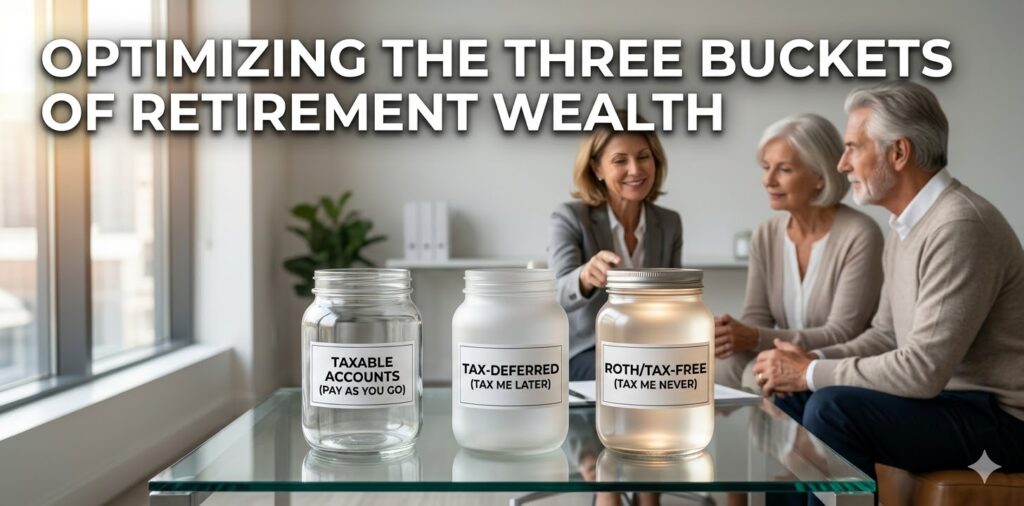
I think about it as if we all have three main financial buckets in life:
| Bucket | Type | When are you taxed? |
| Bucket 1 | Taxable Accounts | Pay as you go |
| Bucket 2 | Tax-Deferred Accounts | Tax later (e.g., traditional IRA) |
| Bucket 3 | Tax-Free Accounts | Tax never (e.g., Roth IRA) |
Let’s look more closely at Bucket 1—the Taxable Account.
The Real Wealth Strategy: Maximizing Your Taxable Accounts
We get that massive step-up in basis in a taxable account, which you do not get in an IRA. If you bought stock for $20 and it’s now worth $100 when you pass away, and your kids inherit it, the cost basis resets to $100. That is a very powerful way to pass money on.
Furthermore, during your lifetime, any “qualified dividends” and long-term capital gains thrown out by those stock investments are taxed currently at a much more efficient rate than your ordinary income tax bracket (the standard seven brackets starting at 10%, 12%, and jumping to 22%).
For many seniors, you are able to get over $100,000 (if married filing jointly) or more in long-term capital gains and qualified dividend income, and legally and easily, pay virtually no tax on that.
The Real IRA Threat vs. The Taxable Opportunity
It is a common story among seniors: you accumulated hundreds of thousands (perhaps even $1 million) over your working life in your S&P 500 funds within an IRA, only to find yourself struggling to navigate Required Minimum Distributions (RMDs).
The power of the taxable bucket is most evident when you compare it directly to a tax-deferred IRA at death:
- IRA Heirs are Forced to Take Distributions (RMDs): Your heirs cannot wait. They must take RMDs immediately based on their own life expectancy (or the account must be fully emptied within 10 years).
- Ordinary Income Taxes (Ouch): Every dollar withdrawn from that traditional IRA is taxed as ordinary income at the heir’s likely-higher tax rate.
- Step-Up Basis Loss: Yes, they get a “step-up basis” on the assets within the IRA for simplicity of calculation, but that is a secondary point. What was lost is the tax benefit. Any future growth of that money in the IRA is still taxed as ordinary income upon withdrawal.
When you use the billionaire strategy, that previous tax obligation is erased, leaving your heirs with zero capital gains tax and no forced distributions if they choose to hold onto the stock. That can be a very powerful thing, especially when combined with a Roth IRA or Roth conversions (Bucket 3).
Finding the Middle Ground: The Practical Strategy for Seniors
While the “borrow until you die” strategy might make sense for billionaires (with $100 million or more) and simplified portfolios with immense appreciation, it may not make sense for the average $2 million portfolio that must support your own retirement lifestyle first and foremost. Debt equals risk, and margin calls can erase decades of disciplined saving.
The solution is not to use high-risk borrowing, but to use Software-Based Financial Planning to optimize your Taxable (Bucket 1) assets alongside your tax-deferred and tax-free accounts.
If you want to plan this stuff out yourself, use professional-grade software designed for everyday retirees like us. The software I like is called Bolden (it used to be called New Retirement). You can sign up for a 2-week free trial right here to test it out. It helps you visualize your “three buckets,” model Roth conversions, calculate the long-term impact of Required Minimum Distributions, and see the value of a taxable account for your heirs. I like Bolden because it’s powerful, it’s easy to use, and it’s affordable for individual retirees.
Another really important decision we all need to make is not just minimizing our tax, but also maximizing our time and enjoyment until we get to retirement. And that’s why I made a special video on that topic: “Eight Things to Stop Doing in Your 50s and 60s in Order to Enjoy Your Journey More.”
🌿 Weekly wellness, health & beauty insights — straight to your inbox
Free subscription · Cancel anytime