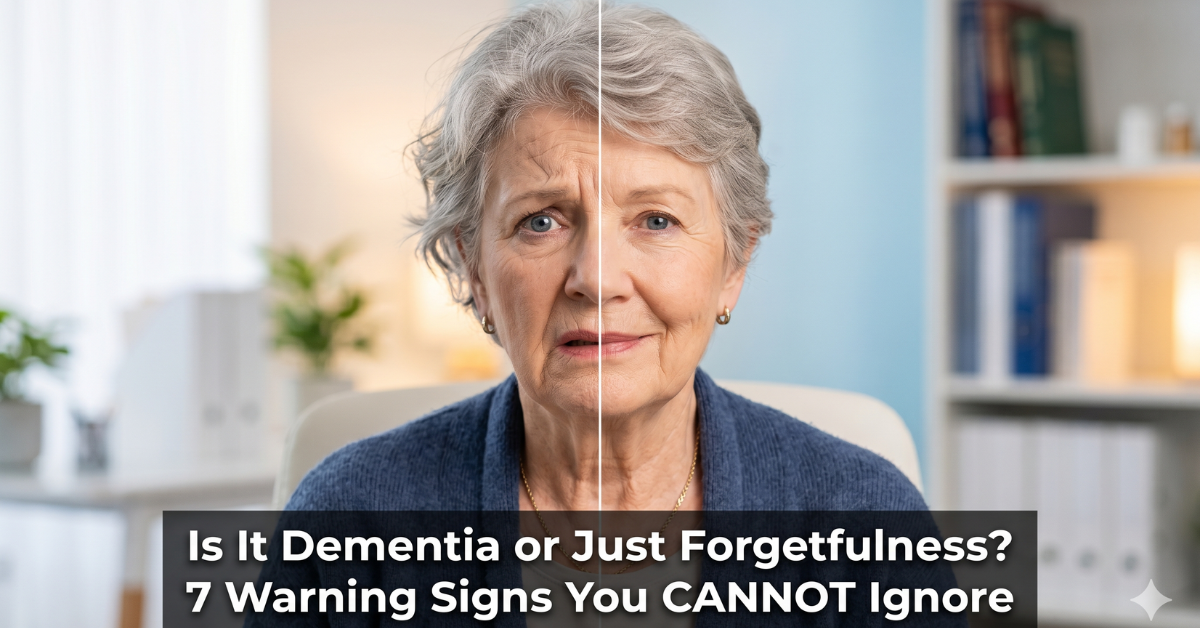
Is It Dementia or Just Forgetfulness?
7 Warning Signs You CANNOT Ignore
By the SeniorJourney Editorial Team | Health & Wellness | 8 min read
You walk into the kitchen — and stop cold. Why did I come in here? You search for your keys for ten minutes, only to find them in your coat pocket. You forget your neighbor’s name, the one you’ve known for fifteen years. Your heart skips a beat. Is this just getting older… or is something more serious happening?
If you’ve asked yourself that question — or quietly worried about a parent, a spouse, or a dear friend — you are not alone. Millions of Americans over 60 wrestle with this fear every single day. And the truth is: the line between normal aging and the early stages of dementia is thinner than most people realize.
The good news? When caught early, dementia’s progression can often be meaningfully slowed. But that window of opportunity only stays open for so long. That’s why knowing — truly knowing — the difference between harmless forgetfulness and genuine warning signs could be one of the most important things you do this year.
In this guide, we’re going to walk through 7 specific warning signs that neurologists and geriatric specialists consistently flag as red flags for early dementia. Some will surprise you. All of them deserve your attention.
First: What’s the Difference Between Normal Aging and Dementia?
Before we dive into the warning signs, let’s clear the air on something crucial. Normal aging does affect your brain. Processing speed slows down. It may take a moment longer to recall a word or a name. You might need to write things down more often than you used to. This is completely expected — and not a cause for alarm.
Dementia, on the other hand, is not a normal part of aging. It is a progressive neurological syndrome — most commonly Alzheimer’s disease — that disrupts daily function, relationships, and independence. The distinction lies not just in what you forget, but how it affects your ability to live your life.
Quick Benchmark: Forgetting where you put your glasses = normal. Forgetting that you wear glasses = a potential warning sign.
⚠️ Warning Sign #1: Forgetting Things You Just Did — Over and Over
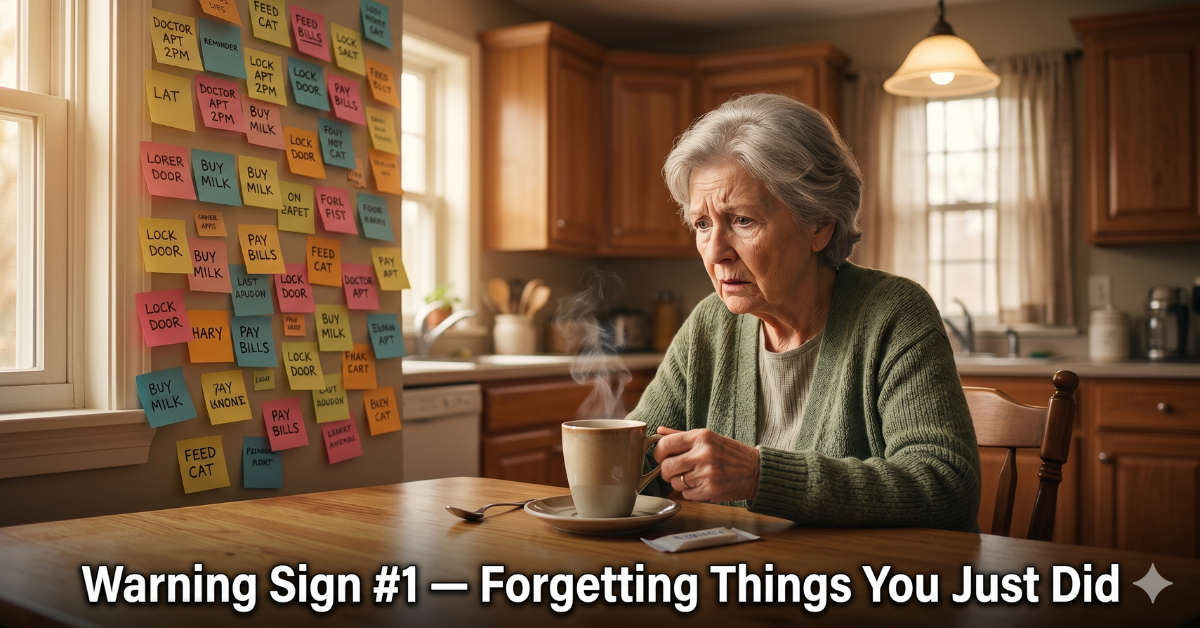
We all occasionally forget what we had for breakfast last Tuesday. That’s normal. What’s not normal is repeatedly forgetting major recent events — a doctor’s appointment you went to yesterday, a conversation you had with your child this morning, or asking the same question three times within an hour.
The hallmark of early Alzheimer’s-type dementia is what neurologists call short-term episodic memory impairment. The brain’s hippocampus — the seat of new memory formation — begins to deteriorate, making it extremely difficult to encode new experiences. Long-term memories (your wedding day, your childhood home) may remain vivid even as recent memories dissolve.
Watch for: Repeatedly asking the same question. Relying heavily on memory aids for things that used to come easily. Forgetting important events shortly after they happen — not days later, but hours later.
Sponsored — Editor’s Pick
🧠 Is Your Brain Getting the Fuel It Needs?
Jarrow Formulas Neuro Optimizer is a clinically formulated blend of 7 brain-supporting nutrients — including Phosphatidylserine, Alpha Lipoic Acid, and CDP Choline — designed to support memory, mental clarity, and long-term cognitive health. Don’t wait until your brain is struggling. Start nourishing it today.
👉 See It on iHerb — Protect Your Memory Now⚠️ Warning Sign #2: Getting Lost in Familiar Places
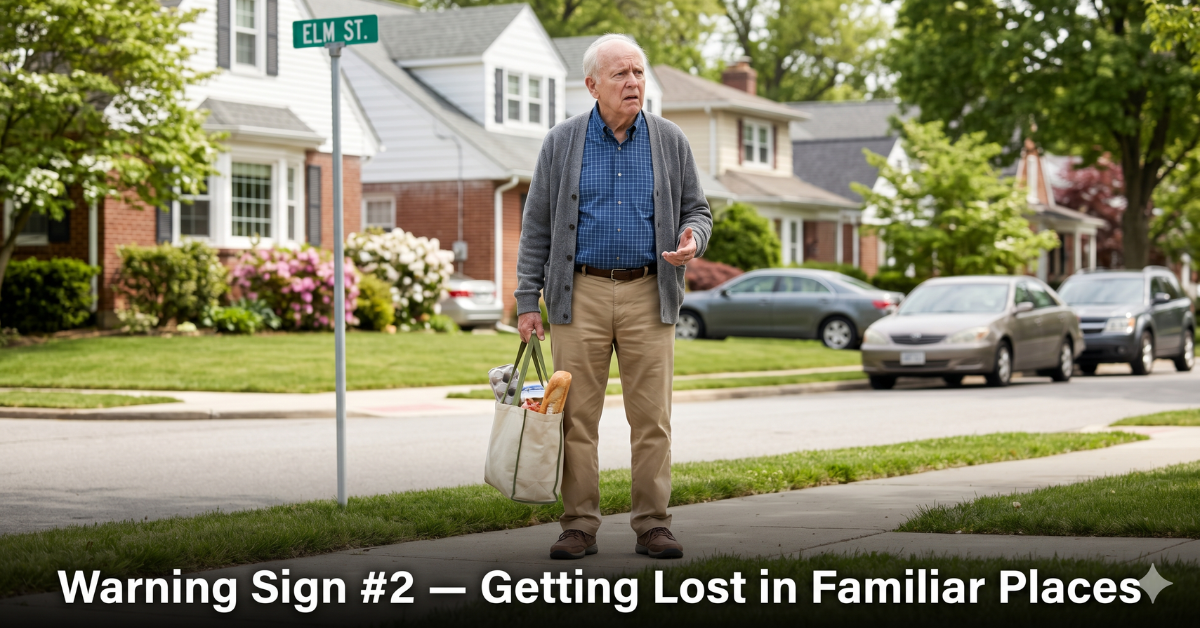
Imagine driving to the grocery store you’ve visited hundreds of times — and suddenly not recognizing where you are. Or walking through your own neighborhood and feeling an unsettling sense of being completely lost. This is one of the most frightening symptoms of early dementia, and one of the most telling.
Spatial disorientation — losing your way in familiar environments — happens because dementia damages the brain’s ability to process and navigate spatial information. The brain’s internal GPS begins to malfunction. What was once automatic becomes bewildering.
Watch for: Getting confused on routes you’ve driven for years. Becoming disoriented in familiar buildings. Needing help navigating places that used to be second nature.
⚠️ Warning Sign #3: Struggling to Find the Right Words

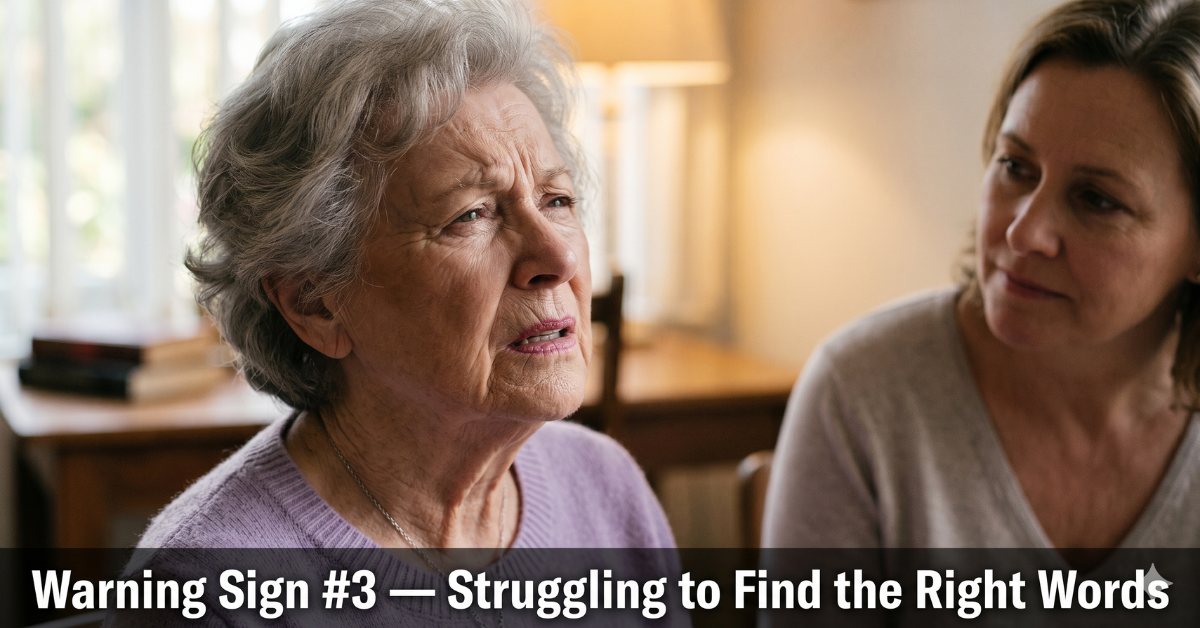
“You know… the thing… the, um… oh, what do you call it?” We’ve all had that moment. But when word-finding difficulties become a constant, daily struggle — pausing mid-sentence, using vague substitute words, losing track of what you were saying entirely — it may signal something more serious.
Aphasia (language impairment) is a documented symptom of early dementia. As neurological damage spreads, the brain’s language centers are disrupted. People with early Alzheimer’s often have difficulty with names of objects and people, struggle to follow or contribute to complex conversations, and may repeat themselves frequently without realizing it.
There’s a meaningful difference between occasionally forgetting a word — which is perfectly normal — and regularly struggling to communicate thoughts that used to flow naturally. The former is age-related. The latter deserves a medical conversation.
Watch for: Frequently stopping mid-sentence. Substituting odd words (calling a “watch” a “hand clock”). Difficulty following conversations. Repeating the same story within the same conversation.
Nature’s Brain Superfood
🍄 Lion’s Mane: The Mushroom Your Brain Has Been Waiting For
Research suggests Lion’s Mane mushroom may stimulate Nerve Growth Factor (NGF), supporting brain cell health and cognitive clarity. California Gold Nutrition’s Organic Lion’s Mane is 100% organic, non-GMO, and third-party tested for purity. Give your neurons the natural support they deserve.
👉 Try Organic Lion’s Mane on iHerb Today⚠️ Warning Sign #4: Poor Judgment and Making Unsafe Decisions
This warning sign is particularly heartbreaking — and particularly dangerous — because it often leaves individuals vulnerable to exploitation before anyone realizes what’s happening. Dementia can quietly erode the brain’s decision-making centers, leading to choices that seem wildly out of character.
Financial vulnerability is often one of the earliest red flags. Seniors with cognitive decline become prime targets for scammers — phone fraud, “grandparent scams,” and sweepstakes schemes. They may give away large sums, send money to strangers, or make impulsive purchases that make no practical sense.
Beyond finances, poor judgment can appear as: leaving the stove on repeatedly, wearing inappropriate clothing for the weather, ignoring personal hygiene in ways they never would before, or failing to recognize dangerous situations.
Watch for: Sudden susceptibility to scams. Neglecting bills or finances that were always well-managed. Dressing strangely for weather conditions. Making decisions that seem completely contrary to their long-held values and personality.
⚠️ Warning Sign #5: Sudden Personality and Mood Changes
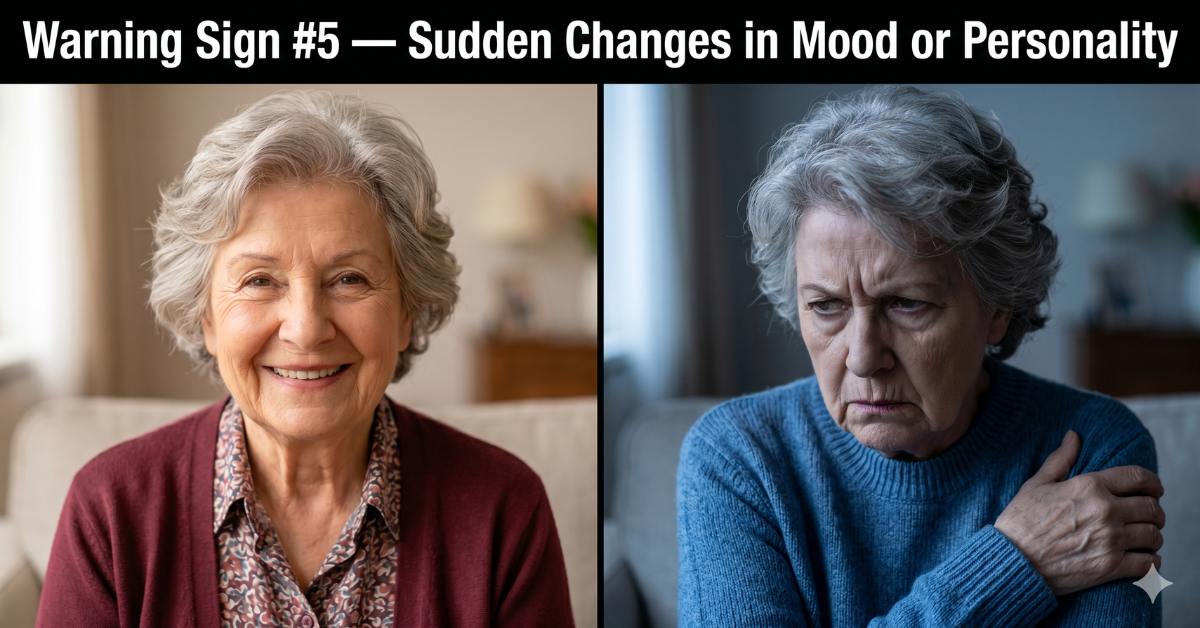
Here’s something few people expect: one of the earliest signs of dementia isn’t always about memory at all. It’s about who the person is becoming. Family members often describe it this way — “My mother is just… different now. She used to be so warm, and now she’s suspicious of everyone.”
Dementia-related personality changes can include a gentle soul suddenly becoming irritable or aggressive, a social butterfly withdrawing completely from friends and activities, or a person of deep integrity becoming uncharacteristically paranoid or suspicious — even of family members they’ve trusted for decades.
Depression and anxiety frequently co-occur with early dementia and can actually precede memory symptoms by years. Researchers believe this may occur because the brain regions responsible for emotional regulation are damaged early in the disease process.
Watch for: Increased anxiety, depression, or paranoia without clear cause. Withdrawal from hobbies and social events they used to love. Unexplained irritability, especially in familiar, comfortable settings. A general flatness or loss of enthusiasm for life.
Support Your Brain Health
🛒 Shop Our Curated Brain & Memory Health Collection
Trusted supplements, brain-healthy products, and wellness essentials — hand-picked for the 55+ community.
🛍️ Browse the Amazon Store →⚠️ Warning Sign #6: Inability to Handle Familiar Everyday Tasks
There’s something quietly devastating about watching someone who spent decades cooking family meals suddenly become unable to follow a simple recipe they’ve made a thousand times. Or seeing a person who managed household finances for 40 years unable to balance a checkbook or pay a bill online.
This warning sign goes beyond forgetting. It’s about procedural breakdown — the inability to execute sequences of steps that were once completely automatic. Activities of Daily Living (ADLs) like cooking, driving, managing medications, or operating household appliances become increasingly challenging.
This happens because dementia disrupts the brain’s ability to plan and sequence actions — a function handled by the prefrontal cortex, which is heavily affected as the disease progresses.
Watch for: Difficulty following familiar recipes. Trouble with previously mastered technology. Struggling with medication schedules. Getting confused or frustrated by tasks that were once effortless.
Essential Brain Nutrition
🐟 Your Brain is 60% Fat — Feed It the Right Kind
Omega-3 fatty acids (DHA and EPA) are among the most researched nutrients for brain health and cognitive function. NOW Foods Omega-3 Fish Oil delivers a high-quality, purified dose in every softgel. Your brain built the world you love — it deserves to be protected.
👉 Get NOW Foods Omega-3 on iHerb⚠️ Warning Sign #7: Losing Track of Time, Dates, and Seasons
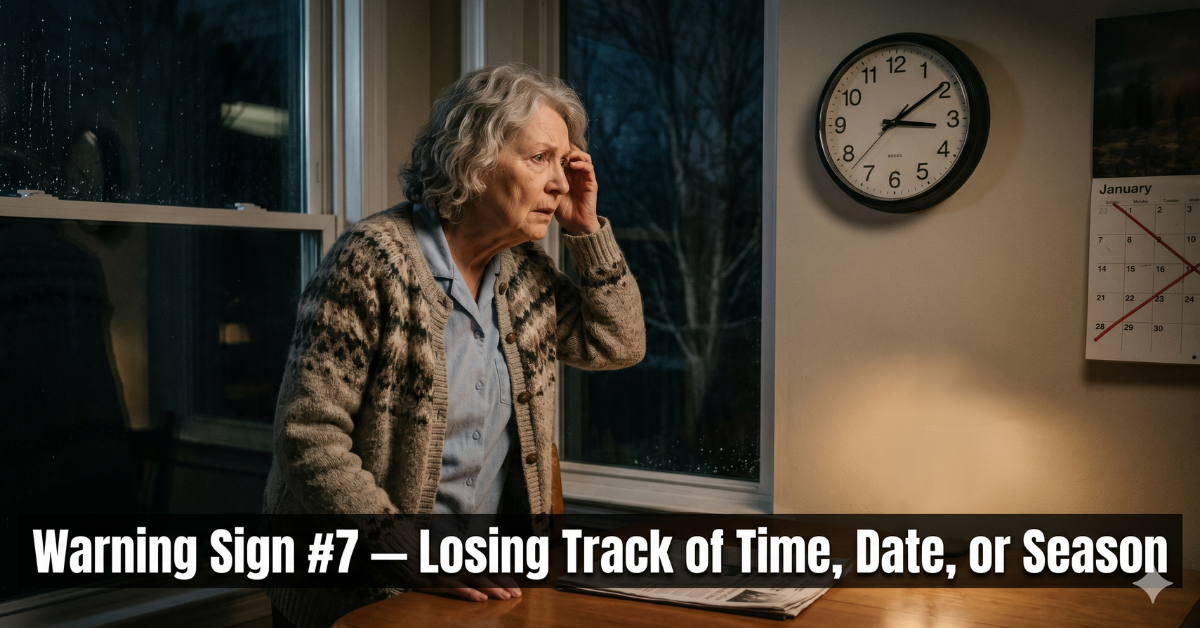
We all occasionally lose track of what day it is — especially after a long holiday weekend. But dementia-related temporal disorientation is something far more profound. It means genuinely not knowing what year it is. Believing it’s a different decade. Waking up and not knowing whether it’s morning or night.
People with early to moderate dementia often become confused about the passage of time in ways that feel deeply unsettling to family members. They may believe a deceased spouse is still alive. They may prepare for a holiday that was months ago. They may think they need to go to a job they retired from 20 years ago.
This symptom also makes individuals vulnerable to nighttime wandering — a dangerous situation that affects a significant percentage of people with Alzheimer’s disease and causes enormous stress for caregivers.
Watch for: Consistent confusion about dates, months, or years. Difficulty understanding the order of events. Getting confused about current seasons. Becoming disoriented when waking, especially at night.
✅ Your Action Plan: What to Do If You See These Signs
Step 1: Document What You’re Observing
Before any medical appointment, keep a simple journal — even just notes on your phone — of specific incidents. Write down the date, what happened, and how often it’s occurring. Doctors need concrete examples, not vague impressions. The more specific you are, the more actionable the conversation becomes.
Step 2: Schedule a Cognitive Evaluation — Don’t Wait
Make an appointment with a primary care physician and ask specifically about a cognitive screening. Tools like the MMSE (Mini-Mental State Examination) or the MoCA (Montreal Cognitive Assessment) can provide important baseline information. If your primary care doctor has concerns, they can refer you to a neurologist or geriatric specialist. Early intervention matters enormously.
Step 3: Address Brain-Health Foundations Now
While waiting for appointments, focus on the lifestyle factors that research consistently links to brain health: regular aerobic exercise (even walking 30 minutes a day makes a measurable difference), quality sleep, social engagement, mental stimulation, and a diet rich in omega-3 fatty acids, antioxidants, and anti-inflammatory foods. These aren’t cures — but they are protective.
Step 4: Have the Conversation With Family
If your concern is about a loved one, approach the conversation with compassion and without accusation. Use “I noticed” statements rather than “you always” language. Offer to accompany them to a doctor’s appointment. Many people resist because they’re frightened — what they need most is to know they won’t face this alone.
Immune + Brain Support
🍊 Inflammation Is the Enemy — Fight Back With Vitamin C
Chronic inflammation is increasingly linked to accelerated cognitive decline. California Gold Nutrition’s Gold C delivers USP-grade Vitamin C — 1,000mg per capsule — to support immune health, reduce oxidative stress, and help protect your brain’s long-term vitality. 240 capsules. Unbeatable value. No compromises.
👉 Get USP Grade Vitamin C on iHerbCellular Energy for Your Brain
⚡ Your Brain Runs on Energy — Don’t Let It Run Low
CoQ10 powers your mitochondria — the energy factories in every brain cell. PQQ supports the growth of new mitochondria, making this combination uniquely powerful for cognitive vitality. California Gold Nutrition’s CoQ10 + PQQ formula is precisely dosed, third-party verified, and softgel for superior absorption. Your energy-starved brain cells will thank you.
👉 Try CoQ10 + PQQ on iHerb TodayThe Bigger Picture: Why Early Detection Changes Everything
Here is the hard truth that deserves to be said plainly: there is currently no cure for Alzheimer’s disease or most forms of dementia. But early detection is not without profound meaning. It is not simply about preparing for what’s coming — though that matters enormously for families. It is about gaining time.
Early-stage interventions — both pharmaceutical and lifestyle-based — have shown the strongest evidence of slowing progression. People diagnosed in the earliest stages are able to participate meaningfully in their own care planning, legal and financial decisions, and conversations with family about their wishes. They retain agency for longer. That is not a small thing. That is everything.
Emerging research in the field of Alzheimer’s prevention — particularly the work coming out of the FINGER trial and similar multimodal interventions — increasingly supports the idea that aggressive lifestyle modification in the early stages can meaningfully impact the trajectory of cognitive decline. The time to act is not when symptoms are severe. It is now.
If you’ve read this far, something in this article spoke to you. Trust that instinct. A concern noticed and addressed today is worth infinitely more than the same concern dismissed and delayed.
📺 Want More Guidance Like This?
We go deeper on brain health, senior wellness, and real talk about aging on the SeoulcastUSA YouTube channel. From expert interviews to practical daily tips, it’s the resource we wish existed when we needed it most. Come join our community.
▶️ Subscribe to SeoulcastUSA on YouTubeHealth Disclaimer: The information provided in this article is for general educational purposes only and is not intended as medical advice. It should not be used to diagnose, treat, cure, or prevent any disease or health condition. Always consult a qualified healthcare professional — including your primary care physician or a board-certified neurologist — before making any health-related decisions. Supplement advertisements included in this post represent sponsored content; individual results may vary.
💡 Frequently Asked Questions (FAQ)
Q: At what age does dementia typically begin to develop?
Most cases of Alzheimer’s disease — the most common form of dementia — are diagnosed in people 65 and older. However, early-onset Alzheimer’s can affect people in their 40s and 50s, though this is far less common. Age is the single greatest risk factor, with the likelihood roughly doubling every five years after age 65.
Q: Can dementia be prevented entirely?
Currently, there is no guaranteed way to prevent dementia. However, a substantial body of research supports that certain lifestyle habits — regular physical exercise, quality sleep, a Mediterranean-style diet, mental stimulation, and strong social connections — are associated with significantly lower risk and slower progression of cognitive decline.
Q: How is dementia officially diagnosed?
Diagnosis typically involves a combination of cognitive assessments (such as the MMSE or MoCA), medical history review, neurological examination, blood tests to rule out reversible causes (thyroid issues, vitamin deficiencies), and brain imaging (MRI or CT scan) to assess structural changes. A neurologist or geriatric specialist can provide the most thorough evaluation.
Q: Are there supplements that actually help brain health?
Several supplements have emerging scientific support for cognitive health, including Omega-3 fatty acids (DHA/EPA), Lion’s Mane mushroom, CoQ10, Phosphatidylserine, and antioxidants like Vitamin C and E. These are not treatments for diagnosed dementia, but may support overall brain health when taken as part of a healthy lifestyle. Always consult your doctor before adding supplements, particularly if you take prescription medications.
Q: If I’m worried about a loved one, how do I bring it up without causing conflict?
Choose a calm, private moment. Use “I noticed” rather than “you always” language. Express concern from a place of love, not frustration. Offer to come to a doctor’s appointment together. Avoid confrontational framing — many people deny symptoms out of fear, not stubbornness. Patience, consistency, and empathy are the most powerful tools you have.
Recommended Tags:
dementia warning signs, early dementia symptoms, memory loss in seniors, alzheimer’s early signs, forgetfulness vs dementia
🌿 Weekly wellness, health & beauty insights — straight to your inbox
Free subscription · Cancel anytime