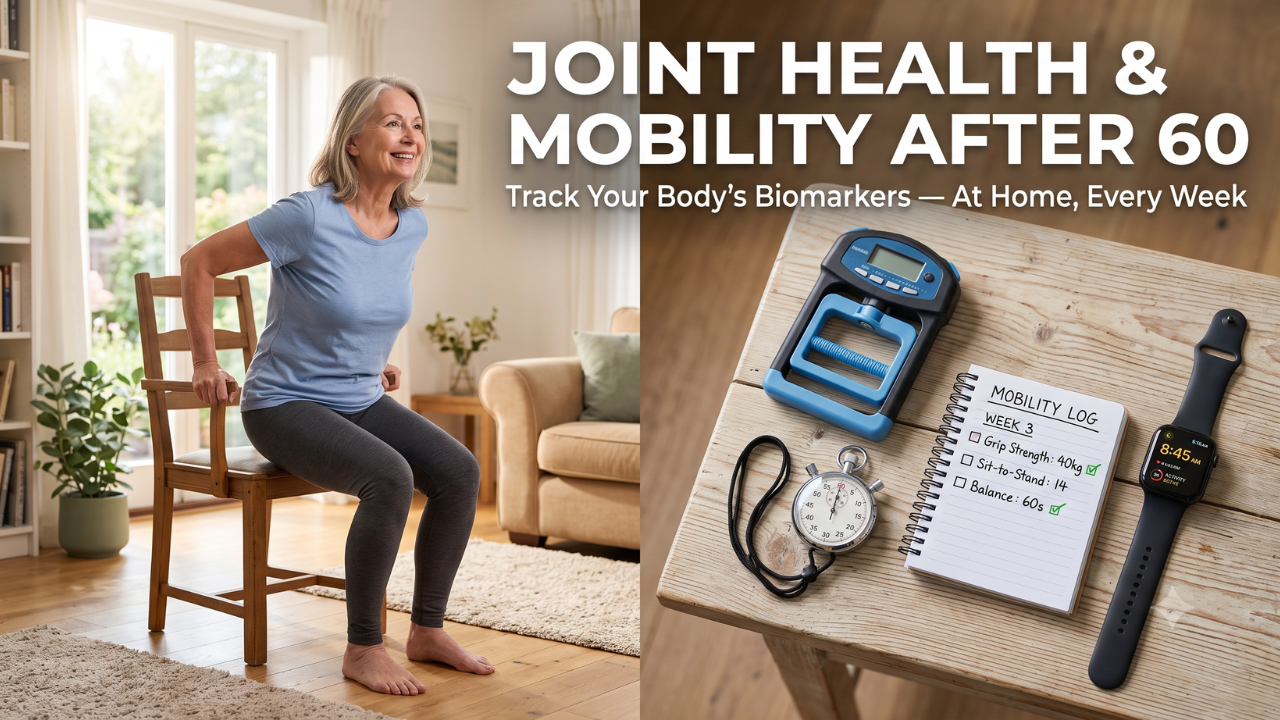
Joint Health & Mobility After 60: 5 Home Biomarkers You Can Track This Week
By the SeniorJourney Wellness Team | Health & Longevity
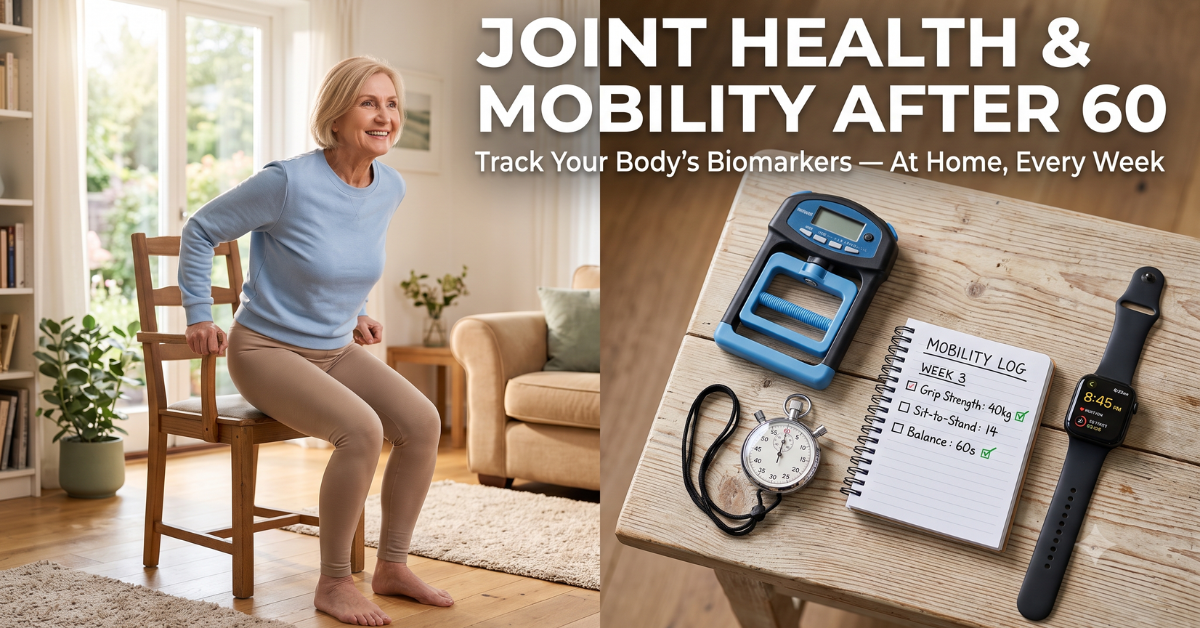
There is a particular kind of quiet worry that tends to arrive somewhere in our sixties. It is not dramatic. It shows up when a jar lid feels a little tighter than it used to, or when getting up from the couch requires a small pause before the second push. Most of us brush it off. We tell ourselves it is just a Tuesday, just a long week, just getting older.
But here is something worth sitting with: your joints and your muscles are constantly sending you data. The tightness in your knee, the hesitation in your grip, the extra half-second it takes to stand — these are not random inconveniences. They are measurable signals, and increasingly, researchers and geriatric specialists agree that tracking them at home, consistently, may be one of the simplest and most powerful things you can do for your long-term independence.
This guide walks through why joint health and mobility deserve real attention after 60, and introduces five simple biomarkers you can measure in your own living room — no clinic visit, no expensive equipment, just a bit of intention and about fifteen minutes a week.
Why Joint Mobility Matters More Than You Think
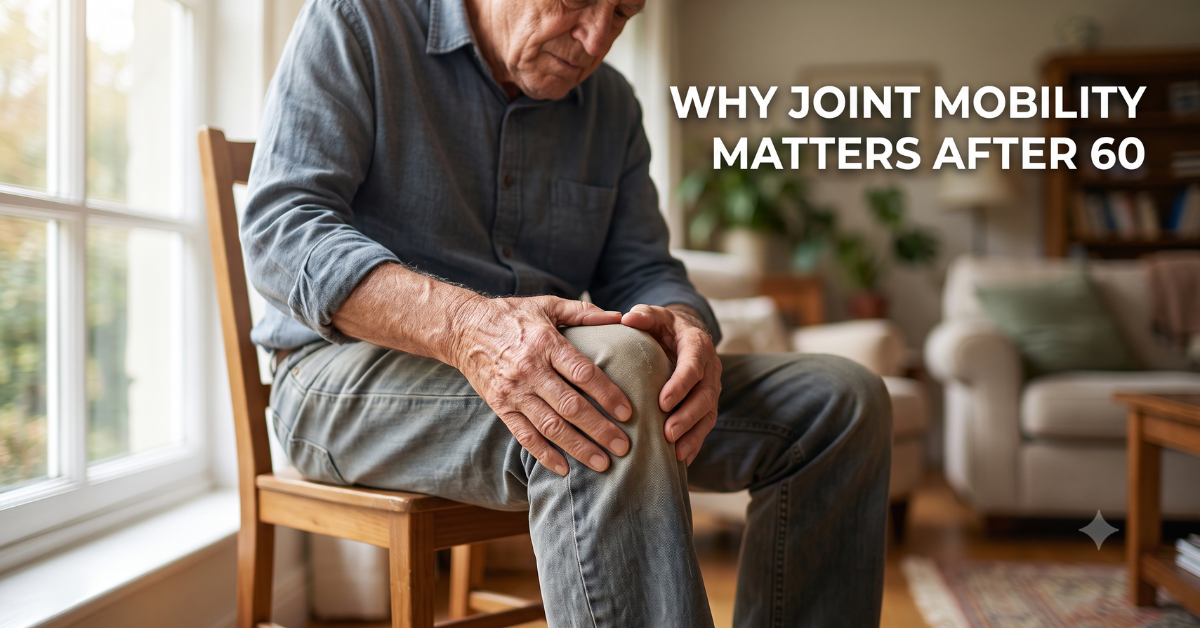
Mobility is not just about walking without pain. It is the quiet foundation underneath almost everything you value about independence — cooking your own meals, traveling to see grandchildren, gardening on a Saturday morning, or simply getting dressed without assistance.
As we move into our sixties and seventies, three things tend to happen gradually and often without much notice. Muscle mass declines, a process researchers call sarcopenia. Joint cartilage naturally thins, particularly in weight-bearing joints like the knees and hips. And balance systems, which rely on a delicate coordination between your inner ear, eyes, and leg muscles, become slightly less reliable.
None of this is cause for alarm. It is simply biology. But the encouraging part — and this is really the heart of this article — is that all three of these processes respond remarkably well to early awareness and consistent, gentle intervention. The people who maintain the most independence into their eighties and nineties are rarely the ones who never experienced any decline. They are the ones who noticed small changes early and adjusted their habits accordingly.
That is exactly what home biomarker tracking allows you to do.
What Is a “Home Biomarker,” Exactly?
In a clinical setting, a biomarker is simply a measurable indicator of what is happening inside your body. Blood pressure is a biomarker. Blood sugar is a biomarker. And as it turns out, several of the most meaningful predictors of healthy aging can be measured with nothing more than a chair, a stopwatch, and a few minutes of attention.
Geriatric researchers have increasingly pointed to functional biomarkers — grip strength, walking speed, the ability to rise from a chair — as being just as predictive of long-term health outcomes as many lab values. The advantage for you is obvious: you do not need a referral, a co-pay, or a waiting room. You need about fifteen minutes on a Sunday afternoon.
Below are the five biomarkers we recommend tracking weekly, along with simple at-home methods for each one.
Biomarker #1: Grip Strength
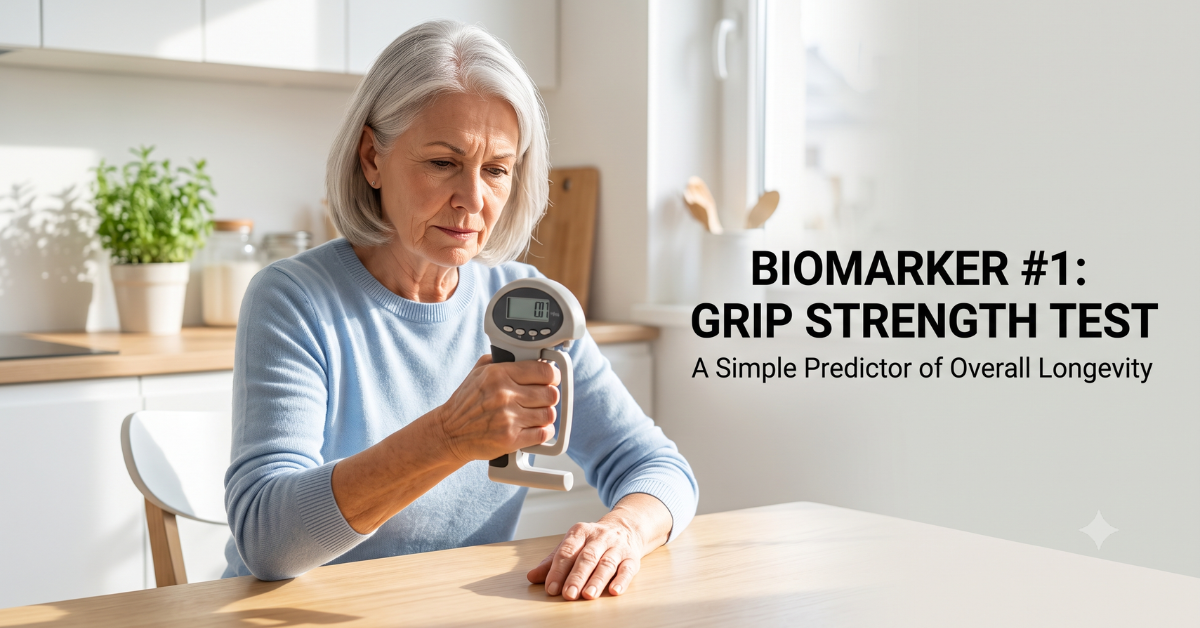
If you could only track one number for the rest of your life, many longevity researchers would point you toward grip strength. It sounds almost too simple to matter, yet study after study has linked hand grip strength to overall muscle health, cardiovascular resilience, and even cognitive function in later life. Your hands, in a sense, are a window into your whole body’s strength reserve.
Measuring it at home is genuinely easy with a small digital hand dynamometer. You simply squeeze the handle as hard as comfortably possible, and the device displays your grip force. Testing once a week, always in the same seated position with your elbow at a 90-degree angle, gives you a consistent trend line over time rather than a single noisy data point.
🖐️ Try this at home: A compact digital hand grip tester with an adjustable handle and backlit display makes weekly tracking simple and consistent — no clinic visit required. View on Amazon →
Biomarker #2: Walking Speed (Gait Test)
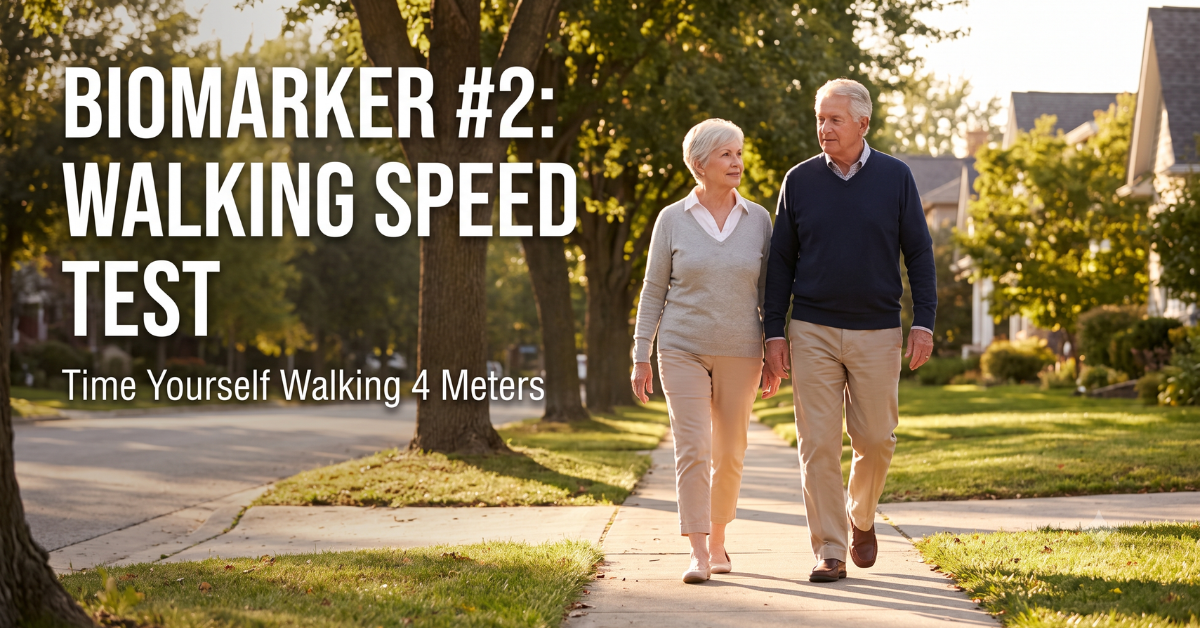
Walking speed has earned a nickname among researchers: the “sixth vital sign.” It is that reliable as a predictor of health outcomes. The test itself could not be simpler. Mark a flat, clear stretch of hallway or sidewalk exactly four meters long — roughly thirteen feet. Starting from a standing position, walk the distance at your normal, comfortable pace while a family member times you, or use your phone’s stopwatch if you are testing alone.
Generally speaking, a pace above roughly 0.8 meters per second is associated with strong functional independence, while a noticeably slower pace over several months is worth mentioning to your physician — not as a cause for worry, but as useful information for a broader conversation about your overall health picture.
🛍️ Curated Wellness Picks for Active Aging
Explore our hand-picked Amazon collection of home mobility and wellness tools, chosen specifically with seniors in mind.
Browse the SeniorJourney Amazon Shop →Biomarker #3: The Sit-to-Stand Test
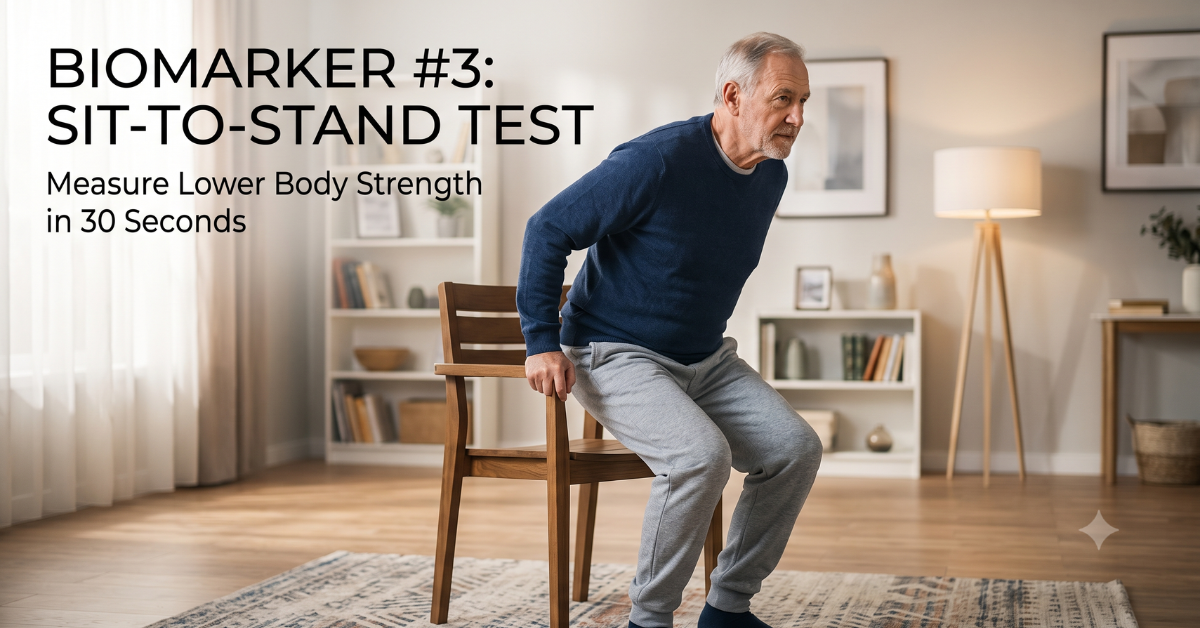
This test measures lower body strength, which happens to be one of the most important factors in fall prevention. Using a sturdy, armless chair, sit with your arms crossed over your chest, then stand up fully and sit back down again as many times as you comfortably can within thirty seconds.
There is no need to push through discomfort or turn this into a competition with yourself. The point of the test is simply to establish your own personal baseline, then watch how that number gently improves — or stays steady — over the following weeks as you incorporate light strength work into your routine.
💪 Supportive tools for this test: A resistance band set with varying tension levels is a gentle, joint-friendly way to build the leg and hip strength that makes the sit-to-stand movement easier over time. View on Amazon →
Biomarker #4: The Single-Leg Balance Test
Balance quietly underpins almost every daily movement, from stepping off a curb to reaching for something on a high shelf. To test it safely, stand near a countertop or sturdy chair for support, then lift one foot slightly off the ground and see how many seconds you can hold that position without needing to grab hold of anything.
Do not worry if the number feels low at first. Balance is one of the most trainable functions in the human body at any age, and simply practicing this test a few times a week tends to improve the underlying skill on its own, even before you add any formal balance exercises.
⌚ Track it consistently: A senior-friendly smartwatch with fall detection and gait monitoring can quietly log your walking steadiness in the background between your weekly manual tests. View on Amazon →
Biomarker #5: Shoulder & Hip Flexibility
The last biomarker is less about a number and more about a feeling — but it can still be tracked meaningfully. Reach one arm overhead and behind your back, and the opposite arm up from below, trying to touch your fingertips between your shoulder blades. Note roughly how close your fingers come, in inches, and repeat on the other side.
For hips, a simple seated forward reach while sitting on the edge of a chair, legs extended, gives you a comparable sense of your lower body flexibility over time. Neither test needs to be perfect. The goal is simply a consistent, gentle check-in with your own range of motion, tracked in the same notebook alongside your other four numbers.
🛍️ More Wellness Essentials for Everyday Comfort
From joint-friendly stretching aids to home comfort essentials, our curated shop is built around what actually helps daily life after 60.
Browse the SeniorJourney Amazon Shop →Your Weekly Action Plan: A Step-by-Step Guide
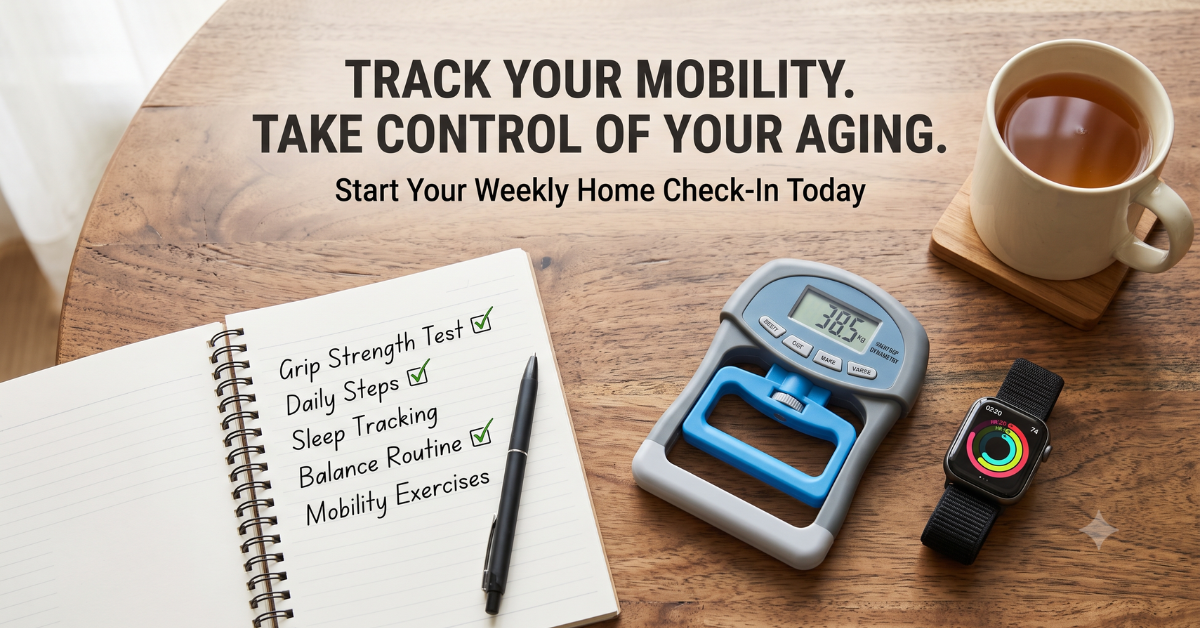
Knowing the five biomarkers is one thing. Actually building them into your week is another. Here is a simple, three-step framework we recommend to readers who are just getting started.
Step 1: Choose one consistent day and time. Sunday mornings work well for many people, right after breakfast, before the day gets busy. Consistency matters far more than perfection. Testing at the same time, in the same order, removes a lot of the natural variation in your results.
Step 2: Keep a simple paper log. Resist the urge to overthink this. A plain notebook with five columns — one for each biomarker — is more than enough. Write the date, then your grip strength number, your walking time, your sit-to-stand count, your balance seconds, and a rough note on flexibility. Over eight to twelve weeks, patterns will start to speak for themselves.
Step 3: Share the trend, not just a single number, with your doctor. A single low reading rarely means much on its own. But a gentle downward trend across several weeks is genuinely useful information for your physician, and can help guide conversations about physical therapy, strength training, or other supportive next steps long before a fall or injury forces the issue.
A small bundle-style home therapy kit — combining a grip trainer, finger extension tool, and stress ball for warm-up — can be a comfortable way to build these habits into a relaxed weekly routine rather than something that feels clinical or intimidating. View this home therapy kit on Amazon →
A Gentle Reminder About What This Really Means
It is worth saying plainly: none of this is about chasing perfect numbers or comparing yourself to anyone else, including your younger self. The purpose of home biomarker tracking is simply awareness — catching small shifts early enough that a short walk, a few resistance band sessions, or a conversation with your doctor can make a meaningful difference before a bigger problem develops.
Independence in your seventies, eighties, and beyond is rarely the result of one dramatic decision. It tends to be built quietly, week by week, through small consistent habits like the ones described in this guide. You are, in a very real sense, the best-positioned person to notice changes in your own body early — you simply need a simple system for paying attention.
We hope this guide gives you a warm, practical starting point for taking care of the body that has carried you this far. If you would like to see these five tests demonstrated step by step, along with more real-life guides on healthy aging, we would love to have you visit our SeoulcastUSA YouTube channel, where we walk through routines like these together, one video at a time.
💡 Frequently Asked Questions
Q1. Is it safe for someone with arthritis to try the sit-to-stand or grip strength tests at home?
Generally, yes, as these are low-impact, gentle assessments rather than intense exercises. However, anyone with diagnosed arthritis, joint replacements, or significant pain should check with their doctor or physical therapist before starting, and should stop immediately if any test causes sharp pain.
Q2. How often should I actually re-test these five biomarkers?
Once a week is ideal for most people. Testing more frequently often just adds noise from day-to-day fatigue or soreness, while testing less than once a month makes it harder to catch meaningful trends early.
Q3. What should I do if I notice a biomarker getting worse over several weeks?
Avoid panicking over a single data point, but do bring a few weeks of consistent readings to your next doctor’s visit. A clear trend, even a gentle one, gives your physician far more useful information than a one-time complaint of feeling “a bit weaker lately.”
Q4. Do I need expensive equipment to track these biomarkers accurately?
Not at all. A basic digital hand grip tester, a stopwatch or smartphone, a sturdy chair, and a simple notebook are enough to get meaningful, consistent results for all five tests described in this guide.
🌿 Weekly wellness, health & beauty insights — straight to your inbox
Free subscription · Cancel anytime