Health Disclaimer: This article is for informational purposes only and is not medical advice. Please talk with your doctor before starting a new exercise routine, especially if you have had a recent fall, dizziness, joint surgery, or a heart condition.
Affiliate Disclosure: This post contains sponsored and affiliate links. If you click and make a purchase, SeniorJourneyBlog.com may earn a small commission at no extra cost to you. We only share resources we believe may be useful to our readers.
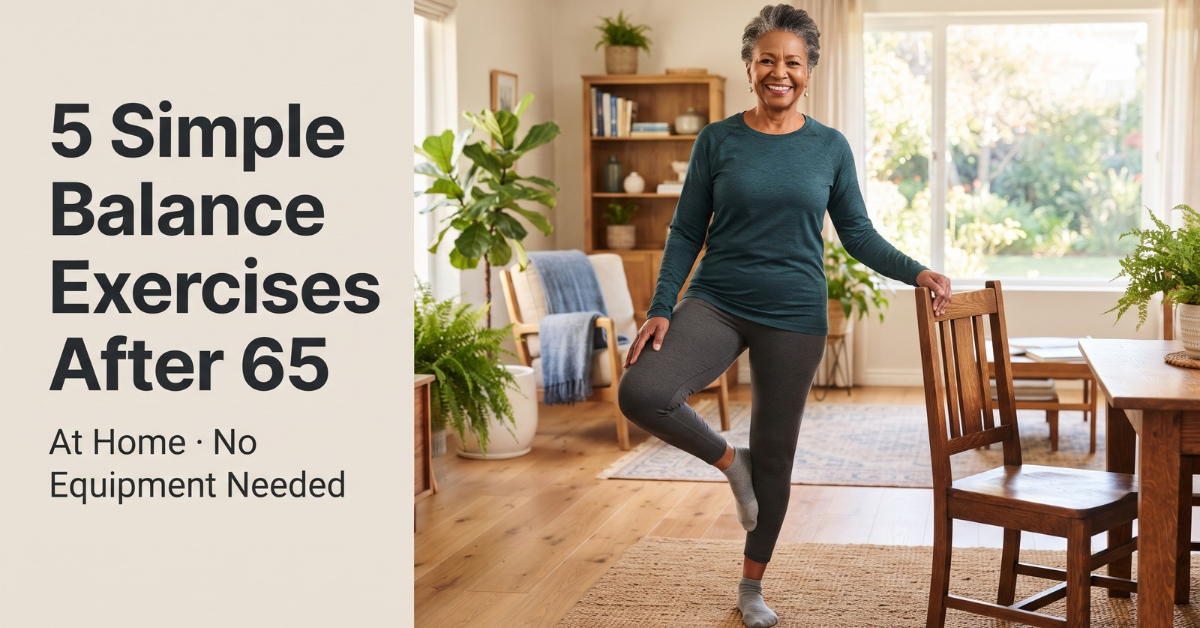
Balance exercises after 65 are one of the simplest, most powerful things you can do to keep living life on your own terms — and you can start today, in your own kitchen, with nothing but a sturdy chair.
Living in California, I see it all the time: friends in their late sixties and seventies who still garden, babysit grandkids, and walk to the farmers market every Saturday. When I ask what they do to stay so steady, the answer is rarely “I go to the gym.” It’s usually something much smaller. A few minutes of standing on one foot while the coffee brews. A habit of rising from a chair without using their hands.
That’s what this guide is about. No fancy equipment. No complicated routines. Just five simple, research-supported moves you can do at home, plus a four-week plan to help you build the habit and feel more confident on your feet.
🌿 Weekly wellness, health & beauty insights — straight to your inbox
Free subscription · Cancel anytime
In this guide, you’ll learn:
- Why balance changes as we age — and why that’s not the end of the story
- A quick safety checklist before you begin
- 5 simple balance exercises, each with an easier and harder version
- A step-by-step 4-week action plan
- Everyday home habits that support steadier movement

Why Balance Exercises After 65 Matter More Than You Think
Balance isn’t just one skill. It’s a team effort between your eyes, your inner ear, the nerves in your feet, your muscles, and your brain. As the years go by, each member of that team can slow down a little. Your vision may change. Your leg muscles may lose some strength. The signals from your feet may get a bit quieter.
None of these changes alone means you will fall. But together, they can make everyday moments — stepping off a curb, turning quickly in the kitchen, getting up at night — feel less certain.
What the Numbers Say
Here’s what the Centers for Disease Control and Prevention (CDC) reports, as of October 2026:
- More than 14 million adults 65 and older — about 1 in 4 — report falling each year.
- Falls are the leading cause of injury for adults 65 and older.
- About 37% of people who fall report an injury that needed medical care or limited their activity for at least a day.
- The age-adjusted fall death rate for older adults has risen by about 21% since 2018.
- According to a CDC fact sheet, fewer than half of older adults who fall tell their doctor about it.
Those numbers can feel heavy. But the CDC is clear on one more point: falls are common, but they are not an inevitable part of aging. Many are preventable.
The Good News: Your Balance Can Improve
A large Cochrane review — one of the most trusted types of research summaries — looked at 108 studies with more than 23,000 older adults living at home. The researchers found that exercise reduced the rate of falls by about 23%. The strongest evidence was for programs built mainly around balance and functional exercises — movements that look a lot like everyday life, such as standing up from a chair or shifting your weight from one leg to the other.
That’s exactly what the five moves below are. They train the small, practical skills you use dozens of times a day. And the more you practice them, the more automatic — and confident — those everyday moments become.
Before You Start: A 2-Minute Safety Checklist
A few minutes of preparation makes every session safer. Run through this list before your first workout:
☑ Talk to your doctor first if you’ve fallen recently, feel dizzy often, or have had hip, knee, or back surgery.
☑ Pick a sturdy chair without wheels. A heavy dining chair or a kitchen counter works well.
☑ Clear the space — no throw rugs, cords, or pets underfoot.
☑ Wear supportive shoes or go barefoot on a non-slip floor. Skip loose slippers and smooth socks.
☑ Keep a phone nearby, especially if you live alone.
☑ Move slowly. Balance work is about control, not speed.
Stop right away and call 911 if you feel chest pain or pressure, sudden shortness of breath, sudden weakness or numbness on one side of the body, face drooping, trouble speaking, or a sudden severe headache. These can be signs of a heart attack or stroke.
Find Your Starting Level
Every exercise below can be done at four levels of support. Start where you feel completely safe, and move up only when your current level feels easy for a full week.
| Level | Support | Good for |
|---|---|---|
| 1 | Two hands on the chair | Brand-new beginners, or after a recent fall |
| 2 | One hand on the chair | Most people starting out |
| 3 | One fingertip on the chair | After 2–3 steady weeks |
| 4 | Hand hovering just above the chair | When Level 3 feels easy and controlled |
The 5 Simple Balance Exercises You Can Do at Home
Do these in order. The whole routine takes about 10 to 15 minutes. Breathe normally throughout — holding your breath makes balance harder, not easier.
Move 1: Chair Stand (Sit-to-Stand)
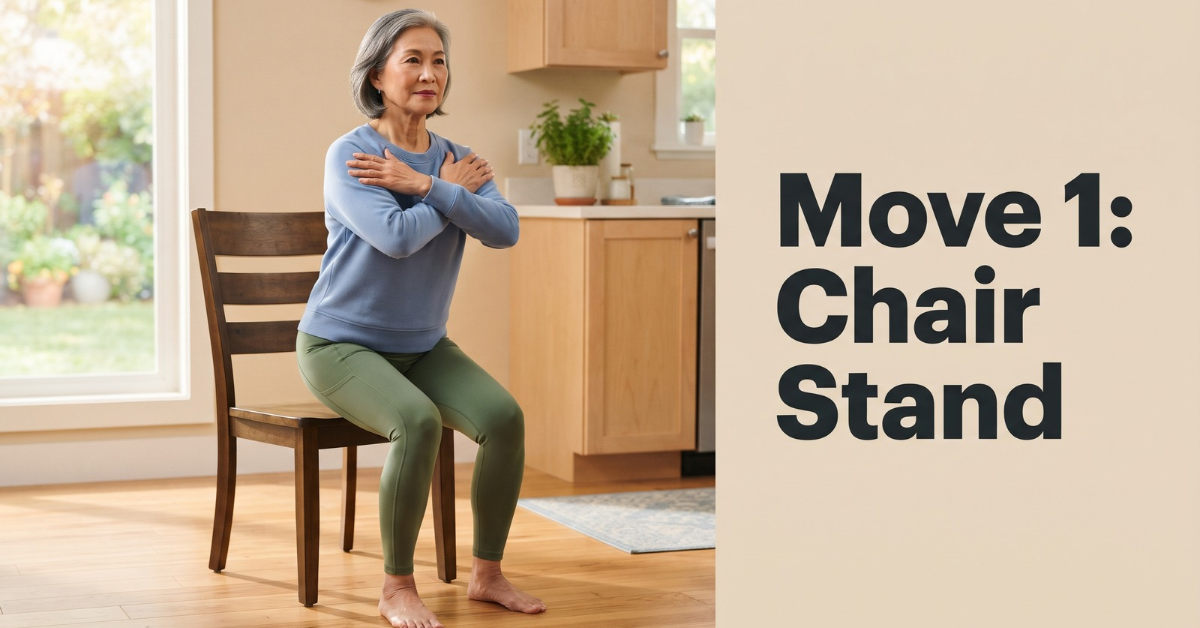
Why it helps: Getting up from a chair, a car seat, or a toilet is one of the most common daily movements — and one of the most common moments for a wobble. This move builds strength in your thighs and hips, the muscles that power you up and catch you when you lean too far.
How to do it:
- Sit near the front edge of a sturdy chair, feet flat and hip-width apart.
- Cross your arms over your chest (or rest your hands on your thighs).
- Lean slightly forward, “nose over toes,” and press through your heels to stand all the way up.
- Pause for a breath. Then slowly sit back down, counting to three as you lower.
Reps: 8–10 times, 1–2 sets, with a short rest in between.
Easier: Push off the armrests or your thighs with your hands.
Harder: Take 5 slow seconds to sit down.
Common mistake: “Plopping” into the chair. The slow lowering is where most of the strength is built.
Move 2: Single-Leg Stand
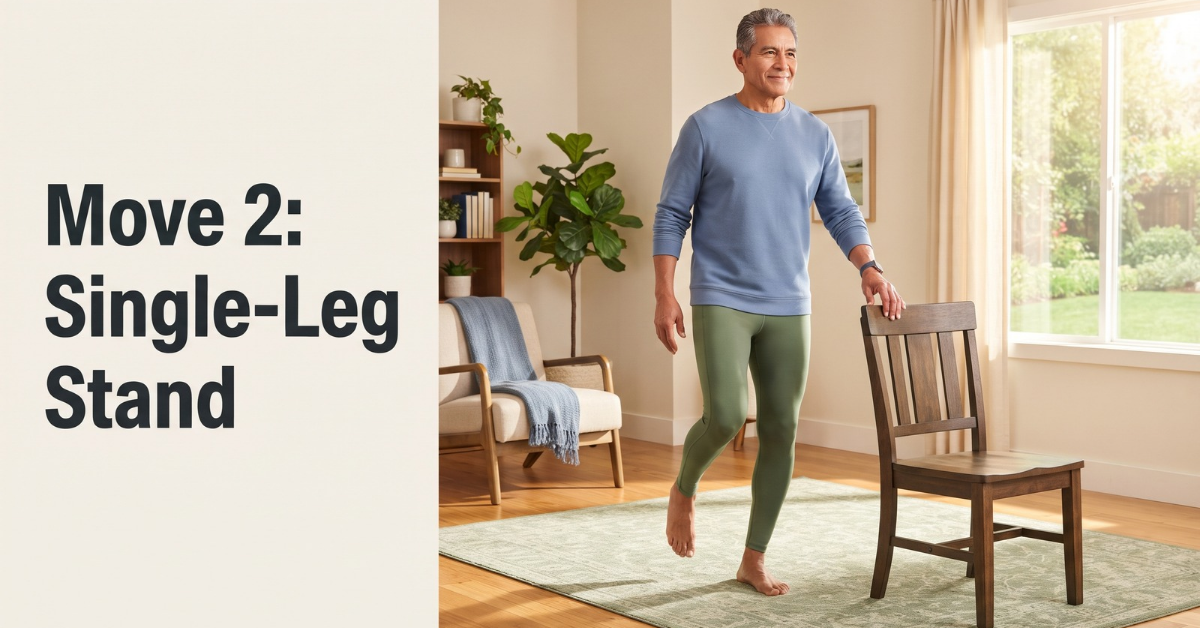
Why it helps: Every step you take is a split second on one leg. Climbing stairs, stepping into the tub, and putting on pants all ask your body to balance on one foot. This move trains exactly that.
How to do it:
- Stand behind your chair, holding the back at your chosen support level.
- Shift your weight onto your left foot.
- Slowly lift your right foot a few inches off the floor.
- Hold for up to 10 seconds, then lower and switch sides.
Reps: 3–5 holds on each side.
Easier: Just lift your heel, keeping your toes on the floor.
Harder: Work up to 30 seconds, or slowly turn your head left and right while balancing.
Common mistake: Locking the standing knee. Keep it soft — straight, but not jammed back.
Habit tip: Mayo Clinic suggests practicing one-leg balance during everyday moments — like while brushing your teeth — with a counter close by for support. Two minutes a day adds up fast.
One more thing worth knowing: balance is a whole-body skill, and that includes rest. When you’re tired, reaction time slows and small wobbles are harder to catch. A good night’s sleep is part of your balance routine, too.
Sponsored Resource
Looking for Support With Better Sleep?
If restless nights leave you feeling foggy in the morning, this sleep and wellness resource shares ideas some readers find helpful. Check with your doctor before trying any new sleep product.
Learn More About Sleep SupportMove 3: Heel-to-Toe Walk
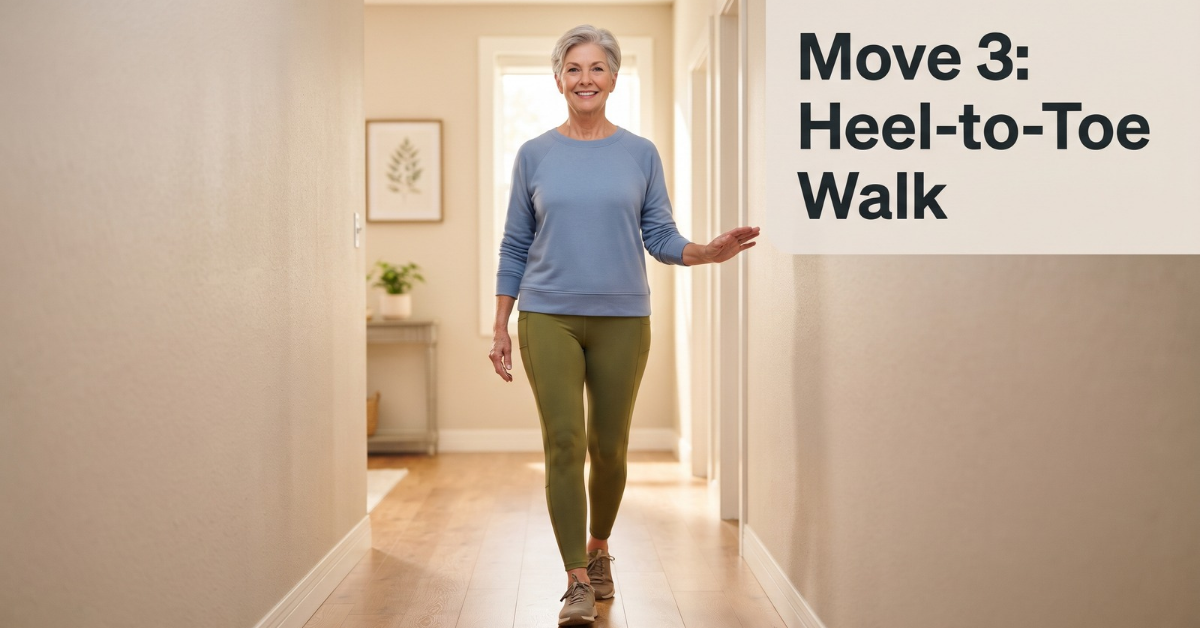
Why it helps: Walking in a narrow line challenges your side-to-side stability — the kind you need on a crowded sidewalk, a narrow hallway, or an uneven garden path. It’s sometimes called a “tandem walk,” and it’s a classic move in fall-prevention programs.
How to do it:
- Stand next to a wall or kitchen counter so you can reach it at any time.
- Place your right heel directly in front of your left toes, so they touch or nearly touch.
- Now place your left heel directly in front of your right toes.
- Keep your eyes on a spot straight ahead — not on your feet — and continue for 10–20 steps.
Reps: 2–3 lengths of your hallway or counter.
Easier: Leave a small gap between heel and toe.
Harder: Walk more slowly, pausing for one second on each step.
Common mistake: Looking down. Your eyes are a big part of your balance system — keep them up and forward.
Move 4: Heel and Toe Raises
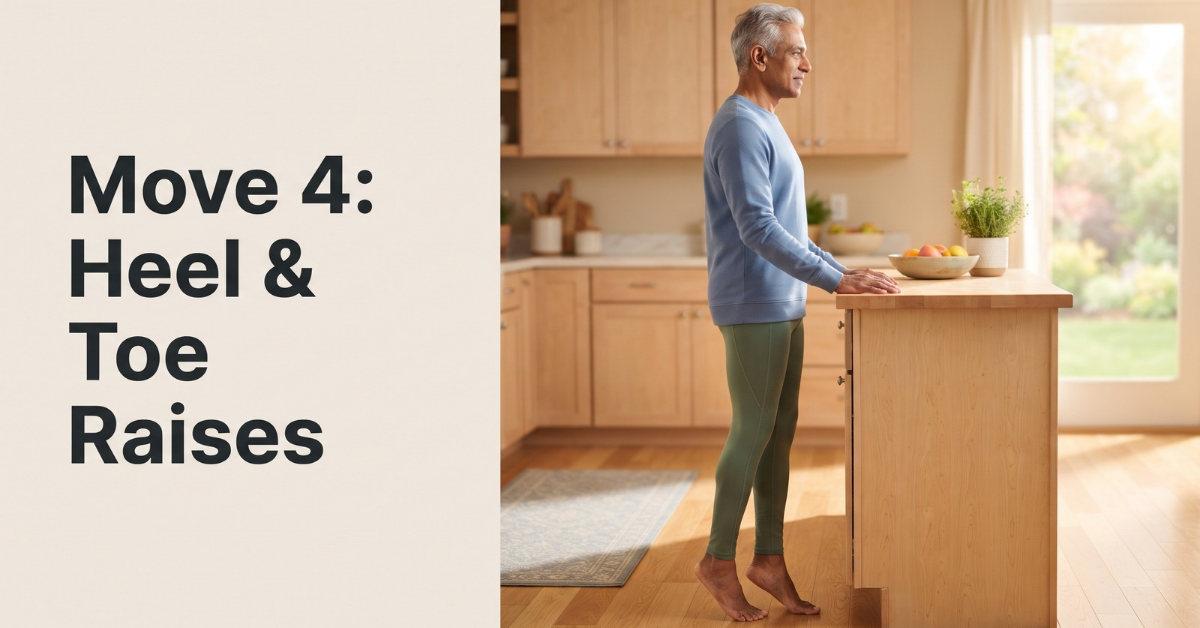
Why it helps: Your ankles are your first line of defense when you start to tip. Strong calves and shins help you make the tiny corrections that keep you upright — and help you lift your toes so they don’t catch on a rug edge or a step.
How to do it:
- Stand facing a counter or chair back, hands resting lightly on it.
- Slowly rise onto the balls of your feet, lifting your heels as high as is comfortable.
- Hold for 2 seconds, then lower slowly.
- After your heel raises, rock back gently onto your heels and lift your toes off the floor. Hold for 2 seconds and lower.
Reps: 10 heel raises, then 10 toe raises.
Easier: Do toe raises while seated.
Harder: Lower your heels very slowly — about 4 seconds down.
Common mistake: Leaning forward on the counter. Keep your body tall, as if a string were gently lifting the top of your head.
Have you noticed how much focus these moves take? That’s because balance is as much a brain activity as a muscle one. Your brain is constantly combining signals from your eyes, ears, and feet to keep you upright. Staying mentally engaged is part of staying steady.
Sponsored Resource
Interested in Brain Wellness?
This resource focuses on memory, focus, and nerve support as part of an overall brain-wellness routine. Supplements aren’t right for everyone — ask your doctor or pharmacist before adding one, especially if you take other medications.
Explore Brain Wellness SupportMove 5: Side Leg Raise
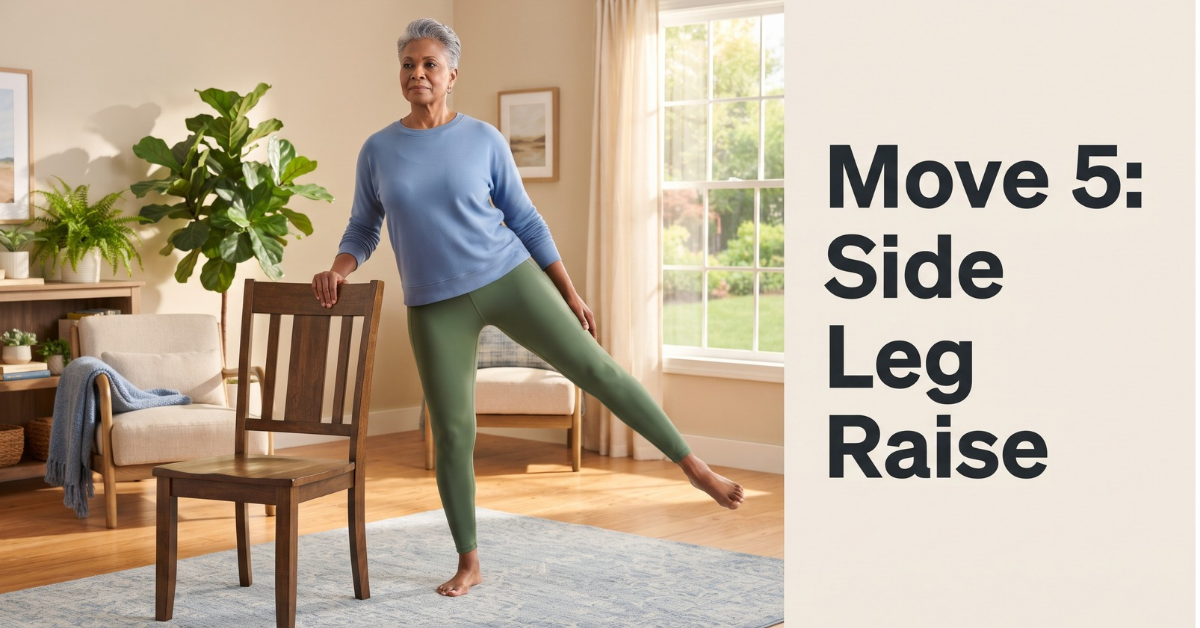
Why it helps: Many falls happen sideways — when you turn, sidestep, or get bumped. The muscles on the outside of your hips keep your pelvis level and stop you from tipping to the side. This move wakes them up.
How to do it:
- Stand tall behind your chair, holding on with one or both hands.
- Keeping your toes pointing forward, slowly lift your right leg out to the side about 6–12 inches.
- Hold for 1 second, then lower with control.
- Finish all reps, then switch sides.
Reps: 8–10 on each side.
Easier: Do “weight shifts” instead — stand with feet hip-width apart and slowly shift your weight from one foot to the other, holding each side for a few seconds.
Harder: Hold the raised position for 3 seconds.
Common mistake: Leaning your upper body to the opposite side to lift higher. A smaller, cleaner lift is better than a big, tilted one.
The 5 Moves at a Glance
Print this table or take a screenshot so you have it handy next to your chair.
| Exercise | What It Trains | Starting Goal | Everyday Payoff |
|---|---|---|---|
| Chair Stand | Thigh & hip strength | 8–10 reps | Getting up from chairs, cars, the toilet |
| Single-Leg Stand | One-leg stability | 10 sec each side | Stairs, dressing, stepping into the tub |
| Heel-to-Toe Walk | Side-to-side control | 10–20 steps | Narrow spaces, uneven paths |
| Heel & Toe Raises | Ankle strength | 10 + 10 reps | Catching a trip, clearing rug edges |
| Side Leg Raise | Outer hip stability | 8–10 each side | Turning, sidestepping, getting bumped |
Your 4-Week Step-by-Step Action Plan

Knowing the moves is step one. Doing them consistently is where the change happens. Here’s a simple plan that grows with you, one week at a time.
Step 1 — Week 1: Learn the Moves
- Do the routine 3 days this week (for example, Monday, Wednesday, Friday).
- Use Level 1 or Level 2 support on every exercise.
- Focus on form, not numbers. Do fewer reps if you need to.
Step 2 — Week 2: Build the Habit
- Keep the 3-day schedule and reach the full rep counts.
- Add one “everyday balance moment” — a single-leg stand while brushing your teeth.
- Mark each session on a paper calendar. Seeing the checkmarks is surprisingly motivating.
Step 3 — Week 3: Reduce Your Support
- Pick one or two exercises that feel easy and move up one support level.
- Stay at your current level on anything that still feels shaky.
- Notice daily life: Is it easier to get out of the car or climb your porch steps?
Step 4 — Week 4: Add a Gentle Challenge
- Try one “harder” version from the guide above.
- Consider adding a 4th day, or a short daily walk on your off days.
- Celebrate! Four weeks of showing up for yourself is a real accomplishment.
A Sample Week
| Day | What to Do | Time |
|---|---|---|
| Monday | Full 5-move routine | 10–15 min |
| Tuesday | Easy walk + toothbrush balance | 10–20 min |
| Wednesday | Full 5-move routine | 10–15 min |
| Thursday | Rest or gentle stretching | — |
| Friday | Full 5-move routine | 10–15 min |
| Weekend | Walk with family or a friend | Your choice |
Speaking of celebrating: reaching a personal milestone is a wonderful time to reflect on how far you’ve come. Some families love turning a parent’s or grandparent’s life stories into a keepsake that can be shared for years.
Sponsored Resource
Turn Your Memories Into a One-of-a-Kind Song
In a few easy steps, this service transforms your memories and feelings into a professionally produced, personalized song — a heartfelt gift for a birthday, anniversary, or family gathering.
Create Your Personal SongEveryday Habits That Support Steadier Movement
Exercise is the heart of better balance, but your surroundings and daily habits matter, too. Think of these as the “supporting cast” for your new routine.
Make Your Home Work for You
- Light the path. Add plug-in night-lights between the bedroom and bathroom.
- Remove trip hazards. Secure or remove throw rugs, and keep cords along the walls.
- Add grab bars by the toilet and in the shower or tub.
- Use handrails on both sides of stairs if you can.
- Keep everyday items within reach so you don’t need a step stool.
- Stand up slowly, especially after lying down. Sit on the edge of the bed for a moment before you rise.
Many Medicare Advantage plans include an over-the-counter (OTC) allowance for certain everyday health and wellness items. What’s covered varies a lot by plan, so it’s worth checking what yours includes before you shop.
Sponsored Resource
Check Your OTC Benefits in One Place
If your health plan includes an OTC benefit, this app from Chapter can help you see what you may be eligible for. Always confirm details with your plan directly.
See Your OTC BenefitsFuel Your Body Well
Skipping meals or not drinking enough water can leave you light-headed — not a great combination with standing exercises. Try to eat regular meals with some protein, which helps your muscles recover, and keep a glass of water nearby during your routine. If you have questions about your specific nutrition needs, your doctor or a registered dietitian is the best person to ask. For more everyday wellness reading, you can also visit WellbeingPrime.
Sponsored Resource
Curious About Skin and Gut Wellness Gummies?
This daily gummy is designed around skin and gut wellness. As with any supplement, talk with your doctor or pharmacist first to make sure it’s a good fit for you.
Learn About the GummiesKeep Up With Your Checkups
- Eyes: Get your vision checked regularly. Outdated glasses can quietly throw off your balance.
- Medications: Ask your doctor or pharmacist to review everything you take, including over-the-counter sleep aids. Some medicines can cause dizziness or drowsiness.
- Feet: Numbness, pain, or poorly fitting shoes all affect how steady you feel. Mention them at your next visit.
- Teeth: Routine dental care is part of whole-body wellness, and it’s easy to let it slide. Add it to the same calendar where you track your balance routine.
Sponsored Resource
A Popular Dental Wellness Resource
Looking for ways to support your oral health routine at home? This dental wellness resource is worth a look — and keep up with regular visits to your dentist, too.
Explore Dental WellnessTell Your Doctor About Any Fall
Even a fall that didn’t hurt is worth mentioning. Remember that fewer than half of older adults who fall bring it up with their doctor. Your doctor can check for causes you might not notice — like blood pressure drops, inner-ear issues, or medication side effects — and may refer you to a physical therapist for a personalized program. The CDC’s falls page also links to a short “Falls Free CheckUp” you can take at home.
Protect Your Independence Online, Too
Staying independent isn’t only about staying on your feet. Scams that target older adults — fake bank alerts, “tech support” calls, and look-alike websites — are a real concern. A few habits help: never share passwords or codes with callers, double-check web addresses before you log in, and call your bank directly using the number on your card if something feels off.
Sponsored Resource
Browse More Safely With NordVPN
NordVPN offers online security tools that can help protect your connection and warn you about risky websites — an extra layer of protection while you shop, bank, and email online.
Learn More About NordVPNWhen to Ask for Extra Help
Home exercises are a great start, but some situations call for professional guidance. Reach out to your doctor if:
- You’ve fallen in the past year, or you’re afraid of falling and avoiding activities because of it.
- You feel dizzy, light-headed, or like the room is spinning.
- You can’t get up from a chair without using your arms.
- Your balance has changed noticeably in a short time.
- Any exercise causes pain that doesn’t go away after you stop.
A physical therapist can tailor these moves to your body, check your form, and safely progress you. There’s no shame in getting a coach — even elite athletes have one.
You Can Start Today
Here’s the most encouraging thing about balance exercises after 65: they meet you exactly where you are. If today you need both hands on the chair, that’s perfect. That’s your starting line. A month from now, you may be holding on with a single fingertip — and noticing that the porch steps, the grocery store aisles, and the walk to the mailbox feel just a little more certain.
You don’t need a gym or special gear. You need a sturdy chair, ten minutes, and the willingness to show up for yourself three days a week. You’ve handled far harder things in life. This one is well within reach.
Frequently Asked Questions
How often should I do balance exercises after 65?
A good starting point for many people is 10–15 minutes, about three days a week, plus small daily habits like a one-leg stand while brushing your teeth. As your balance improves, you can add days or try harder versions. Your doctor or a physical therapist can help you choose the right amount for your health.
What should I do if I feel dizzy during an exercise?
Stop right away, hold onto your support, and sit down slowly. Rest and sip some water. If dizziness happens often, let your doctor know. If it comes with chest pain, trouble speaking, face drooping, or sudden weakness on one side, call 911 immediately.
Can I do these exercises if I use a cane or walker?
Possibly, but check with your doctor or physical therapist first. They may suggest seated versions, such as seated toe raises, or show you how to use a counter for safer support. Never practice standing balance moves without something sturdy within reach.
Join Journeygram 🌿
A friendly community for adults 50+.
Share stories, photos, and tips with people who get it.
Grandkids · Travel · Health · Skin Care · Money · New Friends