⚠️ Health Disclaimer: The information in this article is for educational purposes only and does not constitute medical advice. Always consult your physician or a licensed physical therapist before beginning any new exercise program, especially if you have existing health conditions or a history of falls.
Why Does Balance Get Harder As We Age?
Balance is a surprisingly complex skill. Your body uses signals from your eyes, inner ears, muscles, and joints — all working together in a fraction of a second — to keep you upright. As we age, each of those systems naturally slows down a little.
Muscle mass decreases by roughly 3–8% per decade after age 30, and that rate accelerates after 60. Reaction time lengthens. Vitamin D levels — crucial for muscle function — tend to drop. And many medications commonly prescribed for seniors can affect coordination and blood pressure.
But here is the empowering truth: the body responds to training at any age. Research published in the British Journal of Sports Medicine consistently shows that targeted balance and strength exercises significantly reduce fall risk — even in adults in their 80s and 90s. You are not “too old” to improve. Not even close.
1 in 4
Americans over 65 fall each year (CDC)
37%
Of falls result in injury requiring medical care
Up to 40%
Fall reduction with regular balance training
5 Simple Balance Moves — Start Today, Feel the Difference
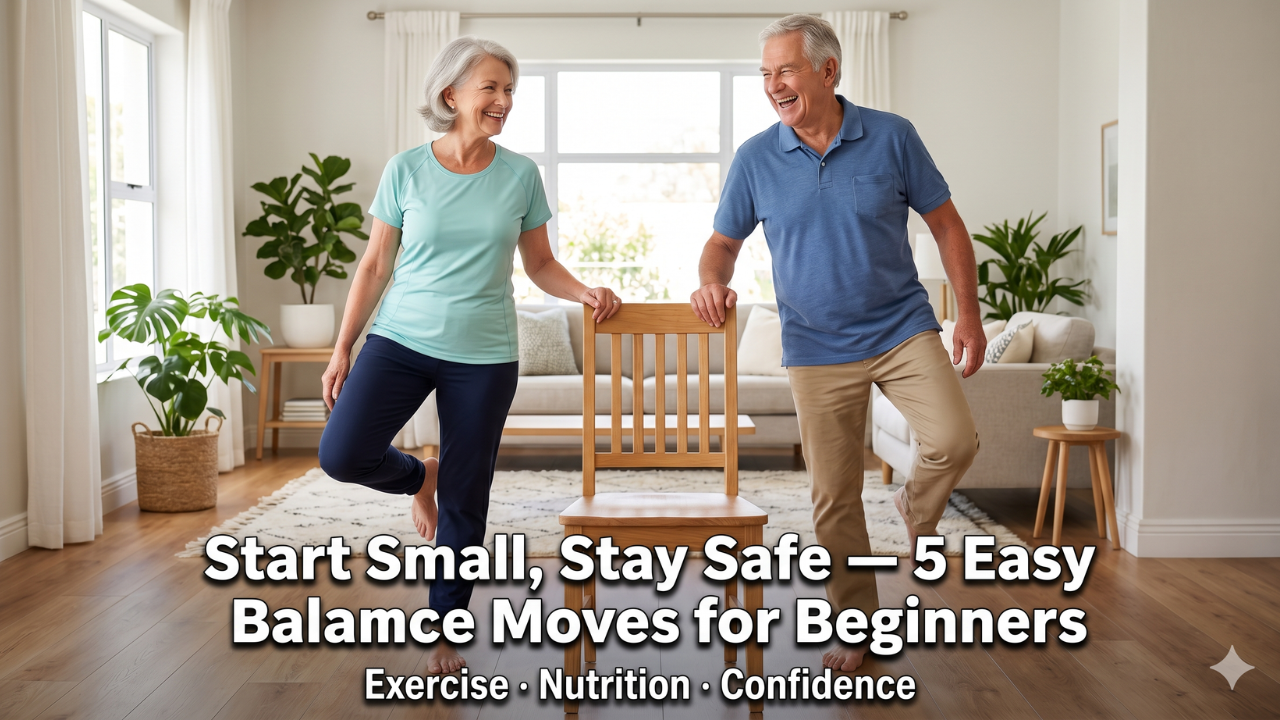
You don’t need a gym membership, special equipment, or a personal trainer to begin improving your balance. A sturdy chair and a safe floor space are all you need. The five exercises below are specifically chosen because they are beginner-friendly, joint-safe, and scientifically proven to build the muscles and neural pathways that keep you steady.
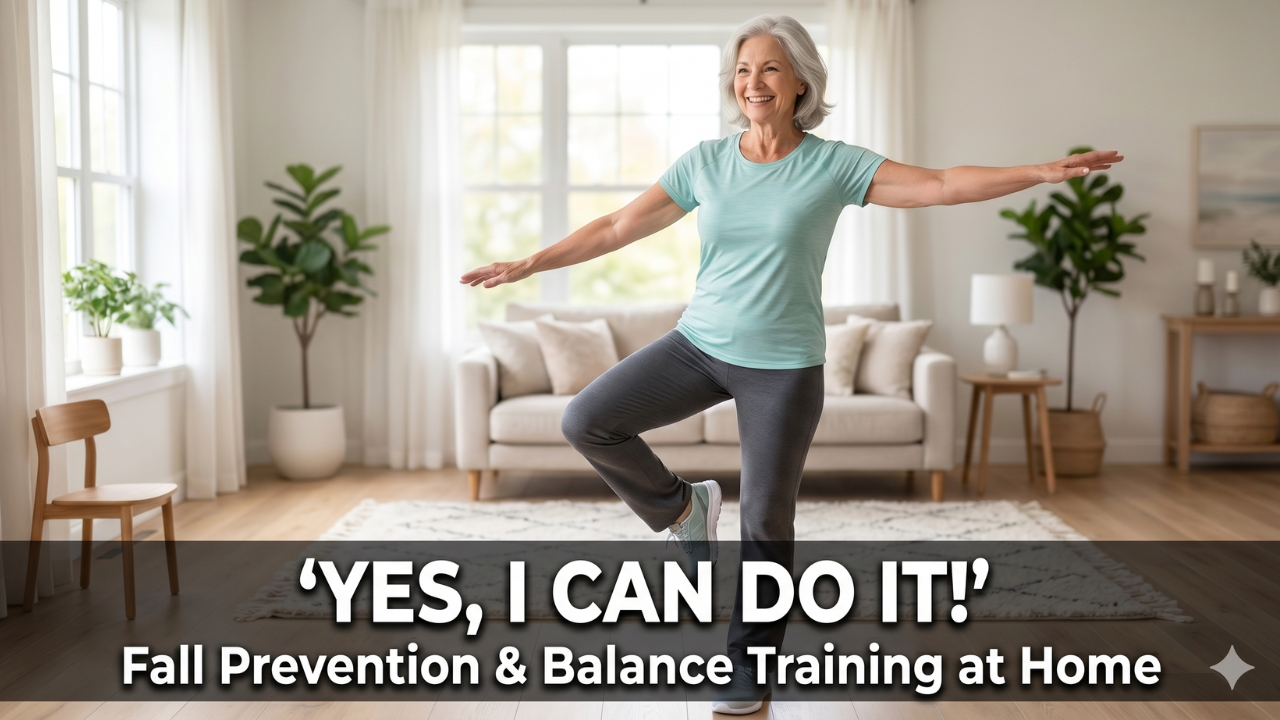
🦶 Move 1: Single-Leg Stand (The Foundation)
How to do it: Stand behind a sturdy chair with both hands on the back. Slowly lift one foot about 6 inches off the floor. Hold for 10 seconds. Lower, then repeat on the other side. Aim for 3 reps per leg.
Why it works: This activates your ankle stabilizers and trains your nervous system to react quickly to balance shifts.
🚶 Move 2: Heel-to-Toe Walk (The Tightrope)
How to do it: Walk in a straight line — placing your heel directly in front of your toes with each step. Take 10 steps forward along a wall or hallway for safety. Turn slowly and repeat.
Why it works: This challenges your cerebellum (the brain’s balance center) and improves gait — one of the top predictors of fall risk.
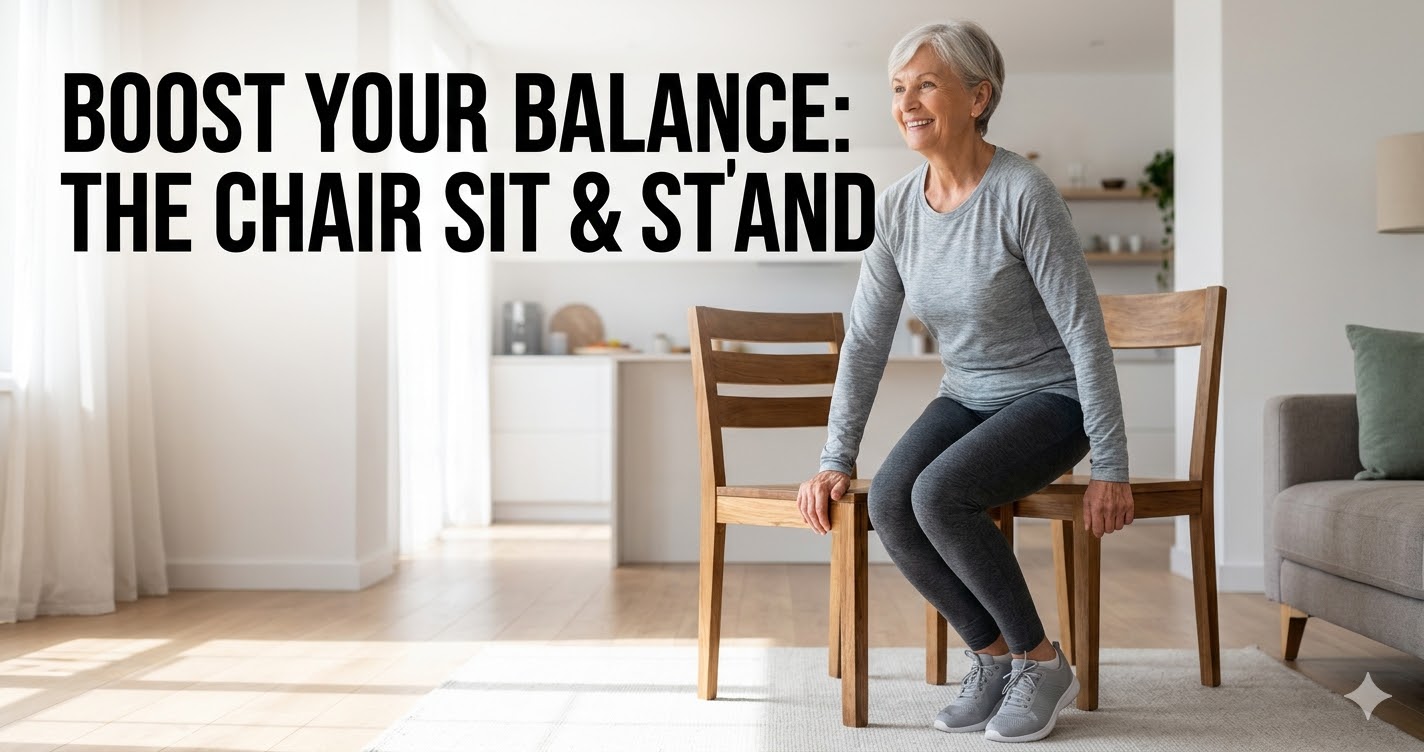
🪑 Move 3: Sit-to-Stand (The Power Builder)
How to do it: Sit in a firm chair with feet flat on the floor, hip-width apart. Cross your arms over your chest. Lean slightly forward and push up to standing using your leg muscles — not your arms. Slowly sit back down. Repeat 8–10 times.
Why it works: Strengthens quadriceps and glutes, the two muscle groups most responsible for preventing trip-related falls.
↔️ Move 4: Side Step Shuffle (The Lateral Defender)
How to do it: Stand next to a wall or countertop. Take 5 slow steps sideways to the right, then 5 steps back to the left. Keep your toes facing forward. Repeat 3 times in each direction.
Why it works: Lateral movements are where most falls happen. This builds hip abductor strength and improves sideways reactivity.
🦵 Move 5: Calf Raises (The Ankle Anchor)
How to do it: Stand behind your chair, hands lightly on the back. Slowly rise up onto your tiptoes, hold for 2 seconds, then lower. Repeat 12–15 times. Progress to single-leg raises when you’re ready.
Why it works: Strong calves and ankles are your first line of defense when you catch yourself from a stumble.
🛒 Senior Journey Picks · Amazon
Balance & Mobility Essentials
Grab bars, non-slip mats, resistance bands & more — hand-picked for safe, confident movement at home.
Your 4-Week “Yes I Can” Action Plan
STEP-BY-STEP · BEGINNER FRIENDLY · NO GYM NEEDED
Week 1–2: Build Your Base (10 min/day)
Start with Moves 1, 3, and 5 only. Do them every other day — Monday, Wednesday, Friday works perfectly. Focus on form, not speed. Keep a chair within reach at all times. Write down how many reps you complete each session in a small notebook.
Week 3: Add Movement (15 min/day)
Introduce Moves 2 and 4 (Heel-to-Toe Walk and Side Step). Add a 5-minute gentle warm-up walk around your home or neighborhood first. Try to exercise 4 days this week. Notice whether your single-leg hold time is getting longer — that’s real progress!
Week 4: Full Routine + Lifestyle Integration
Complete all 5 moves, 4–5 days per week. Start weaning off the chair for support on Moves 1 and 5 (keep it nearby for safety). Add one lifestyle upgrade this week: remove loose rugs, install a bathroom grab bar, or improve your bedroom lighting. Small changes, enormous impact.
Ongoing: Celebrate & Progress
Track your single-leg hold time every two weeks. Celebrate every 5-second improvement — that’s your nervous system rewiring itself. Consider joining a local Tai Chi or yoga class as the next step. Share your progress with a friend or family member; accountability doubles your success rate.
Feed Your Bones & Muscles: What I Actually Take Daily
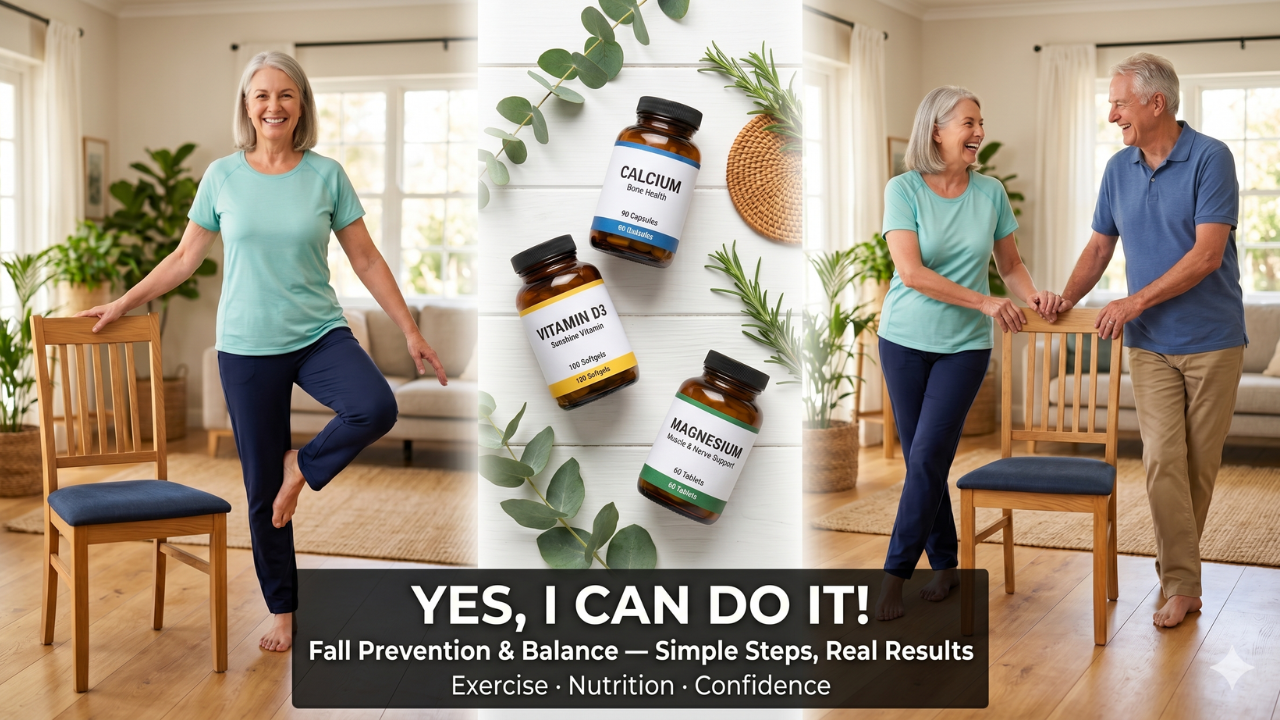
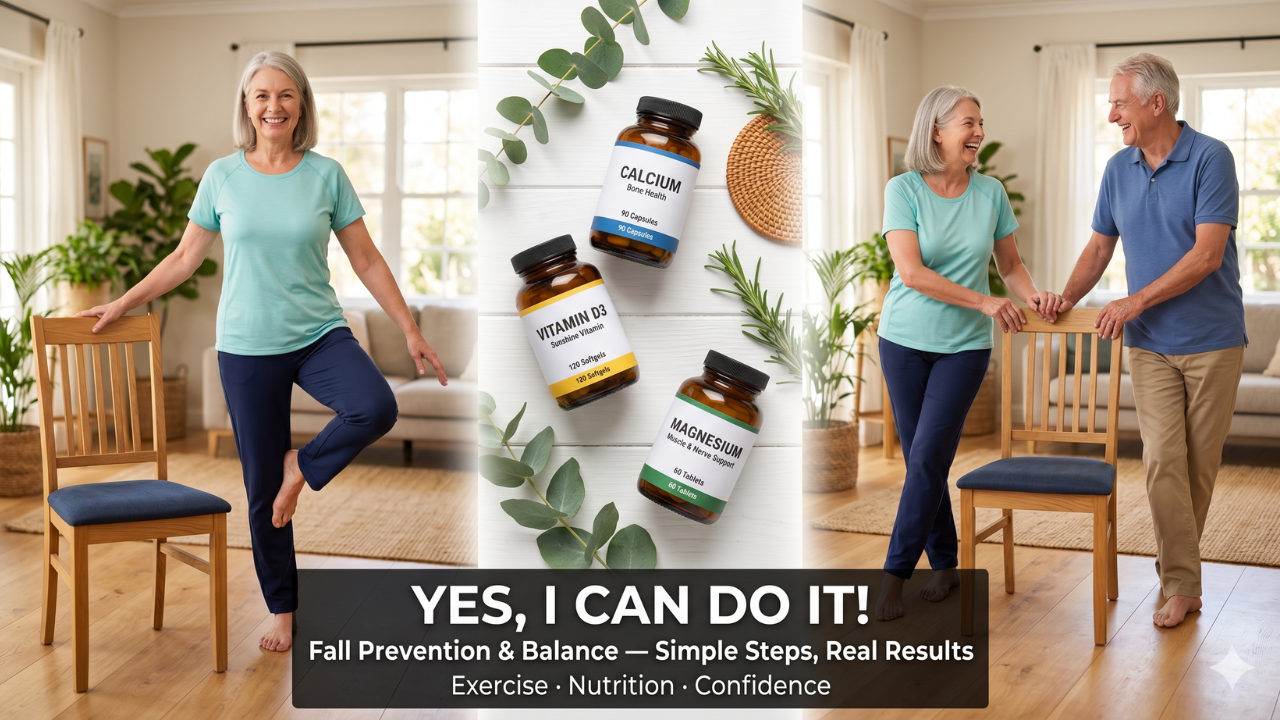
Exercise is the engine of balance improvement — but nutrition is the fuel. Three nutrients in particular have strong clinical evidence for supporting the bones, muscles, and nerve function that underpin fall prevention:
🦴 Bone Foundation
21st Century Calcium, Magnesium, Zinc & D3
This is my everyday bone support formula. Calcium and Magnesium work together for bone density; Zinc supports muscle repair; D3 ensures your body actually absorbs the calcium. One tablet covers the key bases without a complicated regimen.
☀️ Bone + Heart Duo
California Gold Nutrition Vitamin D3 + K2 (MK-7)
Vitamin D3 is one of the most studied nutrients for fall prevention — low levels are directly linked to muscle weakness and increased fall risk. The K2 (MK-7 form) helps direct calcium to your bones rather than your arteries, making this a smart pairing for cardiovascular health too.
💪 Muscle Recovery
NOW Foods Magnesium Glycinate 100mg
Magnesium Glycinate is gentler on the stomach than other forms and has excellent absorption. I take this in the evening — it supports muscle relaxation and nerve function, and many seniors find it also improves sleep quality, which itself is a significant fall risk factor.
* Disclosure: The supplement links above are affiliate links through iHerb. If you purchase through these links, I may earn a small commission at no extra cost to you. I only recommend products I personally research and believe in.
🏠 Home Safety · Amazon
Make Your Home Fall-Proof
Grab bars, shower benches, non-slip mats, night lights — our curated safety picks for every room.
Make Your Home Your Safest Training Ground
More than 60% of falls happen at home — and most of them are preventable with a simple safety audit. Walk through your home with fresh eyes and address these five areas this week:
💡
Lighting
Add night lights in hallways, stairs, and bathrooms. Use motion-activated lights for nighttime trips.
🪵
Rugs & Floors
Remove loose rugs or secure them with non-slip backing. Keep floors clear of cords and clutter.
🚿
Bathroom
Install grab bars by the toilet and in the shower. Use a non-slip bath mat. Consider a shower bench.
👟
Footwear
Wear supportive, closed-toe shoes with non-slip soles indoors. Avoid walking in socks or slippers on hard floors.
🪜
Stairs
Ensure handrails are secure on both sides. Apply non-slip strips on each step. Never carry items that block your view of steps.
The Hidden Factor: Fear of Falling
Here is something that doesn’t get talked about enough: the fear of falling is itself a major risk factor for falling. When we become afraid, we move less. We shuffle instead of stepping confidently. We hold back from activities we love. And over time, this inactivity causes the very muscle loss that makes falls more likely.
The antidote is action — gentle, supported, progressive action. Every time you complete a balance exercise, you are building not just physical strength, but neurological confidence. Your brain learns: “I can handle this. I am stable. I am capable.” That mental shift is just as powerful as any muscle you build.
💡 Frequently Asked Questions
How long before I see improvement in my balance?
Most people notice meaningful improvement within 4–6 weeks of consistent practice — 3 or more sessions per week. The single-leg stand is a great benchmark: if you can hold for 10 seconds at the start and 20 seconds six weeks later, that’s real, measurable progress.
Is it safe to do these exercises if I have arthritis or knee pain?
Many of these exercises are low-impact and joint-friendly — but always check with your doctor or physical therapist first. The Sit-to-Stand and Calf Raises can typically be modified for knee sensitivity. Never push through sharp pain.
Do supplements really help prevent falls?
Vitamin D supplementation in particular has strong clinical evidence for reducing fall risk when blood levels are deficient — which is very common in adults over 60. Calcium and Magnesium support the muscle function and bone density that underpin balance. Supplements work best alongside exercise, not as a replacement for it.
What if I’ve already had a fall? Is it too late to start?
Absolutely not — in fact, after a fall is one of the most important times to begin a balance program. Research shows that fall survivors who engage in targeted exercise have significantly lower rates of subsequent falls. Start slowly, have support nearby, and work with your healthcare team to design a safe starting point.
🎬
Want to See These Exercises in Action?
Head over to the SeoulcastUSA YouTube channel where I walk you through every move, step by step — with modifications for beginners. Watching once makes doing it so much easier!
SENIOR JOURNEY BLOG
seniorjourneyblog.com · Empowering Confident, Active Living After 55
🌿 Weekly wellness, health & beauty insights — straight to your inbox
Free subscription · Cancel anytime