The Ultimate Guide to Chair-Based Somatic Exercises for Seniors: Reclaim Comfort, Mobility, and Confidence After 55
A warm, step-by-step guide to chair-based somatic exercises for seniors who want to move more freely, feel steadier on their feet, and protect their independence — one gentle chair session at a time.

There is a particular kind of quiet worry that many of us carry as we move past our fifties, sixties, and seventies — the worry that our bodies are becoming strangers to us. A knee that clicks when it didn’t used to. A shoulder that won’t quite reach overhead the way it once did. A moment of unsteadiness getting up from the couch that lasts only a second, but stays with you for the rest of the day.
If any of that sounds familiar, please know this: you are not failing at aging. You simply haven’t yet been introduced to one of the gentlest, most effective tools available for reclaiming comfort in your own body — chair-based somatic exercises for seniors.
This guide was written specifically for the SeniorJourney community — people who value practical, trustworthy information over trends and gimmicks. We’re going to walk through what somatic movement actually is, why it works differently than ordinary stretching, how to build a safe daily practice using nothing but a sturdy chair, and how to support your body’s recovery with smart nutrition and financial choices along the way. By the end, you’ll have a complete action plan you can start today, sitting right where you are.
You won’t need a gym membership, a group class schedule, or any prior exercise experience to get real value from this guide. Everything described here can be done in your own living room, at your own pace, using furniture you almost certainly already own. That accessibility isn’t an accident — it’s the entire point. The best wellness practice is always the one you’ll actually do, day after day, and few things are more sustainably doable than settling into a favorite chair for twenty quiet minutes.
What Is Somatic Movement, and Why Is It Different From Regular Exercise?
Most exercise programs are built around a simple goal: move the muscle, build the muscle, repeat. Somatic movement asks a different, more interesting question — not “how strong can this muscle become,” but “does my nervous system actually trust this movement?”
The word “somatic” comes from the Greek soma, meaning “the living body as perceived from within.” Somatic exercises are slow, small, mindful movements designed to reconnect your brain with muscles that have quietly tightened, guarded, or become forgotten over years of stress, injury, or simply sitting too long. Rather than forcing a stretch from the outside, you gently invite the muscle to release from the inside — through awareness, breath, and unhurried repetition.
This distinction matters enormously for anyone over 55. Traditional stretching often assumes a body with full flexibility and no chronic guarding patterns. Chair-based somatic exercises for seniors assume exactly the opposite — it meets a body that has spent decades protecting itself, and it works with that protective instinct instead of fighting it. That is precisely why it can be practiced safely while seated, at a pace that never asks you to push through pain or force a range of motion your joints aren’t ready for.
Physical therapists and movement researchers describe this process using a concept called sensory-motor amnesia — the idea that certain muscles, after years of tension (often from stress, old injuries, or repetitive posture like prolonged sitting), essentially “forget” how to fully release, even when you consciously try to relax them. Chair-based somatic sequences are designed to gently re-teach that release, one small, deliberate movement at a time.
There is also a practical reason this style of movement resonates so deeply with the 55-and-older community: it removes the two biggest barriers that keep people from exercising consistently — fear of falling, and fear of pain. When you already know your feet are planted and the chair beneath you is solid, your nervous system stops spending energy on vigilance and can instead focus entirely on the quality of the movement itself. That shift, from “bracing for impact” to “exploring with curiosity,” is often the single biggest reason people stick with a somatic practice long after they’ve abandoned gym memberships, resistance bands still in their packaging, or walking programs that quietly fizzled out after the first cold week of winter.
It’s worth noting, too, that somatic exercise isn’t a new fad dressed up in wellness language. Its roots trace back to the work of movement educators in the mid-twentieth century who studied how chronic stress and repetitive habits reshape the way we hold our bodies — and, more importantly, how those patterns can be gently unwound later in life. What has changed in recent years is simply how accessible this knowledge has become, now available to anyone with a chair and twenty quiet minutes, rather than only to those who could attend specialized clinics.
The Science-Backed Benefits of Chair-Based Somatic Exercises for Seniors
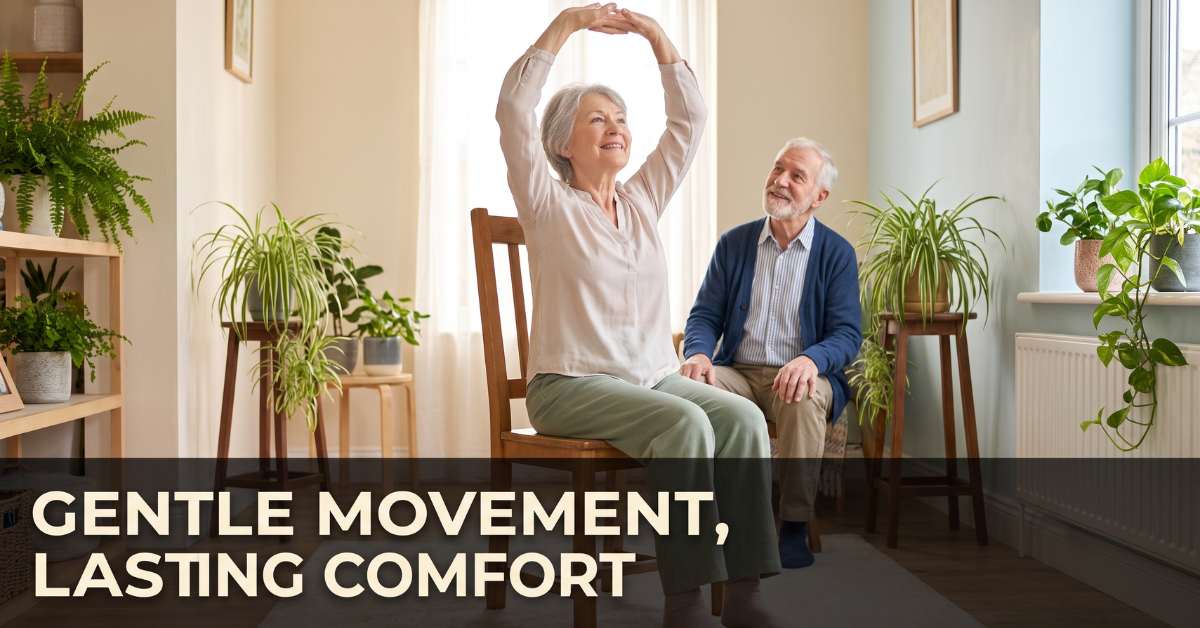
1. Balance and Fall Prevention
Falls remain one of the most significant threats to independence in later life, and much of that risk comes not from weakness alone but from a loss of proprioception — your body’s internal sense of where it is in space. Somatic exercises rebuild this sense from a safe, seated position before you ever need to rely on it while standing. As your nervous system relearns subtle control over the hips, spine, and shoulders, that awareness carries over into everyday movements like turning to answer the phone, reaching for a cabinet, or stepping off a curb.
2. Relief From Chronic Stiffness and Joint Discomfort
Many seniors live with a baseline level of stiffness in the neck, shoulders, lower back, and hips — often the result of years of compensating for old injuries or simply spending long hours seated. Because somatic movements are slow and exploratory rather than forceful, they can often reduce this stiffness without aggravating arthritic joints or sensitive tissue, which is why physical therapists frequently recommend them as a gentle entry point for people who have been told to “avoid high-impact activity.”
3. Nervous System Regulation and Stress Relief
Slow, breath-linked movement activates the parasympathetic nervous system — the body’s natural “rest and restore” mode. For seniors managing the stress of retirement transitions, health concerns, or the loss of loved ones, a daily somatic practice can become a genuine anchor of calm, distinct from the racing pace of the outside world.
4. Preserved Independence and Confidence
Perhaps the most meaningful benefit is the least measurable one: confidence. When you know your body can move safely and predictably, everyday tasks — getting dressed, gardening, playing with grandchildren, traveling — feel less daunting. That confidence is, in itself, one of the strongest predictors of continued independence.
5. Better Sleep Quality
Many practitioners report an unexpected side benefit: improved sleep. The combination of gentle physical release and slow, diaphragmatic breathing lowers cortisol levels in the hours before bed, which can shorten the time it takes to fall asleep and reduce nighttime waking — something many seniors find has quietly declined over the years without realizing how much it affects daytime energy and mood.
6. Support for Cardiovascular and Metabolic Health
While chair-based somatic exercise is gentle, it is not without measurable physiological benefit. Regular, low-intensity movement has been shown to support healthy blood pressure and improve circulation, particularly in people who spend long stretches of the day seated. For those managing early-stage cardiovascular concerns, this kind of movement is often an ideal complement to more vigorous activity recommended by a cardiologist, precisely because it doesn’t spike heart rate or blood pressure the way high-intensity exercise can.
Who Benefits Most From This Practice?
While chair-based somatic exercise is genuinely suitable for nearly any adult over 55, we find it resonates most strongly with a few specific groups within our community:
- Those recovering from a fall or a recent hip or knee surgery, who need a gentle re-entry point into movement without the intimidation of a full gym or group class.
- Caregivers who spend hours each day physically supporting a spouse or parent and have quietly let their own mobility needs slide.
- People managing chronic pain conditions such as fibromyalgia or osteoarthritis, who have been told repeatedly to “stay active” but find most exercise recommendations too intense for their current comfort level.
- Anyone who simply wants a calm, sustainable start after years away from any structured movement practice, without the pressure of measuring progress against younger standards.
Safety First: What You Need to Know Before You Begin

Before we walk through the routine itself, a few safety notes are essential — not as a formality, but because doing this correctly is what makes the practice genuinely beneficial rather than risky.
- Choose a sturdy, armless chair with a flat, firm seat — avoid chairs with wheels, cushions that sink, or rounded seats that tilt.
- Place the chair on a non-slip surface, ideally on a rug with a rubber backing or a hard floor with a non-slip mat underneath the legs.
- Wear supportive, closed-back shoes or grippy socks — never loose slippers.
- Check in with your healthcare provider before beginning any new movement routine, especially if you have a diagnosed balance disorder, recent surgery, uncontrolled blood pressure, or advanced osteoporosis.
- Move within a pain-free range. Somatic movement should feel like a gentle exploration, never a stretch that causes sharp pain, numbness, or tingling.
- Keep a phone or call button within reach, especially if you are practicing alone at home.
Choosing the Right Chair: A Closer Look
It’s worth spending an extra moment on chair selection, because this single decision affects the safety of every movement that follows. Dining chairs, sturdy kitchen chairs, and firm office chairs without wheels tend to work best. Avoid recliners, chairs with deep cushioning that causes you to sink, and anything with armrests positioned too close together to allow full shoulder rotation. The seat height matters as well — ideally, your knees should sit at roughly a ninety-degree angle with both feet flat on the floor, neither too high nor too low. If your usual chairs are too low, a firm cushion can raise the seat height safely; if they’re too high, a stable footrest can be used to keep your feet properly grounded.
Posture Awareness Throughout the Day
The benefits of a twenty-minute session can be quietly undone by eight hours of slumped, unsupported sitting in front of a television or computer. You don’t need to sit rigidly upright all day — that itself creates its own tension — but a simple mid-afternoon check-in can help: notice whether your shoulders have crept up toward your ears, whether your lower back has rounded into the cushion, and whether your chin has drifted forward. A gentle reset, simply by walking through Step 2 and part of Step 3 for two or three minutes, can interrupt hours of accumulated postural strain before it settles in.
This same principle of “protecting yourself before you need to” extends beyond the physical. Many of the seniors in our community have shared with us that they feel far more confident moving through their day, both physically and digitally, once they’ve put a few simple safeguards in place. We’ll return to that idea a little further down, because your safety on the internet deserves just as much attention as your safety in a chair.
Common Mistakes to Avoid When Starting Out
Even a practice this gentle can be undermined by a handful of common habits. Here are the mistakes we see most often among beginners, and how to sidestep each one.
Mistake 1: Treating It Like a Stretch to “Win”
The instinct to push a little further, hold a little longer, or chase a visible stretch is deeply ingrained from decades of conventional fitness advice. But in somatic movement, more is not better. The goal is the smallest movement that produces a genuine sense of release. If you find yourself straining, you’ve overshot the target — simply back off ten or twenty percent and continue from there.
Mistake 2: Holding Your Breath
It’s remarkably common to unconsciously hold the breath during unfamiliar movement, which actually increases muscular guarding — the opposite of what we’re trying to achieve. If you notice you’ve stopped breathing naturally during any step, pause, take three slow breaths, and then continue at a gentler pace.
Mistake 3: Practicing Inconsistently
Somatic change is cumulative. A single twenty-minute session can leave you feeling looser for a few hours, but the lasting neurological change — the kind that actually improves your balance and reduces chronic stiffness — comes from repetition across weeks, not from any single “great” session.
Mistake 4: Skipping the Reflection Step
It’s tempting to rush through the final minute of stillness at the end of a session, especially once you feel physically finished. But this brief pause is where your nervous system actually registers and stores the new, looser pattern. Skipping it is a bit like taking a photograph and closing the camera before the shutter clicks.
Adapting the Routine to Your Own Mobility Level
No two bodies arrive at this practice from the same starting point, and a good routine should flex to meet you where you are rather than the reverse. Below are three adjusted approaches depending on your current comfort level.
If You’re Just Starting Out (Low Current Mobility)
Focus entirely on Steps 2 and 3 for the first one to two weeks — breathing and neck/shoulder release. Keep every movement to roughly half the range described, and don’t worry at all about Steps 4 and 5 until these feel completely comfortable. There is no timeline you need to meet; some people spend a full month here before progressing, and that is entirely appropriate.
If You Have Moderate Mobility and No Major Restrictions
Follow the full six-step routine as written, three to five times per week, and expect gradual, noticeable improvement over two to three weeks.
If You’re Already Active and Looking to Deepen the Practice
Once the full routine feels easy, you can extend each hold from two or three breaths to five or six, and add a light resistance band during Step 5 for additional hip stability work. Even at this more advanced level, the core principle remains unchanged: movement should always stay well within a pain-free, unforced range.
The Complete Action Plan: Chair-Based Somatic Exercises for Seniors, Step by Step
Below is a full routine you can complete in roughly 20 to 25 minutes, broken into six manageable steps. This is the heart of any effective set of chair-based somatic exercises for seniors: slow, small, breath-linked movement rather than force. You do not need to complete all six steps every day — even five minutes of Step 2 alone, done consistently, will begin to make a difference. Consistency matters far more than intensity here.
Step 1: Setting Up Your Space
Place your chair in a quiet spot with enough room to extend your arms fully in every direction. Sit toward the front edge of the seat with both feet flat on the floor, hip-width apart, and your spine tall but not rigid. Rest your hands gently on your thighs. Take a moment before you begin to simply notice how your body feels right now — no judgment, just observation. This noticing is itself part of the somatic practice.
Step 2: Warm-Up Breathing
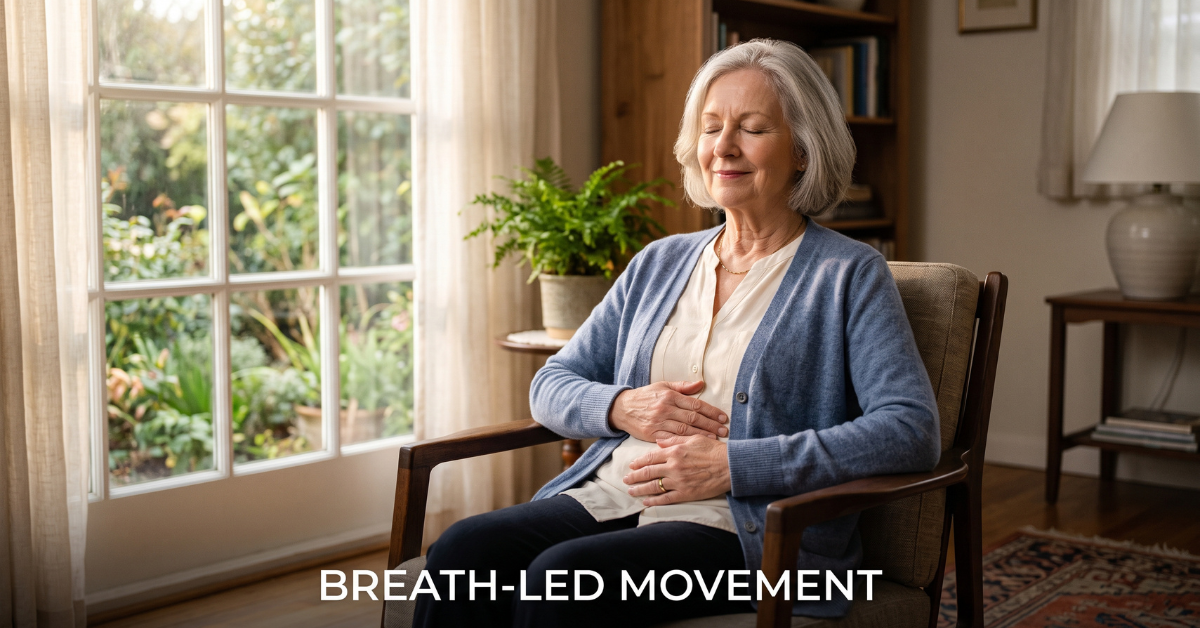
Rest both hands lightly on your abdomen. Inhale slowly through your nose for a count of four, feeling your belly rise gently against your hands. Exhale through your mouth for a count of six, letting your shoulders soften and drop with each breath out. Repeat this for eight to ten full breaths. This single step does more than “warm you up” — it signals to your nervous system that it is safe to release tension, which makes every movement that follows more effective.
Step 3: Neck and Shoulder Release

Slowly tilt your head to the right, bringing your ear gently toward your shoulder without lifting the shoulder to meet it. Hold for three slow breaths, feeling for the smallest release rather than forcing a deep stretch. Return to center and repeat on the left. Next, roll both shoulders slowly backward five times, then forward five times, keeping the movement smooth rather than mechanical. Finish by gently drawing your chin back, as if making a soft “double chin,” to release tension at the base of the skull — a small movement that many people find surprisingly effective against tension headaches.
Step 4: Gentle Spinal Rotation
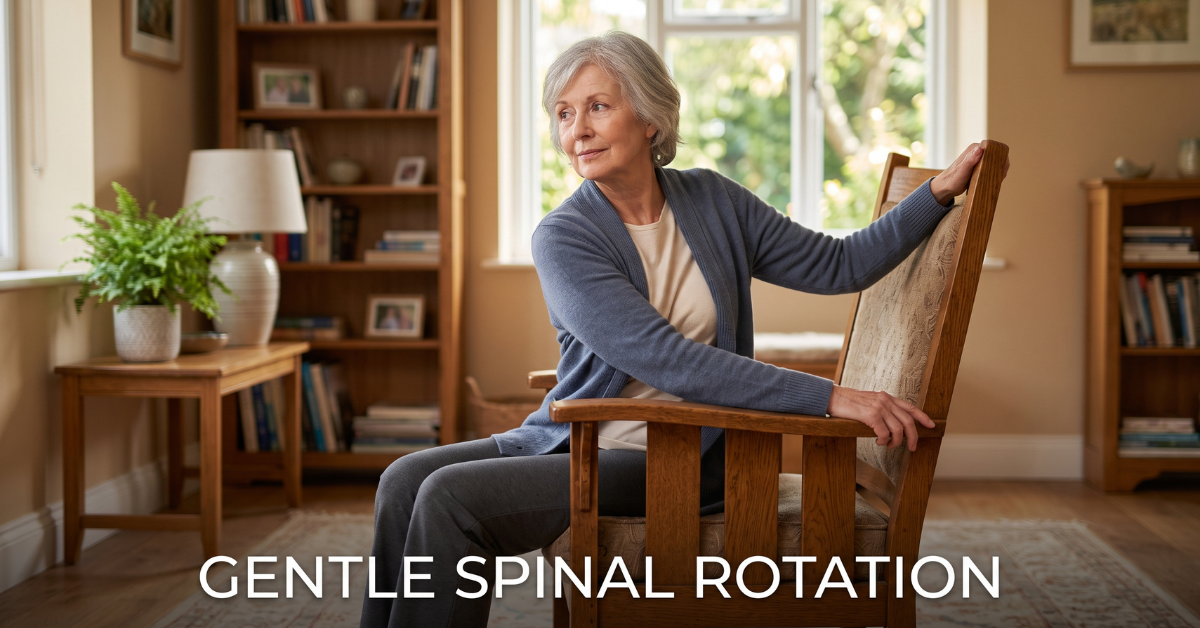
Sitting tall, place your right hand on the outside of your left knee and your left hand on the back of the chair. On an exhale, gently rotate your torso to the left, turning your gaze over your left shoulder. Move only as far as feels comfortable — this is not a deep twist, but a slow exploration. Hold for two breaths, then return to center. Switch sides. Repeat two to three times per side. This movement is particularly valuable for maintaining the rotational mobility we rely on for everyday actions like checking a blind spot while driving or reaching into the back seat of a car.
Step 5: Hip and Pelvic Mobility

Sitting tall, gently lift your right ankle and rest it just above your left knee, allowing your right knee to open outward — this is sometimes called the seated “figure-four” position. If this feels too intense, simply hold your ankle without resting it on the opposite knee. Sit tall and hold for five slow breaths, feeling a gentle opening through the outer hip rather than a sharp stretch. Lower the leg with control and repeat on the other side. This single movement can meaningfully improve comfort when walking, climbing stairs, and rising from low seating.
Step 6: Cool Down and Reflection
Return to your seated starting position, hands resting on your thighs. Take three more slow breaths, and once again simply notice how your body feels compared to when you began. Many people are pleasantly surprised by how different — looser, calmer, steadier — they feel after just twenty minutes. This closing reflection is not a throwaway step; it is how your nervous system consolidates the changes you just practiced.
Supporting Your Body From the Inside: Nutrition and Joint Recovery
Movement is only one half of the equation. What you nourish your body with directly affects how well your joints and muscles respond to that movement. One of the most well-researched nutrients for supporting joint comfort and reducing everyday inflammation in adults over 55 is omega-3 fatty acids, commonly found in fish oil.
Many of our readers ask what a trustworthy, high-quality omega-3 supplement looks like. We regularly recommend California Gold Nutrition’s Omega-3 Premium Fish Oil, which is a straightforward, well-dosed option worth discussing with your doctor if you’re looking to add omega-3 support to your daily routine, especially alongside a new movement practice like this one.
A gentle reminder: Supplements are meant to complement, not replace, a balanced diet and your doctor’s guidance — particularly if you take blood thinners or other medications, since omega-3s can interact with certain prescriptions.
Hydration and Joint Comfort
It’s easy to overlook, but adequate hydration plays a surprisingly large role in how joints feel during movement. Cartilage itself is composed largely of water, and mild, chronic dehydration — common among older adults whose thirst signals naturally become less reliable with age — can contribute to a subtle sense of stiffness that has nothing to do with arthritis or injury. A simple habit worth adopting alongside your new movement practice: keep a glass of water on the table near your chair, and take a few sips before and after each session.
Protein and Muscle Maintenance
After age 50, the body naturally becomes less efficient at building and maintaining muscle, a process researchers call sarcopenia. While chair-based somatic exercise is not primarily a strength-building practice, the muscles you are gently re-engaging still benefit from adequate protein intake — generally spread across meals throughout the day rather than concentrated in a single sitting. Simple sources like eggs, plain yogurt, fish, and legumes are usually well tolerated and easy to incorporate without any drastic dietary overhaul.
Making the Most of Your Medicare OTC Benefit
Here’s something many Medicare Advantage members don’t realize until it’s too late: a large portion of enrollees receive a monthly or quarterly over-the-counter (OTC) allowance — a credit specifically intended for things like supplements, mobility aids, non-slip bath mats, resistance bands, and other everyday health products. And every quarter, a significant amount of this benefit goes completely unused, simply because people don’t know it exists or find the redemption process confusing.
If you’re building a home exercise practice like the one in this guide, your OTC benefit may be able to cover items such as a stability cushion, resistance bands for progressing your somatic practice, or a non-slip mat for your chair setup. Platforms like MyOTC are designed specifically to help Medicare Advantage members track, manage, and actually use these benefits before they expire — it’s worth five minutes of your time to check whether you have unused funds sitting there right now.
Protecting Yourself Beyond the Chair: Financial and Digital Safety
We mentioned earlier that safety extends beyond the physical, and this is a topic we feel strongly about sharing honestly with our community, even though it isn’t the most comfortable subject.
Studies and industry reports consistently show that more than 70% of scam and phishing victims are seniors. This isn’t a coincidence — it reflects the reality that older adults are disproportionately targeted specifically because scammers know that a lifetime of pension contributions, retirement savings, and Social Security deposits sits in those accounts. Every time you check your bank balance on your phone at a coffee shop, browse the news on public Wi-Fi at the airport, or simply use an unsecured home network, you are potentially exposing exactly the information these bad actors are looking for.
This is exactly why so many people in our community have started using a VPN (Virtual Private Network) as a simple, one-time setup that runs quietly in the background, encrypting your connection so that your banking information, passwords, and personal details aren’t visible to anyone lurking on the same network. We personally recommend NordVPN as a well-established, easy-to-use option that can help protect the retirement income you’ve worked your entire life to build — it takes about five minutes to set up, and after that, it simply works in the background every time you go online.
Protecting your body and protecting your finances aren’t really two separate goals — they’re both part of the same commitment to preserving your independence for as long as possible.
Recognizing the Warning Signs of a Scam
Beyond technical tools like a VPN, it helps to know the common patterns scammers rely on, since awareness itself is one of the strongest defenses available. Be especially cautious of any unexpected call or message that creates urgency — a “problem” with your Social Security number, a “locked” bank account, or a “limited time” offer that requires immediate payment or personal information. Legitimate institutions rarely, if ever, ask for gift card payments, wire transfers, or your full Social Security number over the phone. When in doubt, hang up and call the organization back directly using a number you look up independently, never one provided by the caller.
Practicing on the Go: Travel and Away-From-Home Sessions
One of the quiet joys of a chair-based practice is how portable it truly is. Unlike a routine built around specialized equipment or a particular room in your home, all you need is any sturdy chair — which means your practice doesn’t have to pause when you travel to visit grandchildren, take a long-awaited trip, or spend time recovering at a rehabilitation facility.
A few practical adjustments make travel sessions easier: choose a hotel desk chair or dining chair over a soft armchair, keep your sessions slightly shorter if you’re feeling the fatigue of travel, and don’t be discouraged if a hotel room doesn’t allow quite the same range of motion as your setup at home. The goal on the road is simply continuity — even a shortened five-minute version of Steps 2 and 3 keeps the thread of your practice unbroken until you’re home again.
Long flights and car rides in particular tend to leave the hips and lower back especially tight, so a short session immediately upon arrival — even before unpacking — can make the difference between an evening spent stiff and uncomfortable versus one spent genuinely enjoying wherever you’ve traveled to be.
Practicing With a Friend or Group
While chair-based somatic exercise works perfectly well as a solitary practice, many seniors in our community find it becomes even more sustainable — and more enjoyable — when shared. A weekly session with a neighbor, a spouse, or a small group at a community center adds a layer of gentle accountability and social connection that research consistently links to better long-term health outcomes in older adults.
If you’re part of a senior center, book club, or faith community, consider proposing a short weekly session using this exact routine. No instructor certification is required to lead a gentle, breath-focused practice among peers — simply reading through the six steps together and moving at the pace of the slowest, most cautious participant in the room is more than enough to get started, and the shared sense of accomplishment afterward is often what keeps a group coming back week after week.
Building a Sustainable Weekly Routine for Chair-Based Somatic Exercises

The biggest mistake people make with any new wellness practice is trying to do too much, too fast. Somatic movement rewards patience far more than intensity. Here is a simple weekly framework we recommend to beginners:
| Day | Focus |
|---|---|
| Monday, Wednesday, Friday | Full 6-step routine (20–25 minutes) |
| Tuesday, Thursday | Breathing (Step 2) + Neck & Shoulder Release (Step 3) only, 5–10 minutes |
| Saturday | Full routine + a short walk if comfortable |
| Sunday | Rest, or gentle breathing only |
Track how you feel in a small notebook, or simply notice mentally, week over week. Most people begin reporting noticeably improved comfort in the neck, shoulders, and lower back within two to three weeks of consistent practice. If a particular day feels off — perhaps you slept poorly, or a joint is flaring — feel free to substitute that day’s full routine with just the breathing and neck-release steps rather than skipping entirely. A small, gentle session almost always beats no session at all, and honoring that flexibility is part of what makes a routine sustainable for years rather than weeks.
What Real Progress Looks Like: A Realistic Timeline
One of the kindest things we can offer anyone starting this practice is an honest picture of what to actually expect, because so much wellness content quietly implies instant transformation that leaves people discouraged when their own experience unfolds more slowly.
Week 1
Expect the sessions themselves to feel good — a sense of looseness and calm immediately afterward — but don’t be surprised if that feeling fades by the next day. This is completely normal and does not mean the practice “isn’t working.” Your nervous system is still learning that this new pattern is safe to keep.
Weeks 2–3
This is typically when people notice the first lasting changes: less morning stiffness, an easier time turning to look over the shoulder, or simply feeling steadier when standing up from a low chair. These shifts are often subtle enough that a spouse or friend notices before you do.
Month 2 and Beyond
With continued, consistent practice, many people find the routine has become less of a “task” and more of a genuinely enjoyable part of the day — something closer to a quiet ritual than exercise. This is usually also when noticeable improvements in balance and confidence during everyday activities become apparent.
If you don’t notice meaningful change after six to eight weeks of consistent practice, that’s a good moment to revisit the routine with a physical therapist, who can help identify whether a specific joint restriction or underlying condition needs more targeted attention.
It’s also worth acknowledging that progress in a somatic practice rarely follows a perfectly straight upward line. Some weeks — particularly ones involving unusual stress, illness, poor sleep, or a change in weather that flares up old joint discomfort — will feel like a step backward. This is not a sign of failure or a reason to abandon the practice; it’s simply how the nervous system behaves under variable conditions. The people who see the most lasting benefit are rarely the ones who never have a difficult week, but the ones who quietly return to the chair the following day regardless, without judgment or frustration toward themselves.
The Mind-Body Connection: Why This Matters More As We Age
There’s a quiet kind of wisdom in the way somatic practice treats the mind and body as a single, connected system rather than two separate departments to manage independently. For decades, many of us were taught to think of exercise as something you do to your body — a task assigned from the outside, measured in reps and minutes. Somatic movement flips that relationship. It asks you to listen first, and move second.
This matters more, not less, as we age, because so much of what makes later life meaningful — a shared meal with family, a walk through a favorite park, the simple pleasure of gardening — depends on a body you feel at home in. Chronic tension and unaddressed stiffness don’t just limit range of motion; they subtly erode the sense of ease that makes these everyday moments enjoyable rather than effortful. By gently restoring that ease, chair-based somatic practice offers something that goes well beyond physical flexibility — it offers back a sense of comfortable presence in your own life.
Fitting This Practice Into Your Broader Retirement Wellness Plan
It’s worth stepping back for a moment to see how a practice as small as twenty minutes in a chair fits into the much larger picture of a well-lived retirement. So much of what determines quality of life after 55 comes down to a handful of interconnected pillars: physical comfort and mobility, a sense of financial security, mental and emotional steadiness, and meaningful connection with others. Chair-based somatic exercise touches nearly all of them at once — it protects mobility, it calms the nervous system, and when practiced with a friend or small group, it nurtures connection as well.
We’d gently encourage you to think of this routine not as an isolated health task to check off a list, but as one thread woven into a broader plan for the years ahead — one that also includes staying informed about your healthcare benefits, protecting your savings from those who would take advantage of them, and nourishing your body with the same care and attention you’re now bringing to your movement practice. None of these pieces work in isolation; together, they form the foundation of aging with genuine confidence rather than quiet anxiety.
An Often-Overlooked Detail: Hand and Wrist Mobility
While this guide focuses primarily on the neck, spine, and hips, it’s worth mentioning a small addition many people find valuable: gentle hand and wrist circles, performed for thirty seconds in each direction at the very end of your session. Hands are involved in nearly every daily task — opening jars, buttoning clothing, gripping a steering wheel, texting a grandchild — yet they’re rarely included in typical exercise routines. A few slow, mindful wrist rotations and gentle finger stretches cost almost nothing in time but can noticeably ease the stiffness so many people quietly accept as “just part of getting older.”
A Warm Closing Thought
Aging well was never about chasing the body you had at thirty. It’s about building a genuine, patient relationship with the body you have today — meeting it with curiosity instead of frustration, and giving it small, consistent invitations to move a little more freely each week. Chair-based somatic exercises for seniors offer one of the gentlest, most accessible doorways into that relationship, and we’re honored to walk through it with you.
Whatever stage of this journey you’re starting from — whether you’re recovering from a setback, caring for someone else while quietly neglecting your own needs, or simply curious about a gentler way to move — please know that showing up for even five minutes today is enough. There is no finish line here, no ideal body you’re working toward, only the ongoing, worthwhile practice of treating yourself with the same patience and respect you’ve spent a lifetime offering to others.
Pull your chair a little closer, take one slow breath, and begin. That’s genuinely all it takes to start. Wherever you find yourself today, we’re glad you’re here, and we’ll be right alongside you for every gentle step of the journey ahead.
If you’d like to see these exact movements demonstrated step by step, we warmly invite you to visit the SeoulcastUSA YouTube channel, where you’ll find full video guides that make it even easier to follow along at your own pace, right from your living room.
Looking for more curated senior wellness resources? Explore our recommended products hub at SeniorJourneyBlog’s Recommended Resources.
Health Disclaimer: This article is intended for general educational and informational purposes only and does not constitute medical advice. Chair-based somatic exercises are generally considered low-risk, but every individual’s health situation is different. Please consult your physician or a licensed physical therapist before beginning any new exercise program, particularly if you have a pre-existing medical condition, balance disorder, or recent surgery.
💡 Frequently Asked Questions (FAQ)
Q1: Is chair-based somatic exercise safe for someone with arthritis?
Yes, for most people. Because the movements are slow, small, and performed within a pain-free range, chair-based somatic exercise is often recommended by physical therapists as an arthritis-friendly starting point. However, always consult your doctor first, especially during a flare-up.
Q2: How often should seniors practice chair-based somatic exercises for real results?
Three to five sessions per week of 15–25 minutes each tends to produce noticeable improvements in comfort and mobility within two to three weeks. Consistency matters far more than duration.
Q3: Can I use my Medicare OTC benefit to buy equipment for this routine?
Many Medicare Advantage plans include an OTC allowance that can cover items like resistance bands, non-slip mats, and stability cushions. Check your specific plan’s approved product list or use a benefit-management platform to confirm eligible items.
Q4: Do I need any special equipment besides a chair?
No. A sturdy, armless chair on a non-slip surface is all that’s required to begin. As you progress, some people choose to add a resistance band or stability cushion, but these are optional.
Q5: Why should seniors be concerned about online security while managing their health routines?
Seniors are disproportionately targeted by scammers, in part because retirement and pension accounts represent significant, stable savings. Using tools like a VPN when browsing or banking on public or home Wi-Fi adds a meaningful layer of protection against phishing and data theft.
Q6: How is somatic exercise different from yoga or tai chi for seniors?
Yoga and tai chi are wonderful practices, but they typically involve standing sequences and can require more balance and stamina than some seniors currently have. Chair-based somatic exercise is specifically designed to be performed seated, making it accessible to people recovering from surgery, managing significant balance concerns, or simply looking for the gentlest possible entry point into movement. Many people use it as a stepping stone toward standing practices like tai chi later on.
Q7: What if I feel discomfort during a movement — should I push through it?
No. Somatic movement should never involve pushing through pain. Mild, dull sensations of stretch or release are normal, but any sharp, shooting, or radiating discomfort is a signal to stop immediately, reduce the range of motion, or skip that particular step and consult your physician or physical therapist.
Recommended Tags
chair-based somatic exercises for seniors, senior fitness, somatic exercise, fall prevention, healthy aging
🌿 Weekly wellness, health & beauty insights — straight to your inbox
Free subscription · Cancel anytime